The First Ten Steps of the Morning
The pattern is so specific it could be a signature. Nothing hurts at bedtime. Nothing hurts at two in the morning. But the first steps after getting out of bed land on a sharp, sometimes burning sting at the bottom of the heel — usually toward the inner edge — and the hallway becomes a careful negotiation. Ten or twenty steps in, the heel settles.
By mid-morning it has mostly forgotten the complaint, until the next long sit: a car ride, a lunch break, a film. Standing up again restarts the whole sequence, a little softer than the morning's version.
Doctors call the pattern post-static dyskinesia, which is a formal way of saying the pain lives in transitions after stillness. The tissue involved is the plantar fascia, a thick strap of connective tissue running from the heel bone forward to the base of the toes, acting as a bowstring that supports the arch with every step.
When that strap has been loaded harder than it could repair — more hours standing, more weight carried, more ground pounded, or simply fewer repair resources than the workload demanded — its fibers develop the same disorganized, frayed quality that tendons show in chronic overuse.
The morning sting is the frayed fibers being pulled taut for the first time after a night of the foot resting in a slightly pointed position, the strap shortened and cold.
Here is the part that surprises people: runners get plenty of it, but the most typical patient is not an athlete. Large clinic series put the average person with plantar heel pain in their forties or fifties, on their feet for work, and the trigger is often something as ordinary as a job change, a floor change, or a pair of shoes that quietly wore out. The heel does not announce overuse with a dramatic injury.
It files its complaint in installments, at the start of every day.
- Pain that stings with the first steps after bed or a long sit, then fades with movement, is the classic plantar fascia pattern.
- The tissue involved is a load-bearing strap under the arch, not the heel bone itself.
- The typical case arrives in the forties and fifties with a standing-heavy job — no sport required.
"The heel does not announce overuse with a dramatic injury. It files its complaint in installments, at the start of every day."
Warm the Foot Before You Argue With It
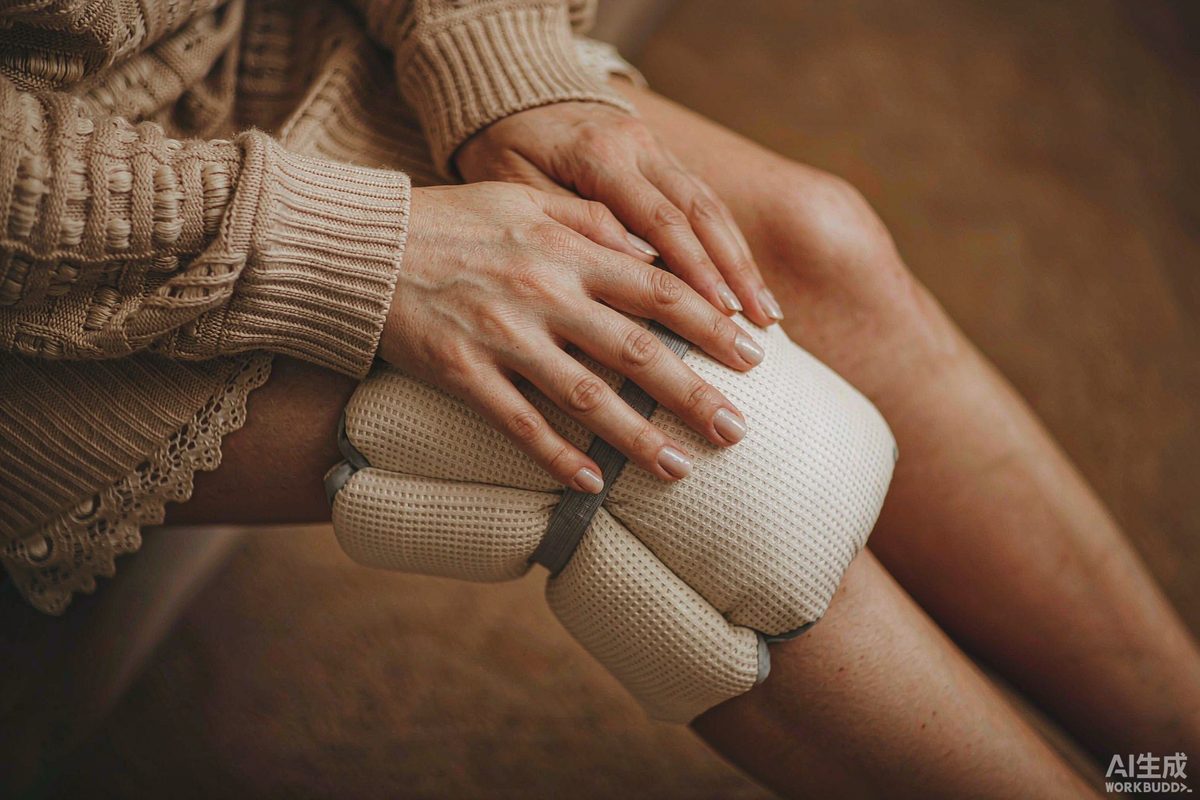
Start every session — and every morning — with warmth, because a cold, shortened fascia is the exact tissue that produced the sting in the first place. A few minutes of heat under the foot before standing does two small useful things. It raises local blood flow, and it lowers the guard of the calf muscles whose tightness is pulling on the same strap from above. Neither effect repairs anything.
Both effects make the stretching that follows tolerable instead of wincing. Warm shower water run over the foot and lower leg, a hot water bottle rolled under the arch while the coffee brews, a warm foot bath — the mechanism matters more than the instrument.
Chinese household medicine never dropped this step, and its reasoning is worth borrowing even without the theory.
An ache that worsens in cold weather, stiffens overnight, and eases with heat fits the classical pattern of cold constraining the channels, and the traditional response is patient warmth applied where the complaint lives — foot soaks steeped in warm water, sometimes with dried ginger or mugwort in the basin, followed by work on the tender spot itself.
Strip out the terminology and you have a sensible clinical sequence: warm, then move, then load.
The counterpoint deserves equal billing. Ice feels right on a hot, freshly aggravated heel, and a cold can rolled under the arch after a long standing day is a reasonable way to settle things down. But ice as a daily program, aimed at a tissue whose problem is disorganized and under-fed rather than inflamed, treats a fire that is not there.
And total rest — the heel equivalent of hiding the kettle — softens the pain while quietly un-preparing the strap for the ten thousand steps it will face the moment the rest ends. Warmth opens the session. Measured load is the session.
- Warm the foot and calf before any stretching — shower, hot water bottle, or a warm soak. Cold, shortened tissue is what stings.
- The old household sequence — warmth, then movement, then measured load — matches what modern programs prescribe.
- Ice is fine for settling a freshly aggravated heel, but chronic plantar fascia pain is not an inflammation to freeze away.
Fascia, Not the Spur
The heel spur deserves its own correction, because it frightens people out of proportion to its guilt. X-rays of painful heels often show a little shelf of bone at the front edge of the calcaneus, and the report names it, and the patient reasonably concludes that a bone hook is the problem.
But the same shelf appears on the scans of many heels with no pain at all, and surgical series have found the painful tissue is usually the fascia itself — thickened, disorganized, threaded with new sprouting nerve fibers — sitting just above where the spur projects. The spur is more like a scar's hard copy: evidence of long-standing pull, not the cause of the ache.
Removing it does not reliably remove the pain, which is why spur surgery is not on the menu for the ordinary case.
What the tissue actually shows under a microscope mirrors chronic tendon problems so closely that researchers renamed the condition plantar fasciosis for a while — the -itis suffix implies inflammation, and the chronic tissue shows little of it. Degeneration, frayed collagen, a few scrappy new vessels and nerves: the biology of a strap asked to do more than its repair schedule covered.
This is why anti-inflammatory pills disappoint as a long-term answer and why stretching and loading, unglamorous as they sound, outperform them over months.
A short list of look-alikes needs ruling out, because they change the plan. Pain centered higher, on the heel pad itself, worse on hard floors and feeling like a bruised bone, suggests fat pad atrophy. Burning, tingling, or electric sensations spreading into the toes point toward a pinched nerve at the inner ankle.
Pain that is constant, throbbing at night, or follows a hard impact deserves an X-ray for stress fracture. And heel pain with marked stiffness lasting past half an hour each morning, especially in both heels or with lower back stiffness in younger adults, should raise the question of inflammatory arthritis — that one needs a clinician, not a stretching program.
- Heel spurs appear on plenty of painless heels; the sore tissue is usually the strap above the spur, not the bone shelf itself.
- Chronic plantar fascia pain is degenerative, not inflammatory — which is why anti-inflammatories fade as a strategy.
- Fat pad pain, nerve burning, night-throbbing, or half-hour-plus morning stiffness each point to a different diagnosis.
"The spur is the scar's hard copy. The complaint lives one layer above it."
Soaks, a Ball, and the Sole's Oldest Point
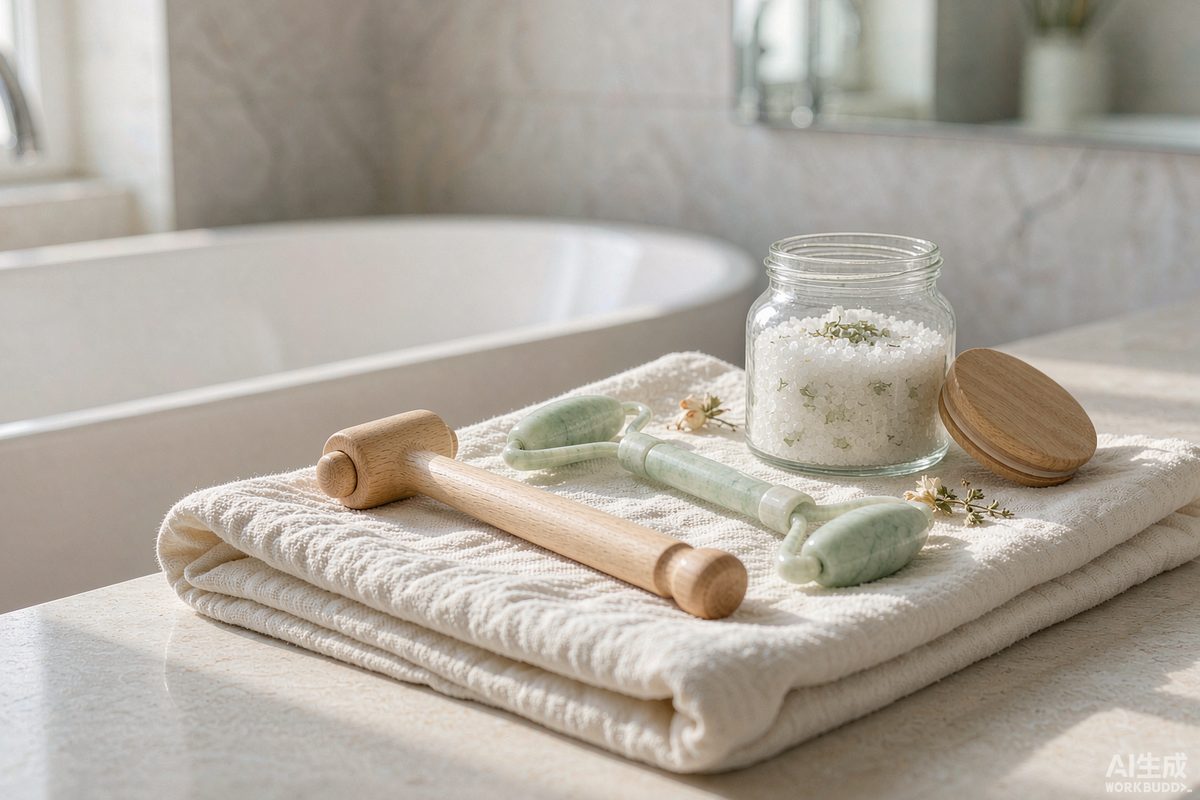
Home care for a heel is a short menu, which is part of its charm. The first item is a small firm ball — a spiky massage ball, a lacrosse ball, or literally a frozen water bottle — rolled slowly under the arch from heel to toe-pad, one to two minutes at a time, several times a day. The rolling is part massage, part stretch: it mobilizes the strap's fibers lengthwise and settles the muscle tension hanging on the arch.
Chilled after a heavy standing day, it doubles as the ice application that actually targets the right tissue.
The second item is the warm soak, the classical step this website keeps returning to because the classical texts keep returning to it.
A basin of comfortably hot water in the evening, fifteen minutes, optionally with a spoon of dried ginger or a bag of mugwort steeping in it, does what the morning warmth does with better ceremony: it opens the evening stretch session and, not incidentally, it is one of the more reliable downshifting rituals for a nervous system that has been standing all day.
The Zhen Jiu Da Cheng collects the points a practitioner would add: Yongquan, KI-1, the dimple on the sole between the second and third metatarsals where the kidney channel begins, and behind the ankle, Kunlun and Shenmai along the outer line that wraps the heel.
Press KI-1 with a thumb for thirty slow seconds and you will find the spot the classical clinicians kept coming back to — tender in exactly the way the morning heel is tender.
None of this is dramatic, and none of it is a substitute for the stretching program coming in the next section. What the ball and the soak do is keep the tissue workable between the stretch sessions and give the day's damage a nightly complaint desk. The foot, of all the body's parts, responds well to being handled — most people never once press on their own sole with intent, and it shows.
- Roll a firm or frozen ball under the arch one to two minutes, several times daily — massage and lengthwise stretch in one motion.
- An evening warm soak, optionally with ginger or mugwort, opens the stretch session and downshifts a standing-day nervous system.
- Yongquan (KI-1) on the sole is the classical entry point of the kidney channel — usually tender exactly where the heel complains.
What the Trials Actually Support
The best-supported single intervention is a stretch most people have never been shown.
In a 2003 randomized trial, patients with long-standing plantar heel pain added a tissue-specific stretch — cross the affected foot over the other knee, pull the toes back toward the shin until the arch's band pulls taut, then rub firmly along it with the thumb while holding — to their program, ten holds of ten seconds, three times a day.
Against a comparison group doing standard calf stretching alone, the fascia-specific group improved faster and further on both pain and function within eight weeks. The stretch is free, takes ninety seconds, and targets the strap directly rather than its upstairs neighbor. Two details make it work: the toes-back position tensions the fascia itself, and the thumb work is done while the tissue is held taut, not slack.
The calf stretch is not worthless — the gastrocnemius and soleus hang on the same system through the Achilles, and tight calves load the strap with every step — so the modern program does both.
A 2021 best-practice guide in the British Journal of Sports Medicine, built on a systematic review plus clinical reasoning, ranks the conservative ladder roughly like this: education and activity modification first, calf and plantar fascia stretching as the core daily prescription, foot orthoses and taping as cheap adjuncts with modest evidence, then extracorporeal shockwave therapy as the referral option when months of honest home program have stalled.
Corticosteroid injection sits lower than most patients expect — it buys short-term relief, but repeat injections carry documented risks of fat pad thinning and fascia rupture, so the guide treats it as a tool for specific situations, not a default.
Acupuncture has a modest but real place in the file. In the 2021 randomized trial comparing manual and electro-acupuncture for plantar heel pain, both groups improved over the treatment weeks, which lands the technique where most manual-therapy evidence lands: a reasonable adjunct for the willing, not a replacement for the stretching that carries the strongest card.
- The plantar fascia-specific stretch — toes pulled back, strap taut, firm thumb strokes, 10 x 10 seconds three times daily — beat calf stretching alone in a randomized trial.
- Do both stretches: tight calves load the same system through the Achilles.
- The 2021 BJSM guide's ladder: education, daily stretching, orthoses or taping, then shockwave — injections lower than most people expect.
"The best-supported treatment for a sore heel is ninety seconds of stretching most people have never been shown."
The Heel Belongs to the Kidney
Classical Chinese medicine files the heel in an unexpected drawer. Bone, in the Neijing's framework, belongs to the kidney — the organ system that stores the deep reserve called jing — and the heel, the body's rearmost point of contact with the ground, was read as kidney territory in a very literal way: the kidney channel begins on the sole, at Yongquan, and the whole foot's underside answered to it.
Heel pain arriving in middle age, without any injury to blame, was classically described as a sign that the kidney's account had thinned — the deep reserves drawn down by years of standing, childbearing, chronic illness, or simply the ordinary accumulation of decades.
The old physicians even noted the tell-tale distribution: soreness deep in the heel, worse with fatigue and better with rest, in people whose hairlines and knees were also filing reports.
The Suwen's chapter on the five strains supplies the mechanism without mysticism: prolonged standing damages the bone, jiu li shang gu. Standing is the skeleton's longest shift. A heel that bears the upright hours day after day, on floors harder than any surface the species evolved on, is a heel whose repair budget is being spent before it accrues.
The classical prescription therefore ran on two tracks at once — press and needle the local points on the sole and behind the ankle, and rebuild the account underneath with the herbs assigned to the kidney, chief among them Niu Xi, achyranthes root, which the Shennong Bencao Jing credits with clearing the aching obstructions of the lower limbs and which tradition says directs its action downward, toward exactly the complaints the heel files.
Honesty requires the boundary: no classical text scores against modern outcome measures, and kidney in this framework is a functional account, not the organ on the blood test.
But the clinical observation underneath — that deep heel soreness clusters in the tired, the older, and the long-standing, and that it answers to rest, warmth, and nourishment at least as much as to any single treatment — is an observation modern rehabilitation has not retired.
- Classically, bone belongs to the kidney and the heel sits where the kidney channel begins on the sole.
- The five strains name the failure mode: prolonged standing damages the bone — an audit of upright hours, not an accident.
- Niu Xi (achyranthes) is the classical below-the-waist herb, said to draw its action down toward the foot.
An Audit of the Standing Life
Most heels have a workload problem, and the workload is auditable. Walk through an ordinary day and count the standing hours and the surfaces: kitchen tile at breakfast, hard office floors, a commute on concrete, an evening on the same kitchen tile again.
Then audit the interface — shoes whose midsoles have quietly collapsed, flat canvas or leather soles with no cushion at all, and the modern specialty of barefoot hours on hardwood and tile at home, which is where many of the worst cases spend their evenings.
Barefoot-on-hard-floor is a respectable position in footwear debates and a punishing one for a strap already in debt; a cushioned house shoe is the cheapest intervention on this page.
The audit usually turns up one recent change, because the strap complains about deltas: a new job on concrete, a market season, a sudden return to running, a bathroom renovation done on weekends, ten pounds gathered over a winter. Observational studies have linked higher body weight and a pronated, rolling-in foot type to chronic plantar heel pain — not a verdict, but a fair notice that load and leverage are inputs.
The fixes are small and stackable: cushioned footwear indoors, a midsole that still has midsole in it, alternating two pairs of shoes so neither compresses to death, standing on a anti-fatigue mat at the desk station, breaking long standing shifts with two minutes of sitting or stretching. None of these repairs the strap. All of them stop the daily re-withdrawal that keeps resetting it.
One more line item belongs on the audit, and it is the calf. Shortened calves pull on the strap through the Achilles with every step, all day, in shoes or out. If touching your toes with a straight back knee is a distant ambition, the calf is drafting the heel's budget without its signature, and the stretching section above becomes doubly mandatory.
- Audit standing surfaces and footwear — collapsed midsoles and barefoot hours on hard floors are the usual silent withdrawals.
- The strap complains about changes: new floors, new jobs, new training, added weight. Find the delta.
- Tight calves tax the heel all day through the Achilles — test straight-leg toe touch honestly.
Twelve Weeks of Mornings
Week one is subtraction plus warmth. The cushioned house shoes appear, the standing audit runs, the ball rolls under the arch a few times a day, and every morning starts the same way: warm the foot, then — before the first barefoot steps — the fascia-specific stretch, toes back, strap taut, ten holds of ten seconds.
The assignment is to make the first ten steps of the day happen on a prepared tissue instead of a cold one. That single change usually cuts the morning sting noticeably within two weeks, and the early win matters because the rest of the program is patience.
Weeks two through twelve are the same prescription with small increments: the stretch three times daily, the calf stretch added on a wall or stair, the ball rolled after long standing days, and normal activity resumed at the pace the heel accepts — a little ache that fades by morning is the negotiation zone; pain that bites and lingers means the day overspent.
If six honest weeks pass without the needle moving, the referral options open up: a hand or foot therapist to check technique and footwear, shockwave therapy as the best-supported next rung, acupuncture for those inclined.
The one-year picture for the ordinary case is genuinely good — the large majority of plantar heel pain resolves with conservative care — but the median timeline is months, not weeks, and programs get abandoned by people who did nothing wrong except bring a sprain's expectations to a strain's problem.
The signals that end the self-program are specific: a heel that started after a fall or a hard landing, pain that throbs at night, numbness or burning into the toes, visible swelling, or the double-sided, half-hour-stiffness pattern of inflammatory arthritis. Those go to a clinician now.
For everyone else, the scoreboard is the one that started this article: the first ten steps out of bed, unremarkable, on the way to the kettle. Unremarkable mornings are the entire prize. They are also, helpfully, the measure.
- Week 1: warmth, the fascia-specific stretch before the first steps, and the standing audit — the early win is real.
- Weeks 2-12 repeat the prescription with normal activity paced to a next-morning-fades rule; shockwave and therapy are the six-week stall options.
- After a fall, night-throbbing, numbness, or long double-sided morning stiffness, go to a clinician — those are not stretch-and-see cases.