What a Morning Heel Wants
A frayed plantar fascia is a strap with a repair debt, and the tools that help are the ones that either pay down the debt — stretching, myofascial work, gradual reloading — or stop the daily re-withdrawals: hard floors, collapsed shoes, the cold shortening of sleep. That is the whole map, and it is worth saying plainly because the product pages disagree.
Nothing on this page regenerates a heel spur, melts inflammation, or cures anything. Three categories earn their place: something that keeps the strap lengthened overnight, something that shares the load during the day, and something for the tissue work between them.
The order matters more than the shopping. The strongest card in the entire deck is a stretching program — two stretches, done daily, free — and a person who buys all three tools below but skips the stretches has spent eighty dollars on a decorated rest. Conversely, a person who does the stretches and changes nothing else usually improves. The tools are force multipliers on a program, not the program.
One more boundary before the shelves. The tools here serve the ordinary overuse heel — the one that stings with the first steps, eases with movement, and lives at the front-inner edge of the heel bone. A heel that started after a fall, throbs at night, burns or numbs into the toes, or carries stiffness that lasts past half an hour each morning belongs in a clinician's room first.
Fat pad bruises, pinched nerves, stress fractures, and inflammatory arthritis all wear plantar fasciitis clothing, and each one laughs at insoles.
The reader who fits the ordinary pattern is the one this page is written for — and the one the classical texts were written for too, as it happens. A heel that complains at the start of the day, on a body that has carried long hours upright, is among the oldest outpatient complaints in the foot's file. The tools below serve that reader.
Each section names the job, the evidence, and the honest limits, so the shopping can happen in the order the recovery actually needs.
- Three tool categories earn their place: overnight lengthening, daytime load-sharing, and between-session tissue work.
- The stretches are the program; the tools are multipliers. The shopping order follows that fact.
- Fall-onset pain, night throbbing, burning toes, or long morning stiffness go to a clinician before any drawer fills up.
"Buy the program first. The tools are force multipliers on a plan, never a substitute for one."
First, the Two Stretches
Because the program outranks the products, it gets a section before them. Stretch one targets the fascia itself, and it is the one a 2003 randomized trial found worth learning: sit, cross the affected foot over the other knee, pull the toes back toward the shin until the band under the arch pulls visibly taut, then rub firmly along it from heel to toe-pad with a thumb, holding ten seconds.
Ten repeats, three times a day — most people attach it to meals so it survives the week. The toes-back position is not optional decoration; it is what tensions the strap instead of the calf.
Stretch two is the calf, done on a wall or a stair edge, knee straight then knee slightly bent for the two muscles, thirty seconds each side, two or three rounds daily. The calves hang on the same system through the Achilles, and tight ones tax the strap with every single step.
A fifteen-dollar stretch strap with loops makes the floor versions easier on a stiff back and gets used more often than the towel most people substitute.
The honest scoreboard: in the trial, the fascia-specific stretch beat calf stretching alone on both pain and function by eight weeks — but the study's own framing was the fascia stretch added to calf work, not instead of it. Both, daily, warmed up first. That is the engine. Everything below is carriage.
Form notes prevent the two common failures. The fascia stretch works when the pull is felt under the arch, not in the joints of the toes — ease off a notch if the toe joints complain. The calf stretch works when the rear heel stays glued to the floor; a floating heel turns the stretch into a calf raise and quietly cancels it. Both are done warm, both are slow, and neither should produce next-day soreness.
- Fascia-specific stretch: foot crossed over the knee, toes pulled back, strap taut, firm thumb strokes — 10 x 10 seconds, three times daily.
- Calf stretch on a wall or stair, knee straight and bent, 30 seconds a side — the calves tax the strap through the Achilles.
- Attach the sessions to meals so they survive the week; warm the foot first.
The Night Splint Question
The night splint answers a real problem: during sleep the foot rests in a slightly pointed position, the fascia shortens, and the first morning steps yank cold, shortened fibers taut — the signature sting. A splint worn overnight holds the foot up so the strap stays lengthened. The logic is good and the evidence is, to be honest about it, mixed.
Older trials and reviews gave simple splints a fair showing, especially in people whose pain had already stood for many months; but a well-built randomized trial that added a tension night splint to a structured home rehabilitation program found the splint added no measurable benefit over the program alone.
Our practical read after reading both sides: the splint is a reasonable, cheap experiment with a defined exit.
Try it if the morning sting has been the dominant symptom for months and the daytime program is already running; expect the dorsal sock-style designs to be far more tolerable than the rigid plastic boots, which most people abandon by week two along with the whole program — a worse trade than no splint at all. Give it three or four weeks of honest wear.
If the mornings have not measurably softened by then, the splint goes in the drawer and nobody owes it an apology.
Fit notes matter. The strap should hold the toes up firmly without pressing the nerve line on the top of the ankle; tingling or a numb toe by morning means the tension or the position is wrong. And a sock splint on swollen ankles is a poor fit — size up or skip it.
One alternative deserves mention because it is already in the house for most people: a towel, a belt, or a stretch strap looped around the forefoot, pulling the toes back gently for thirty seconds before getting out of bed. It is the night splint's poor cousin — it does not survive the whole night, but applied before the first steps it addresses the same shortened-strap problem, and it costs whatever a towel costs.
Many people end up doing both: a towel-pull on waking, program by breakfast.
- Night splints hold the fascia lengthened through sleep — good logic, mixed trial record, cheapest when tried after the daytime program exists.
- Choose sock-style dorsal designs over rigid boots; abandoned rigid boots take whole programs down with them.
- Three or four honest weeks, then judge by the mornings, not by hope. Tingling toes mean the fit is wrong.
A Ball for the Sole, Warm for the Evening
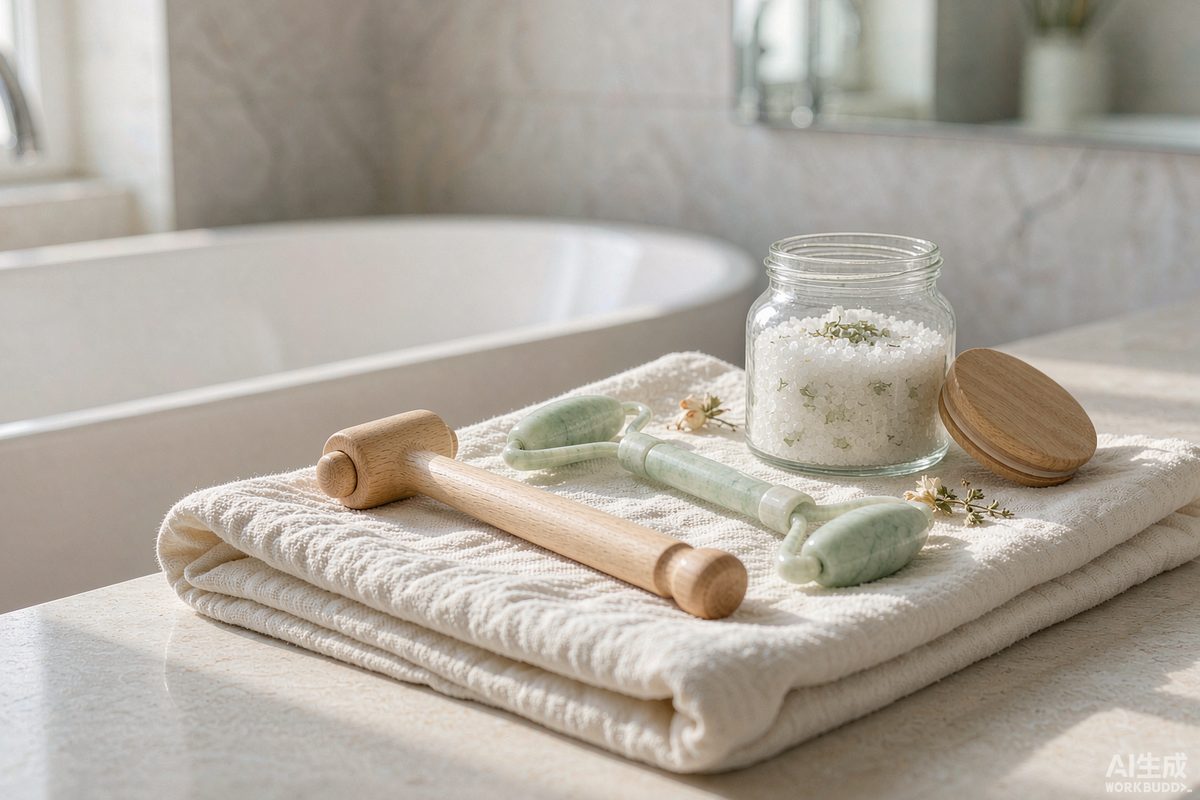
The massage ball is the category most likely to survive contact with real life, because it asks ninety seconds and no schedule. Rolled slowly under the arch — heel to toe-pad, pressing enough to feel the tissue move, one to two minutes — it does two jobs at once: it mobilizes the strap's fibers lengthwise, and it settles the small muscles of the arch whose tension rides on the same system.
A 2026 randomized trial pitting structured myofascial release against traditional physiotherapy for plantar fasciitis found the hands-on fascia work competitive with the clinic menu on pain and function, which is a striking result for a technique that travels in a lunch bag.
The spiky version beats the smooth one for a boring reason: grip. A smooth ball slides over skin; a spiky one catches it, so the fascia rolls with the ball instead of underneath it. Buy a pair — golf-ball scale for the inner arch where the complaint usually lives, tennis-ball scale for the whole sole — and freeze one.
The frozen ball after a long standing day is the cold application that actually targets the right tissue, five slow passes from heel to toes, and it costs nothing beyond freezer space.
Then the evening half of the section, which classical Chinese household medicine supplied without being asked: a basin of comfortably hot water, fifteen minutes, optionally with a spoon of dried ginger steeping in it. Warmth first, then the rolling and stretching — the same sequence the old texts prescribed for a foot stiffened by cold and long hours.
It is also, not coincidentally, the most reliable off-switch most standing workers own.
A word on technique, since the ball punishes haste. Slow passes beat fast ones — the tissue responds to sustained pressure, not friction. Work with the foot relaxed rather than clawed, weight off it, seated. And stop short of bruising: a pleasantly sore arch afterward is the right dose; a heel that is tender to walk on the next day means the pressure was spent, not invested.
- Roll a spiky ball under the arch 1-2 minutes, several times daily; a randomized trial found myofascial release competitive with clinic physiotherapy.
- Freeze one of the pair — the cold ball after long standing days targets the right tissue for pennies.
- Evening warm soak, optionally with ginger, then stretch — the classical warmth-then-work sequence, and a dependable downshift.
Under the Arch: Insoles and Heel Cups
Insoles are the daytime pick, worn in ordinary shoes while the strap rebuilds, and their trial record is the friendliest of the three categories.
A randomized trial in people with chronic plantar fasciitis showed a custom foot orthosis measurably redistributed plantar pressures away from the overloaded spots during walking, and the 2021 British Journal of Sports Medicine best-practice guide lists foot orthoses among the first-line adjuncts, alongside the stretching program.
The mechanism is unromantic — prop the arch, share the load, stop the strap from absorbing every step alone.
The shopping trap is that the shelf sorts by marketing rather than shape. What works is a semi-rigid arch piece with a deep heel cup, not a slab of gel: pure gel cushioning feels kind for a week and does little for the strap, while the supportive shape changes the load path. Off-the-shelf models cover most cases, which is fortunate, because custom orthoses cost ten times as much with a modest evidence edge.
Expect three or four days of odd new pressure before the foot accepts the correction, and treat a collapsing arch piece at the six-to-twelve-month mark as a spent part, not a disappointment.
Two honorable mentions from the same shelf. Heel cups — small silicone cradles — suit the minority whose pain centers on the heel pad rather than the arch, lifting the bruised pad off hard floors.
And cushioned house shoes deserve their own quiet promotion: for many standing-heavy cases the single most effective purchase of the entire recovery is not worn outdoors at all, it is the pair that stops barefoot hours on kitchen tile.
Sizing is where most insole purchases go wrong, and the fix is unglamorous: buy for the shoe, then trim. A full-length insole needs a millimeter of clearance at the toe; a 3/4-length model — which most people find easier to fit — stops short of the toes and spares the front of a snug dress shoe.
Match the arch height to the foot rather than the marketing: a high arch forced onto a tall support aches exactly the way a flat arch forced onto a flat one does.
- Choose semi-rigid arch support with a deep heel cup; gel-only cushioning feels kind and does little.
- Off-the-shelf insoles cover most cases — a randomized trial showed orthoses redistribute load away from the sore spots.
- Heel cups suit heel-pad pain; cushioned house shoes may be the best purchase of the whole recovery.
What the Trials Say About Each Tool
One paragraph per tool, stated as bluntly as the studies allow. Night splint: a randomized trial adding a tension splint to a structured home program found no added benefit — and the older supportive evidence concentrated in long-standing pain, which is where we would spend the fifteen dollars, after the daytime program is already running.
The honest verdict is 'mixed, cheap, worth a defined trial', not the product pages' 'wake up pain-free'.
Insoles: the pressure-redistribution trial plus a first-line listing in the 2021 best-practice guide make this the best-evidenced purchase on the page, with the caveat that the trials mostly test shaped support rather than gel, and that insoles do nothing unless worn — which makes the daily-hours pick also the compliance-dependent one.
Myofascial release: the newest randomized comparison found structured fascial work competitive with traditional physiotherapy for pain and function in plantar fasciitis, and the spiky ball is the home version of exactly that work. It is also the only tool on the page with an additional credential no trial measured: it gets used, because ninety seconds needs no motivation infrastructure.
Read together, the three tools triangulate the same truth the clinic evidence keeps repeating: the strap responds to daily lengthening and shared load, sustained over months. Tools that serve those two jobs earn their drawer space. Tools that promise to shortcut them — magnetic insoles, vibration gadgets, spur-dissolving anything — are spending your attention on a shortcut the tissue has never heard of.
A note on how to hold this evidence, because trial quality varies across the category. The insole and myofascial trials are small randomized comparisons, not registry-scale verdicts, and the night-splint literature spans devices that differ as much as a sock differs from a boot. What the evidence offers here is direction, not precision — enough to spend twenty dollars sensibly, not enough to promise outcomes.
The stretching trials, for comparison, are the strongest links in the whole chain, which is why they got the first section.
- Night splint: mixed evidence, best tried for long-standing morning pain after the daytime program exists.
- Insoles: best-evidenced purchase — shaped, semi-rigid support, worn daily, replaced when the support collapses.
- Massage ball: trial-backed fascial work at ninety seconds a session, and the tool most likely to actually be used.
The Cheap Kit That Covers It
For a standard overuse heel, the whole kit fits in a shoebox and most of it fits in a drawer. Start with the pair of spiky balls — one frozen, one by the bed — and the stretches they escort, because that combination carries the best evidence-per-dollar on this page and begins working the first morning it is used.
Add the semi-rigid insoles next, worn in the shoes that carry the standing hours, sized for the arch you actually have rather than the arch the box promises. The night splint comes last, if at all: a defined three-to-four-week experiment for long-standing morning pain, sock-style, abandoned without guilt if the mornings do not move.
Two free upgrades outrank half the catalog. Cushioned house shoes, so the recovery is not undone nightly on kitchen tile.
And a standing audit — the floors, the hours, the shoes whose midsoles died unremarked — because the classical texts filed this complaint under 'prolonged standing damages the bone' long before anyone had a name for the fascia, and the audit remains the part of the treatment no product can perform on your behalf.
The finishing measure is the one the heel itself set: the first ten steps of the morning, negotiated quietly, on the way to somewhere more interesting. Measure those, not the pain log's daily weather.
And when the drawer is eventually full of retired tools — the outgrown splint, the collapsed insoles, the ball that lost its spikes to a year of freezer work — take the score as what it is: evidence that a strap with a repair debt was met with patience, load shared, mornings reclaimed.
- Buy order: spiky balls first, insoles second, night splint last — or never.
- Cushioned house shoes and a standing audit are the free upgrades that protect everything else.
- The scoreboard is the first ten steps of the morning — unremarkable is the prize.