An Elbow and Its Deadline Problem
The outer elbow is the body's most honest accountant. It does not fail after one dramatic afternoon; it fails after a quarter of quiet overbilling — mouse hours, kettle lifts, a weekend of paddle boarding, the car seat hauled one-handed — and it presents the invoice on an ordinary Tuesday when the coffee mug feels heavier in the right hand than the left.
By the time it hurts to shake hands, the common extensor tendon has been running a repair deficit for months.
The tool market has noticed, and most of what it sells for this elbow is jewelry with a backstory. Copper-infused sleeves. Magnetic wonders. A small industry of vibrating things.
Chinese medicine, for its part, has worked this spot for centuries under the blunt name zhou lao — elbow strain — pressing and needling the tender point itself and the forearm channel line that runs straight through it, on the theory that a sinew worn down by repetition is a depleted account that needs measured work and feeding, not a brace and a prayer.
The classical protocol is almost comically local: Quchi at the outer end of the crease, the tender point itself a finger's width away, worked with patience over weeks. No herbs were going to out-argue a daily overhead press at the warehouse job, and the old physicians knew it — the first prescription, in every version of this story, was a change in the work itself.
The two traditions disagree about almost everything except the central point: nothing worn on the arm fixes a tendon. Load does. The tools worth owning are the ones that manage load — one that blunts the daily aggravation, one that rebuilds the tendon, one that re-trains the grip — and everything else is a costume.
We spent a season with the three categories that kept earning their place, and judged each on a narrow question: what does it do for the elbow, what does the evidence say, and what will it refuse to do no matter what the listing promises. Total drawer cost stayed under fifty dollars, which is worth stating early because the alternatives in the elbow aisle run to four figures and claim considerably more.
One boundary before the reviews. These tools are for the ordinary strain — aching grip, kettle trouble, doorknob weather. An elbow that tingles, that burns lower in the forearm, or that stopped working after a specific accident belongs with a clinician first. Tools after diagnosis, not instead of one.
- Tennis elbow is a repair deficit built from months of small grip loads — no worn object fixes it; load management and reloading do.
- Three honest jobs for tools: blunt the daily aggravation, rebuild the tendon with slow eccentric work, re-train the grip.
- Tingling, burning in the forearm muscle, or pain after an accident means a professional exam before any tool.
"A sinew worn by repetition is a depleted account. The tools below either manage the deposits or they are costume jewelry."
What a Tendon Wants From a Tool
Three jobs cover what home elbow care can honestly accomplish: reduce the daily provocation, reload the tendon, and rebuild the grip. Every tool in this guide earns its line by serving one of those jobs, and anything claiming all three at once was sent home early.
The evidence splits cleanly along the load line.
Passive treatments — laser, ultrasound, magnet sleeves — show thin, inconsistent results across reviews of lateral elbow tendinopathy, while exercise-based loading keeps winning: a 2024 meta-analysis of non-invasive therapies found exercise programs beating passive approaches for pain, grip strength, and function, and a 2023 evidence synthesis on tendinopathy rehabilitation found the biggest real-world obstacle to that effect was not the exercise itself but whether people kept doing it.
Feasibility, it turns out, is a clinical variable. A program nobody finishes is a placebo with a protocol number, which is why the tools below are judged as much on usability as on biology.
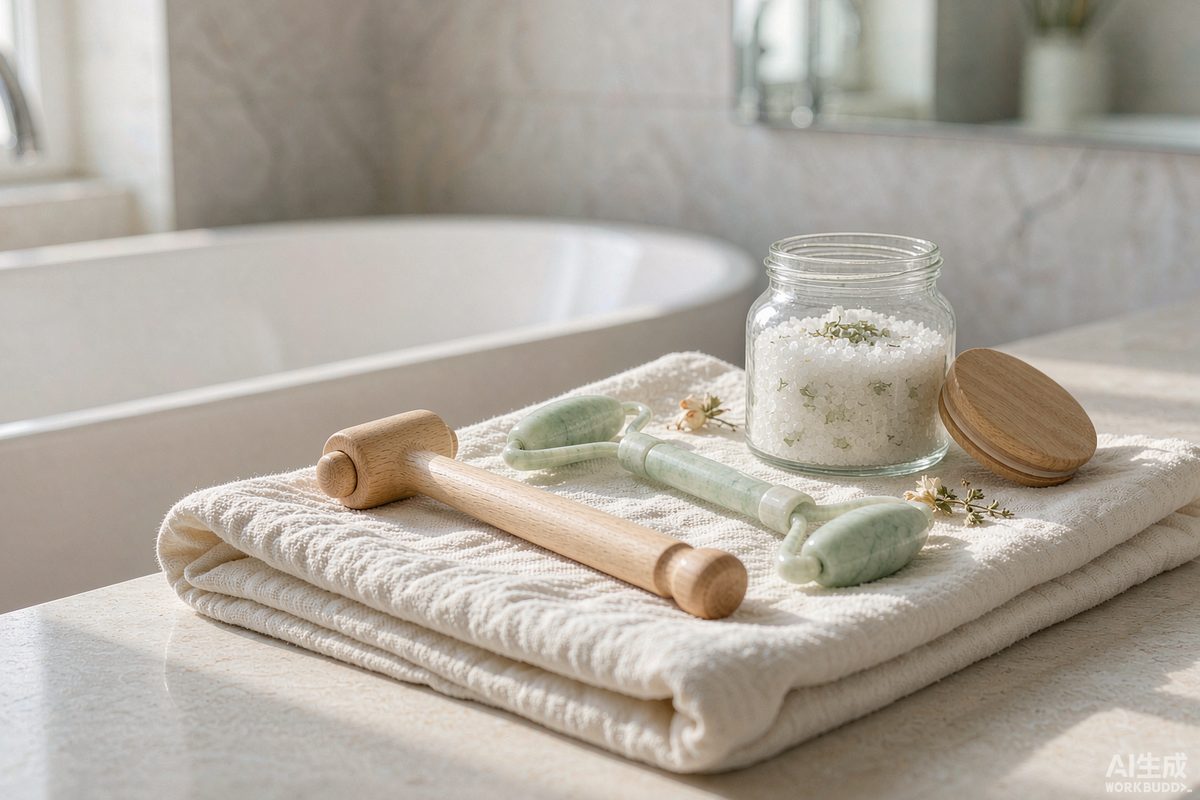
A note on the warm-up step, since it looks like a marketing opportunity and is not. The waffle-weave wrap and bath salts pictured below belong to the old sinew protocol as much as to any spa: warmth relaxes the guarded extensor muscles, nudges local circulation, and drops the volume on the ache before loading begins. Two minutes under a hot shower accomplishes most of it. The salts are optional; the warmth is not.
Loading a cold, braced forearm is how the slow return turns into a fast one.
Sequencing ties the jobs together, and it borrows its logic from the old sinew protocols. Warm the forearm first — a shower, a soak, anything that makes the tissue less hostile to the idea of work. Then do the slow loading. Then, if the elbow is running hot from a heavy day, the unglamorous extras: a warm bath, a minute of easy self-massage along the extensor muscle, and an early night.
The classical texts prescribe warmth and patient local work for a knotted sinew and say nothing about hurrying, and the modern trials agree on the last part whether they mean to or not — tendon remodeling runs on the scale of months, and every honest tool on this page is a monthly subscription, not a weekend purchase.
- Exercise-based loading beats passive treatments for pain, grip, and function across the reviews; sleeves and magnets remodel nothing.
- The real variable is adherence — a program nobody finishes is a placebo with a protocol number. Judge tools on usability.
- Sequence like the old texts: warm first, load second, soothe after. Think in months, not weekends.
The Counterforce Strap: Small, Smug, Effective
A counterforce strap is a padded band worn an inch or two below the bony point of the elbow, cinched snug across the forearm muscle bellies. That is the whole device, and it is the highest-value eight to twenty dollars in the drawer. Its job is mechanical bookkeeping: the compression redistributes the pull of the extensor tendons, damping the jolt that each grip sends up to the sore attachment at the epicondyle.
The elbow still works. It just stops getting billed for every mouse click.
The trial record is better than its modesty suggests.
Randomized comparisons of braces, taping, and injections in tennis elbow have repeatedly found the counterforce strap at least matching kinesiotaping for pain and function — a 2025 randomized study put strap, tape, and corticosteroid injection head to head and found the injection's early advantage fading into comparable outcomes, which makes a strap that costs less than lunch look better with every follow-up month.
The 2006 BMJ trial's one-year verdict on steroids — worst outcomes of any group, most relapses — has made clinicians warier of borrowing relief from the future, and straps sit at the friendly end of that ledger: cheap, reversible, side-effect-light.
Limits, stated plainly. A strap changes nothing about the tendon itself; it is pain management for the aggravating hours, not rehabilitation. Worn too tight it will tingle your fingers and annoy your ulnar nerve; worn to bed it does nothing useful. And there is a subtler trap: some people wear the strap as a license to keep the aggravating workload untouched. That is bailing with the hole open.
The strap buys the elbow quieter days so the loading program can work — it is a co-signer, not a substitute.
A fitting note, because straps arrive one-size and arms do not. The pad should sit over the outer forearm muscle, not the bone, and the strap should rotate with you when you turn your wrist. If your fingers tingle after ten minutes, it is a notch too tight; if it slides when you shake hands, a notch too loose.
Get this wrong and the tool gets misjudged for a fitting problem, which happens more often than any honest review can fix.
- Wear it snug an inch or two below the elbow bone, during aggravating hours — mouse work, tools, carrying — not to bed.
- Trials put the counterforce strap at least on par with kinesiotaping, and a 2025 RCT found it holding its own against injections over time.
- The strap is permission to live normally while the tendon rebuilds — not a license to keep the workload untouched.
The Eccentric Resistance Bar: the One That Rebuilds
A resistance bar — the Flex Bar and its cousins — is a rubber rod about the length of a forearm, color-coded from red (lightest) to black (stiffest), and it is the tool with the clearest trial record on this page.
The classic move is the Tyler twist: grip the bar vertically, load the top wrist into extension, then twist through and let the bottom wrist hinge slowly back down — three to five seconds on the return, every rep. That slow, loaded lengthening is the eccentric phase, and it is the closest thing tendon rehabilitation has to a signature dish.
The evidence: a randomized trial added isolated wrist extensor eccentric exercise — the pattern the bar makes easy — to standard care in chronic tennis elbows and found the eccentric group pulling ahead on pain and function by eight weeks, with the gap widening from there.
Reviews since have kept the direction consistent: eccentric and heavy-slow loading outperform rest and passive care for tendons, including the elbow's. The bar's real innovation is adherence engineering, which the 2023 evidence synthesis on tendinopathy rehab would approve of: the exercise is hard to do wrong, the resistance ladder is printed on the product, and the whole session takes ninety seconds.
The honest limits. This is the tool most likely to be used wrong by exactly the people who need it most — enthusiasm converts the slow return into a fast snap, and a snapped tempo on a hot tendon costs a week. The dosing rule is the field's standard negotiation: ache during the work that settles by tomorrow is acceptable; sharp pain that lingers is a veto.
Start on a lighter color than pride suggests, ten slow repetitions, twice a day. And the bar does nothing for the grip itself, which is where the putty earns its place.
One comparison belongs here because the marketplace blurs it constantly. Wrist curl exercises with a light dumbbell — palm up, forearm supported, wrist hinging slowly — train the same eccentric principle and are equally legitimate; the bar's advantages are grip comfort, the printed tempo cues, and the fact that a rubber rod has never crushed anyone's foot.
If you already own two dumbbells and a patient streak, you can skip the bar. Most households, in our observation, own neither the dumbbells nor the patient streak, and the bar is priced for exactly that market.
- The Tyler twist's slow 3-5 second return is the active ingredient — eccentric loading is the best-supported tendon rehab there is.
- A randomized trial found chronic tennis elbows adding eccentrics pulled ahead of standard care by eight weeks.
- Light color to start, ten slow reps twice daily, ache that clears by morning. Fast tempo on a hot tendon is a veto.
Therapy Putty: Rebuilding the Grip Nobody Noticed Leaving
Grip strength leaves quietly and returns the same way, and it is the variable most elbows actually live by — the reviews keep finding grip strength and function moving together. After weeks of guarding, the forearm muscles that power the squeeze have detuned like any other idle equipment, and no strap or bar re-trains them. A pot of silicone therapy putty does.
It is denser than the desk-toy kind, comes in color-coded firmness, and turns the squeeze into real loading: squeeze, hold a breath, release slowly. The slow release matters — it is the same lengthening-under-load principle the bar applies, applied at grip scale.
Why putty over the spring-loaded grip strengthener everyone already owns a drawer mate of? Resistance curve, mostly. A spring trains fast crushing — maximum force, minimum time — which is precisely the skill profile that helped overload the tendon in the first place. Putty's resistance rises through the whole squeeze and gives its most on the slow release, which matches what the tendon trials actually prescribe.
A multi-pot set provides the ladder: when the softest pot feels like kneading bread, move up one color. Fifteen repetitions, two or three rounds a day, usually during something you were going to sit through anyway.
Honest limits, again. Putty is the slowest-payoff tool on the page and the easiest to abandon, because nothing appears to happen for two weeks. There is also a real ceiling — advanced putty is firm, but it will never load a tendon the way a bar or a light dumbbell does. It is the middle rung: past the phase of doing nothing, not yet at the phase of real loading.
As a bridge it has no competition, and at roughly fifteen dollars the bridge is priced accordingly.
A note on expectations for the putty specifically, because its job is the most invisible. Grip strength after weeks of guarding is not merely weak; it is hesitant — the nervous system has quietly stopped asking the sore side for full effort, a phenomenon grip researchers measure with effort-matching tests and everyone else measures by noticing the good hand keeps volunteering for jars.
Squeeze work re-registers that request. The first sign of return is usually not strength but confidence: you catch yourself lifting the full kettle one-handed without a strategy meeting. Watch for that moment. It precedes the numbers by a week or two and it is the mind's way of telling you the account is refilling.
- Grip strength tracks recovery — putty re-loads the squeeze slowly, on the lengthening phase, where tendons adapt.
- Pick putty over spring strengtheners: fast crushing is the skill that broke the elbow; slow squeeze-and-release is the skill that rebuilds it.
- Expect two silent weeks. The putty is a bridge from rest to real loading, not a final destination.
"The spring trains the crime; the putty trains the recovery. Choose your tooling accordingly."
What We Left Out
The drawer of rejected elbow tools is deep, and the exits deserve names. Magnetic and copper sleeves: no credible mechanism, no trial support worth the word. Vibrating massage gadgets for the epicondyle: pleasant, briefly, and irrelevant to remodeling.
Ultrasound machines for home use: a 2024 meta-analysis puts passive modalities behind exercise across the board, and a consumer unit is a worse version of what already loses. Night splints occasionally earn a clinical mention for stubborn cases, but that is a fitting question for a therapist, not a listing question for a marketplace.
Two honorable mentions sit just outside the drawer. A small forearm massage ball — worked slowly along the extensor muscle belly, not the sore bony point — is a fine addition for elbows that run knotted and hot, and costs less than the strap; the classical text would recognize it instantly as hands-on work at the a shi point's neighborhood.
And a soft wrist brace for sleeping can help the unlucky minority whose elbows are provocation-sensitive even at rest, though that is better decided by a therapist than by a listing. Neither made the main list because neither carries trial weight near what the strap and bar carry — but neither would embarrass the drawer either.
- Magnets, copper, vibration, and consumer ultrasound change nothing about tendon biology — leave them on the shelf.
- A small massage ball worked along the extensor muscle (not the bone) is a worthy fourth pick for knotted elbows.
- Night splinting is a therapist's fitting question, not a marketplace purchase.
Sixty Seconds, Twice a Day
The three keepers slot into a day with almost no scheduling. The strap goes on before the aggravating hours and comes off after dinner. The bar is ninety seconds in the morning and ninety in the evening, after the forearm is warm. The putty lives where you sit — desk drawer, TV table — and absorbs the odd three minutes.
That is the entire program: five or six active minutes a day and one piece of worn equipment, for roughly the price of a takeout dinner. The 2023 evidence synthesis on tendinopathy rehab spent its pages on exactly this gap between what works and what people finish, and the conclusion deserves repeating: the best program is the one that survives contact with your actual week.
A season's worth of expectations, calibrated. Sharper days ease within the first two or three weeks of quieter loading. The kettle test — one-handed, no wince — usually flips somewhere in the second month. Full trust in a handshake takes longer, and that is fine, because tendons remodel on months of deposits, not days of intention.
Relapse after the program ends is common enough to expect and mild enough to handle: the fix is the same program, restarted a notch lighter, not a new diagnosis.
The old sinew framework said the same thing in fewer words: the account rebuilds at the rate it was drawn down. Slightly slower, actually. Budget accordingly — and if the drawer keeps three things instead of six gadget boxes, the elbow, the wallet, and the dog all come out ahead.
- Strap for aggravating hours, bar twice daily after warming, putty at your desk — five or six minutes total.
- Sharper days ease in weeks, the kettle test flips in months, the handshake takes longest. Budget accordingly.
- Relapse means the program restarted lighter — not a new diagnosis.
"The best program is the one that survives contact with your actual week."