Hips and the Chair Problem
The modern hip spends its working life folded. Six to ten hours a day in a chair, the muscles across the front of the joint held short, the gluteals behind them idling, then a sudden request to stand, swing, and climb without a warm-up. Small wonder the sock drawer has become the place where hips file their first complaint — folding is exactly what a chair-shaped hip has stopped rehearsing.
Chinese medicine filed this observation under one of its five occupational strains, and the phrasing has aged well. Prolonged sitting, the Suwen says, damages the flesh — jiu zuo shang rou. Not the joint first, note, the flesh: the muscle and sinew fabric around the pivot, which in the classical sinew-channel picture converge and knot at the hip from several directions.
A stiff hip, in that reading, is rarely one tight muscle. It is several channels binding at a crossing, which is why one heroic quad stretch rarely changes anything and why patient, varied work does.
The tool market has noticed hips lately, and the results are mixed. Some of it is genuinely useful. Some of it is a foam roller with a motor and a backstory.
We spent a season with the three categories that kept earning their drawer space — a stretching strap, a peanut ball, and a fabric resistance band — and ranked them by a narrow standard: what each does for a hip that folds reluctantly, what the published evidence says about that job, and what each tool cannot do, because the listings will not tell you.
One boundary before the reviews. These tools are for the ordinary grumble — stiffness, reluctance, the negotiation with the sock. A hip that wakes you at night, that stopped bearing weight after a fall, or that burns deep in the groin belongs with a clinician first. Tools after diagnosis, not instead of one.
Who this drawer is for, in one sentence: the person whose hips work fine until the day they do not — the new desk job, the running streak, the fiftieth birthday that made itself known in a lunge. Home tools meet that moment well. They are cheap, they fail safe, and they buy comfort and time while the slower work of strength and habit happens underneath.
- The chair, not age alone, explains most modern hip stiffness — hours of shortening at the front of the joint with the glutes idling.
- The classical five strains named prolonged sitting as flesh-damaging centuries before the ergonomic literature got there.
- These tools serve the ordinary stiff hip. Night pain, post-fall pain, or inability to bear weight means a clinician first.
"A stiff hip is rarely one tight muscle — in the classical picture it is several channels binding at a crossing."
What a Hip Wants From a Tool
Three jobs cover most of what home hip care can honestly accomplish: restore range, release what is guarding, and rebuild the strength that carries load. Every tool below is judged against one of those jobs, and the judging is unromantic — a tool that duplicates another, or that claims all three, loses points.
Range work comes first because it is where stiffness shows itself. The evidence for stretching is older and less glamorous than the marketing implies, but one detail from the trials is worth stealing: duration beats intensity.
Work comparing stretch durations in the lower extremity found that holding a stretch in the 30-to-60-second range produced greater gains in range of motion than shorter efforts, and that the gains came from a sustained, low-intensity hold rather than a forceful one.
That single finding eliminates half the gadgets on the market, because what most of them sell — aggressive, fast, motorized end-range force — is the opposite of what the tissue responded to in the studies.
Release and strength follow, each with its own evidence shelf and its own honest limits, covered in the sections below. What ties the three together is sequencing. Warm the hip first — a shower, a short walk, anything that makes the tissue less hostile to the idea of lengthening. Then release what is guarded. Then lengthen what is short. Then strengthen what is asleep.
Same order every time, and no single tool does all four steps, which is why the drawer needs three things in it and not one motorized thing promising otherwise.
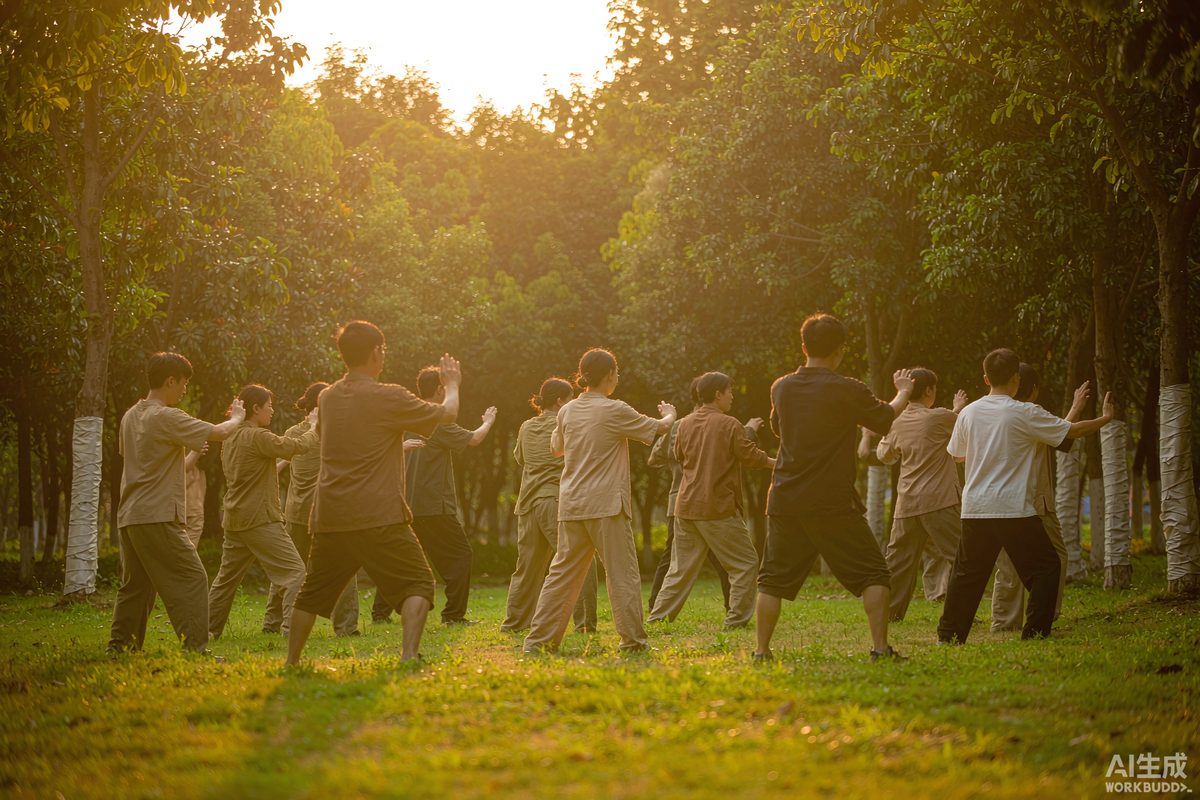
Also worth saying plainly: the tools support movement, they do not replace it. The best-documented intervention for a stiff hip in the entire literature is regular, tolerable, repeated movement — walking, swimming, the slow group exercise pictured above. We scored every tool in this guide against one question: does it make the walk more likely tomorrow?
Everything on this page exists to make that easier, not to substitute for it.
- Three honest jobs for tools: restore range, release guarding muscle, rebuild carrying strength.
- Trials favor 30-60 second low-intensity holds over forceful end-range force — a finding that disqualifies half the gadget aisle.
- Sequence matters: warm, release, lengthen, strengthen. No tool does all four.
The Multi-Loop Stretching Strap
A stretching strap is woven cotton webbing, about six to eight feet long, with a loop every few inches. That is the entire technology, and it is the most valuable tool in the drawer for a hip that folds reluctantly. Its job is to replace your gripping muscles.
In a strap-assisted stretch — hook the foot, lie back, walk the hands down — the strap holds the leg at end range so the muscles meant to be lengthening are not also the ones straining to hold the position.
Anyone who has tried to stretch a hip flexor or hamstring unassisted knows the failure mode: the leg keeps sliding back toward the floor while your quadriceps burn, and the stretch never actually arrives at the tissue that needs it.
The loops are the underrated part. A stiff hip improves in increments too small to feel on any given evening, and the loops turn that progress visible — two weeks ago the foot reached the fourth loop, tonight the fifth. For a population that abandons stretching programs at staggering rates, measurability is not a garnish.
It is the feature that keeps the habit alive, and habits are where all the range-of-motion gains actually live.
The evidence behind the job: duration studies in the lower extremity support holds of 30 to 60 seconds at low intensity, which a strap delivers better than any powered device we tested, because the strap makes holding easy and forcing hard. Sessions are short — five or six stretches, each held while a few slow breaths pass.
Limits, stated honestly. A strap stretches what is willing to lengthen; it does nothing for strength, nothing for the guarding it does not address, and it can be used impatiently like anything else. It is also the least weatherproof habit we know — pack it on trips, because the evenings it skips have a way of becoming weeks. Around twelve dollars. Boring. Keeps its promises.
- The strap's real job: replace your gripping muscles so the stretch lands on the tissue instead of on your quadriceps.
- Loop positions make invisible weekly progress visible — the feature that keeps the habit alive.
- Hold 30-60 seconds at low intensity, after warming up. Five or six stretches is a complete session.
"What most gadgets sell — fast, motorized, aggressive end-range force — is the opposite of what the tissue responded to in the studies."
The Peanut Massage Ball
The deep hip rotators sit under the glutes, tucked against the back of the socket, and they are the reason a foam roller — broad, blunt, and honest about its own limitations — cannot finish the job around a hip. The peanut ball is the targeted answer: two dense rubber lobes joined at a narrow waist, shaped so the muscle gets firm, local pressure while bony edges and sensitive lines sit in the gap between the lobes.
It is the difference between pressing on a drawer and pressing on one drawer's handle.
The evidence shelf for this kind of work is the self-myofascial release literature, and it is more respectable than its infomercial reputation. A systematic review of foam rolling and roller massage found consistent short-term improvements in range of motion without the performance dips that follow aggressive static stretching, along with reported reductions in post-exercise soreness.
The honest reading: the effect is real but immediate and temporary — these tools change how the tissue feels and moves today, and the durable change still comes from repeating the cycle over weeks and from the strength work below. A peanut ball is a reliable opener for an evening session, not a cure for anything.
Technique decides everything here. Lie or lean with the ball under the hip, find the tender spot, and hold — 30 to 90 seconds of steady pressure while breathing slowly, letting the muscle release at its own pace.
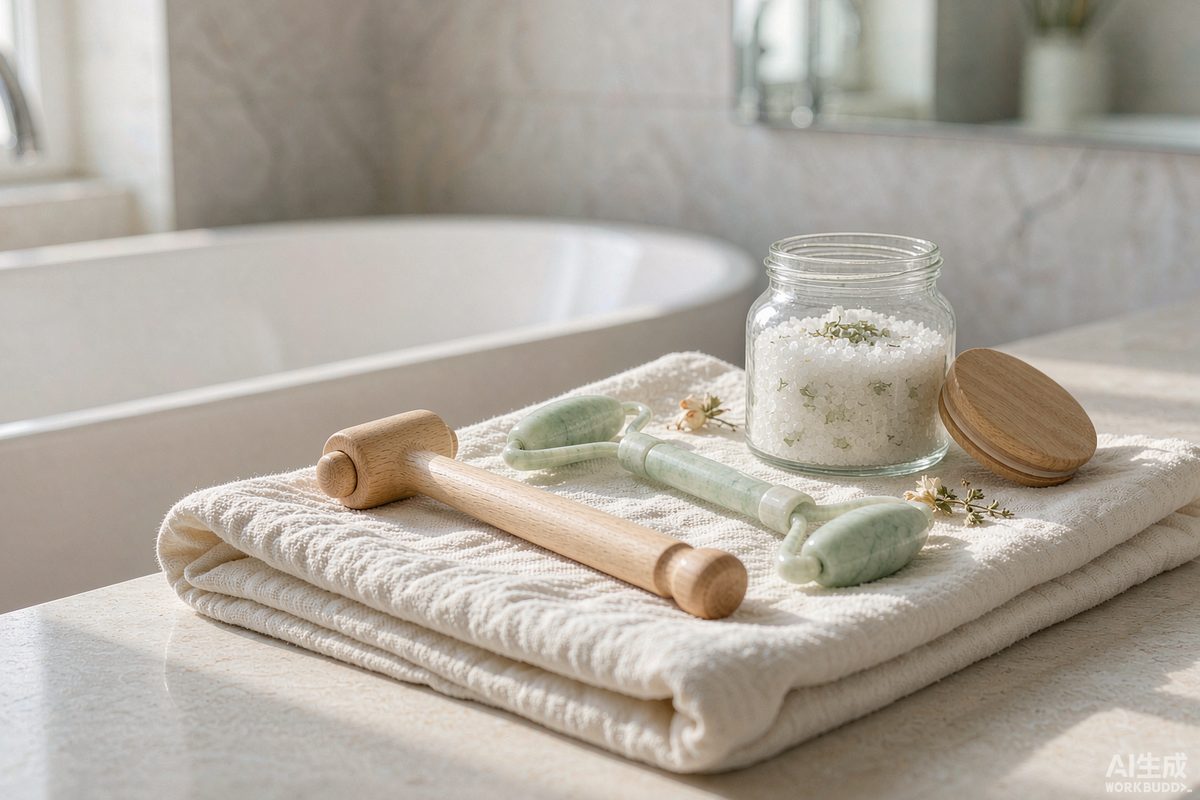
Grinding, rolling hard over the spot, or turning the session into a pain contest achieves the opposite of relaxation: the muscle guards, and you have spent ten uncomfortable minutes teaching it to distrust you. The evening setup pictured above — warm bath first, tools on the towel — is not a luxury arrangement. Warm tissue releases more readily, and the bath is doing half the work.
Limits: this is feel-better-today technology, it should stay off the bony point on the outside of the hip and away from any numbness-and-tingling territory, and cheap versions split at the seam under body weight within a season.
- The peanut shape focuses pressure on deep rotators and glutes while sparing bony edges and the sciatic line.
- Self-myofascial release has trial support for short-term range and soreness relief — immediate and temporary, not a cure.
- Hold, breathe, and wait for release. Grinding into a trigger point makes the muscle guard harder.
The Fabric Band That Makes the Glutes Show Up
If the strap and the ball are about comfort, the band is about the actual load-bearing future of the joint, and it deserves the strongest claim on your drawer space. Wide loops of grippy woven fabric sit above the knees or ankles and add resistance to the exact movements a chair-idle hip never rehearses: clamshells, bridges, side-lying leg lifts, lateral walks.
The gluteal muscles are the body's real hip management system — they steady the joint with every step — and the rehabilitation literature keeps returning to them.
A randomized trial of isolated hip strengthening, though conducted in people with kneecap pain, made the point cleanly: twelve weeks of targeted hip abductor and external rotator strengthening with bands produced greater gains in pain, function, and measured hip strength than continued activity alone.
The relevance transfers because the mechanism does — weak hip stabilizers are a background variable in half the complaints that walk into a joint clinic, and they respond to exactly the low-load, high-repetition, band-assisted work that needs no gym and no equipment beyond this one.
Fabric over latex, and this is not a styling note. Rubber tubing rolls up, pinches the skin behind the knee, and — memorably — snaps. Woven fabric grips the leg, stays put through a full set, survives washing, and lasts for years. A three-band set with a light, medium, and firm loop provides the resistance ladder: when twenty repetitions at one level stop feeling like work, move up rather than adding endless reps.
Limits, honestly stated. The band builds strength only if the sessions actually happen, which is the same clause that governs every tool on this page. It does nothing for range by itself, and the exercises look so easy that people quit before the adaptation arrives — the interesting part starts around week three, not week one. For a stiff hip, this is the tool whose benefits compound.
- Gluteal strength is the load-bearing future of the joint; targeted hip strengthening beat activity-as-usual in a randomized trial.
- Choose woven fabric over latex tubing — no rolling, pinching, or snapping, and it survives the wash.
- The exercises feel trivial for two weeks. The adaptation starts around week three; do not quit before it arrives.
"The band is the only tool here whose benefits compound — comfort tools feel better today; strength tools change next year."
What Didn't Make the List
The hip aisle is wider than the drawer, and most of it can stay at the store. Three categories earned their exclusion.
Motorized hip stretchers and powered end-range devices. The category promises what the duration trials explicitly advise against: fast, forceful pursuit of end range at the front of the hip. The tissue that responded well in studies received long, low-intensity holds; the powered devices deliver the opposite and charge for the privilege.
Around a hip, where a major nerve bundle and blood supply run directly through the folding line, force is the one variable worth minimizing rather than automating.
Vibrating everything. Vibration has legitimate uses in muscle release, and none of them require a motor inside a device shaped for the hip. What the versions we tested delivered was noise, shorter battery life, and a price four times the non-vibrating equivalent, with a sensation best described as busy. The peanut ball above achieves deeper, quieter, and more precise release for the cost of lunch.
One-size compression hip braces. Bracing is a real intervention for specific, diagnosed problems — post-operative hips, certain tendon protocols, a clinician's instructions after injury. The general-purpose compression wrap sold for ordinary stiffness, by contrast, mostly warms the area while doing nothing a pair of reasonably thick leggings does not, and its listings are the most creative in the category.
Warmth is worth having; buy it as a heat wrap, which at least doubles as one, rather than as support that supports nothing in particular.
A fourth category sits in a gray zone rather than a rejection: heated massage seats and vibrating chairs aimed at the hips. They are pleasant, and pleasant has some value in a program that has to survive winter. But they apply pressure indiscriminately across whatever surface they touch, and the hip's most useful work is precise — one rotator, one holding pattern, one slow breath at a time.
If you already own one, enjoy it; just do not let it stand in for the tools above.
The pattern across the exclusions, for what it is worth: every rejected category automates or accessorizes something the three kept tools already do, at higher cost and with a longer route to the same outcome.
- Powered end-range devices automate the opposite of what stretching trials support — long, gentle holds.
- Vibration adds noise and cost, not depth. The peanut ball does the job better for a tenth of the price.
- General compression wraps warm without supporting. If warmth is the goal, buy a real heat wrap.
A Ten-Minute Evening Shape
The three tools work best as one short routine, and the sequence matters more than the duration. Ten minutes, most evenings, after the day's stiffness has loosened.
Minute one or two: warmth. A hot shower over the hip, or the heat wrap, or — the arrangement pictured earlier — a bath with the tools laid out for afterward. Then the ball: two or three spots around the deep hip rotators and glutes, 60 to 90 seconds each, steady pressure, slow breaths, no grinding.
Then the strap, while the tissue is still warm and cooperative: five stretches — the folding stretch, a figure-four, a hamstring hold — each for 30 to 60 seconds at an intensity that never approaches strain. Last the band: one round of clamshells and bridges, two sets of ten slow repetitions, light band to start. Done. The whole thing fits between dinner and whatever the evening was going to be anyway.
A travel note, learned repeatedly: the strap and the band pack; the ball mostly does not matter on the road, because hotel corridors and unfamiliar stairs do its job by surprise. The routine survives the trip in reduced form — strap in the luggage, band in the personal item, a bath standing in for the heat wrap.
Consistency across decades beats intensity across one enthusiastic week, and hips are the joint most likely to test that principle.
What to expect, on a realistic clock. The ball and strap feel different the first evening — looser, less grudging — and the feeling fades by morning at first; that is the temporary part of the evidence doing exactly what the trials said it would.
The compounding part arrives on a scale of weeks: somewhere in the third or fourth week, the sock reach stops being an event, and the strap foot is on a loop further out than it was. Nobody notices the day it happens. That is rather the point of a pivot — it carries you quietly, and it asks only to be moved, warmed, and strengthened in return, most evenings, without drama.
And the standing caveat, unchanged since the first section: routine for the grumble, clinician for the warning signs. The two coexist fine. Most hips, given both, settle into being boring again — which, in a joint, is the highest compliment available.
- Sequence: warmth, ball release, strap stretches at 30-60 seconds, then one band round. Ten minutes total.
- Expect same-night relief within days; expect functional change — the sock test — around weeks three or four.
- Routine for stiffness, clinician for warning signs. Both have a role; neither replaces the other.