The Rules of the Ten Weeks
My left shoulder declared itself in late April. No injury — that is the calling card — just a seatbelt reach that stopped halfway one morning, and three weeks later a bra-hook moment I will spare you the details of. A sports-medicine doctor moved my arm around for ninety seconds, said the words 'capsular pattern,' and sent me home with a printout and no prescription. Freezing phase. Come back if it worsens.
A classic fifty-year shoulder, arriving a few years early, for variety.
Ten weeks, seven tools, three daily measurements. The scoreboard lived on the fridge whiteboard: night pain from 0 to 10, back-pocket reach in finger-widths (how many of my own fingers disappeared behind my back before the shoulder said no), and a high-shelf test — the height at which I could place a cereal box without the shoulder filing a formal objection.
Each tool got at least ten days of daily use, introduced one at a time, with the daily exercises running underneath the whole time.
Full disclosure of the confound: I did pendulum swings, pulley work, and three stretches every single day throughout — the regimen described in our companion piece on the fifty-year shoulder. That was non-negotiable, because motion is the actual treatment and tools are its accessories. Where a tool clearly added something beyond the trend line, I say so below. Where it didn't, I say that instead.
The field: an over-door pulley, an electric shoulder heat wrap, a hook-shaped massage cane, a TENS unit, an acupressure mat, a smokeless moxa box, and a percussive massage gun that cost more than everything else combined. The verdict in one line, before the details — the cheapest thing won, and the most expensive thing went back in the box by day nine.
- Borrow the scoreboard: night pain 0–10, one reach test, one lift test, written down daily. Tools are impossible to judge without a baseline, and memory flatters every purchase.
- Run any new tool ten days minimum. Days one through three of anything are novelty, not data.
The Over-Door Pulley: The Quiet Winner

The pulley is a nylon wheel on a bracket, two handles, and a rope: a device with no moving parts worth $14, and the only object in this test I would call load-bearing. The principle is assisted motion — the good arm pulls the rope and hauls the stiff arm overhead, so the sore shoulder moves through its range without its own muscles fighting the capsule.
Physiotherapy clinics have owned this device for fifty years, and the reason is simple: it converts willpower into range of motion with the willpower removed.
Mine hangs over the bedroom door. Mornings: two sets of ten slow pulls, after the heat, before the stretches. My other motion exercise was the wall crawl — fingers walking up the doorframe — but the crawl invites the good side to cheat and the sore muscles to guard. The pulley cheats back.
It moves the arm in pure translation: no cheating possible, no guarding possible, and you stop at the exact centimeter where the capsule says stop.
The whiteboard tells the story. Back-pocket reach: four finger-widths at baseline. Week five: seven. Week ten: ten — thumb touching belt, which in April would have been a headline. I can't isolate the pulley from the daily regimen and I won't pretend to. What I can say is that ten minutes of pulley work was the one segment I never skipped, because it was the only part that felt like progress rather than homework.
Devices that make the treatment pleasant are doing half the treatment.
The classical frame endorses it without blinking. This is daoyin — the old practice of guided, slow, assisted movement to nourish the sinews — rendered in nylon. The Yi Jin Jing, the sinew-changing classic, is built on the same premise: sinew remolds under slow, repeated, patient pull. A $14 wheel over a door is that sentence, productized.
- Set the bracket over a door that latches — hollow-core doors flex, and a mid-pull bracket slip is how pulleys end up in closets.
- Two counts up, pause at end-range for one breath, three counts down. The pause at the top is where the centimeter-a-week progress actually happens.
The Heated Shoulder Wrap: Fifteen Minutes Before Everything
The wrap is a wide neoprene band with three heat levels and an auto shut-off, shaped to lie over the shoulder summit and drape down the back. It cost about $35 and has exactly one job: fifteen minutes of heat before every motion session, because cold-start stretching a frozen capsule is how mornings get worse.
It earned permanent morning duty. The protocol: wrap on medium while the coffee brews, pendulum swings under the wrap, then pulley, then stretches. On the two mornings I skipped the heat and went straight to motion, the first ten pulls felt like the shoulder had been left outside overnight — tighter end-range, more bite, and that evening's reach numbers ran a finger-width behind. Sample size of two, obviously.
But 'heat before motion' is also the one instruction where a 2,000-year-old text and a modern physical therapy clinic have never once disagreed, so those two mornings were confirmatory rather than revelatory. Cold congeals; warmth moves. My shoulder agreed with the Suwen on the first try.
Where the wrap did not help: night pain. Wearing it in bed was warm, heavy, and useless, and the cord on this model is two-thirds the length it needs to be from any sensibly placed outlet. It also fits shoulders in a 'one size negotiates' way — the strap's velcro has a favorite position and argues against others.
Buy it for the mornings, use it for the mornings, and treat any wrap that claims to fix night pain as advertising rather than evidence. The evidence hierarchy for frozen shoulder puts heat where it has always been: universally recommended, rarely studied, and subjectively not close.
"For painful obstruction where cold is abundant, use warmth: when the channels are warmed, qi and blood move and the sinews soften."
The Massage Cane: The Hook That Reaches What Fingers Cannot
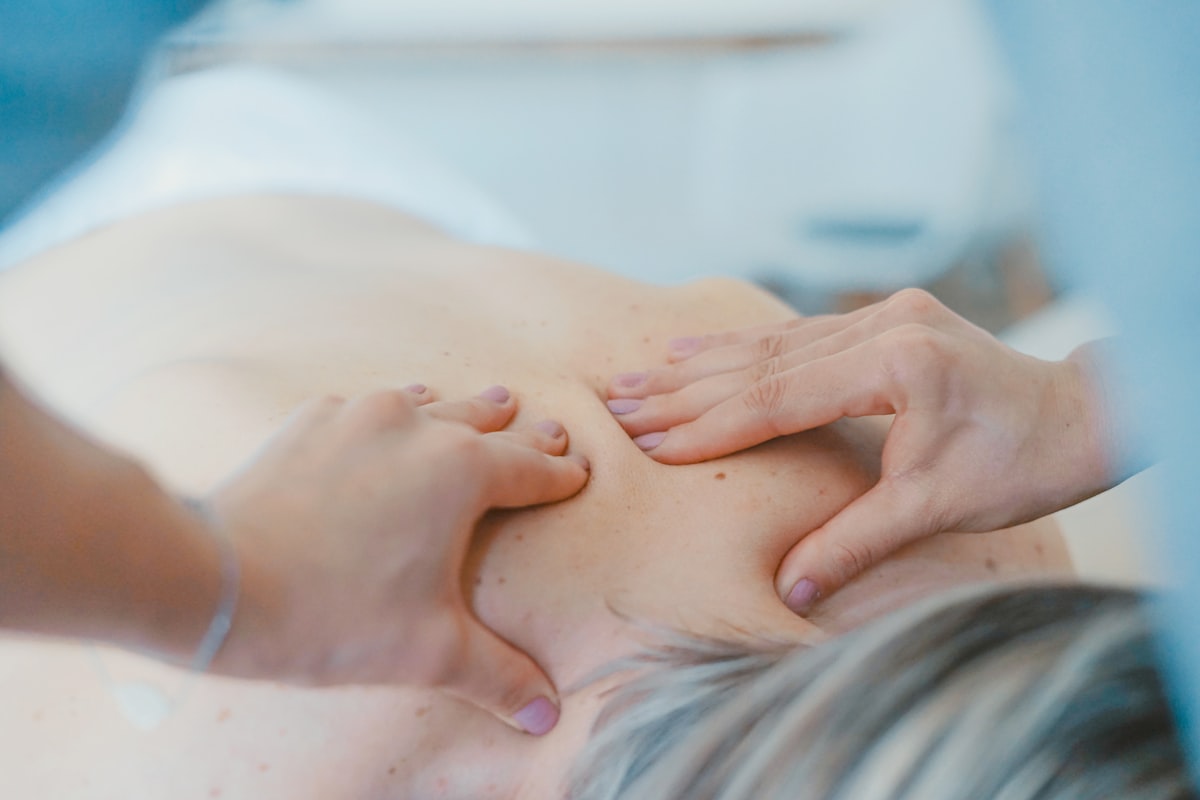
The cane is a fiberglass hook shaped like a question mark, and it exists because a frozen shoulder removes your ability to reach the exact muscles that are guarding it. The back of the shoulder, the border of the shoulder blade, the base of the neck — all the places that knotted up while the joint sulked — are precisely the territory my left hand could no longer visit. The cane visits for it.
Against a wall, hook over the top of the shoulder, I could lean into the posterior cuff and the upper trapezius with slow, searching pressure that fingers on the good hand can't generate sideways. Ten minutes in the evening, mostly while listening to a podcast. The relief was real and short-lived — two, three hours of a shoulder that felt stood down from its own defense.
As a pre-sleep ritual during the weeks when night pain was loudest, that brief stand-down had outsized value: on the nights I did it, I fell asleep faster, because the shoulder had stopped broadcasting.
Now the honesty section. The evidence base for trigger-point work in general is modest and contested, and I can't claim the cane treated the capsule — it almost certainly didn't. What it treated was the guarding around the capsule, and guarding is not nothing. It is the difference between a shoulder at war and a shoulder merely stiff, and that difference is worth real money at three in the morning.
It cost about $25, and it stays — though it has been demoted to the closet hook next to the umbrellas, which is the correct shelf for a useful-but-not-central tool.
- Slow search, not stabbing: press, hold eight to ten seconds, ease off, move an inch. Trigger points respond to patient pressure, and a flinch-release means you found one.
- Wall-lean instead of arm-pull — the good arm only aims the cane; leaning supplies the pressure. Pulling hard with the sore side defeats the purpose.
The TENS Unit: Fine, Actually Fine
TENS — sticky pads, tingling current, the gate-control theory of pain in a $30 box — was the tool I expected to mock and ended up merely respecting. The evidence in frozen shoulder is a modest pile of mixed trials; this is the kind of therapy physical therapists add rather than prescribe. My protocol: thirty minutes during the evening news cycle, two pads around the sore deltoid, current up to a strong buzz.
Effect: the standing evening ache dropped from about a five to about a four while it ran, and sometimes took an hour to climb back. It never touched morning stiffness, never moved a reach number, and the pads are awkward to place one-handed on your own shoulder — my partner earned the title of TENS technician by week two. As pain management goes, that's a B-minus: real, small, cheap, safe.
The design flaw is conceptual more than practical. TENS is a volume knob for pain signals, and frozen shoulder's problem is not the signal. It's the capsule. Every hour with the pads on felt vaguely productive and wasn't, in the way that reorganizing a bookshelf feels like writing. It now lives in the drawer with the phone chargers, deployed on bad evenings and forgotten on good ones.
On reflection, that is exactly the right amount of tool for what it does — and I'd tell anyone in the freezing phase the same thing I told myself: rent relief where it's cheap, but don't confuse an evening at four with a shoulder getting better.
The Acupressure Mat and the Moxa Box: The Evening Rituals
Two tools, one category: lying down and being warmed. Both were bought for the freezing phase's hardest hour — the evening, when the shoulder had accumulated a full day of complaints and the night was still ahead of us.
The acupressure mat — plastic spikes, $22, vaguely alarming — got the strangest assignment: fifteen minutes lying on my back with the sore shoulder blade on the spikes. The first four minutes are a negotiation. Then the back goes warm and heavy and the shoulder, starved of attention by the louder back, stops broadcasting. Is the mechanism real?
The small trials on these mats suggest the relaxation effects are genuine and the specific claims are generous. I'll report the phenomenon without defending the mechanism: those fifteen minutes were the calmest quarter-hours of the ten weeks, and calm evenings are worth $22.
The moxa box is the tradition's entry: a small tin holding a smoldering charcoal-and-mugwort stick on a mesh screen, set over the shoulder summit — over Jianyu, LI15, the point the Zhen Jiu Da Cheng names for shoulders that cannot be raised — for ten minutes while I lay on the good side.
The warmth is different from the electric wrap: slower to arrive, slower to leave, the kind that seems to keep radiating after the stick is out. Damp-weather evenings, when the shoulder ached like a barometer, were where it earned its keep.
Safety, since moxa is fire: the screen stays a centimeter off the skin, ten minutes is the whole dose, check the skin afterward — pink that fades within an hour is normal — and never use it on skin that can't feel. The classical frame, cold congeals and warmth moves, describes the experience exactly.
The trial evidence for moxa in frozen shoulder is thin, so I offer it as a pleasant, plausible ritual rather than a treatment.
- Mat protocol: thin towel over the worst spikes for the first week, then lose the towel. Fifteen minutes, no phone — the point is the stillness.
- Moxa timer: set a real one. Ten minutes feels shorter than it is when the room smells like a campfire and you are horizontal.
The Massage Gun: $120 and a Lesson
The massage gun was the purchase I defended at checkout and regretted by day nine. The theory was reasonable: percussive massage relaxes guarded muscles, guarded muscles were part of the problem, therefore gun. The theory met the capsule.
A frozen shoulder is not a tight muscle. It is an inflamed, contracting bag of connective tissue, and percussion over an inflamed capsule feels less like therapy and more like being politely punched. Two attempts with the ball head on medium produced evenings that ran a full pain point above baseline — the only tool in this test that made anything measurably worse.
To be fair to the gun: used far from the joint, on the forearm and the neck, it is a pleasant appliance, and my partner, whose shoulders are merely normal, borrowed it constantly until we returned it. The lesson generalizes past this one device. Match the tool to the tissue. Massage tools treat muscle; frozen shoulder is not, in the end, a muscle complaint.
A $120 object taught me that sentence better than any diagram, which is an expensive way to learn a sentence I already knew.
It went back in the box, and the box went back to the store. Day nine, full refund, no hard feelings — and a standing rule for the rest of the drawer: if a shoulder tool's own instructions say 'avoid use directly over the joint,' and the joint is the patient, read the room.
The Final Ledger
Ten weeks, roughly $210 spent across seven tools. Here is the shelf as it stands.
Permanent duty: the pulley ($14, used daily since May, the single best dollar in this article), the heat wrap ($35, every morning's opening act), and the massage cane ($25, evenings of the bad weeks). Drawer: the TENS unit — real, small effect, awkward ritual. Guest room: the acupressure mat, borrowed by visitors more than used by me. Kitchen cabinet: the moxa box, summoned for weather fronts.
Returned: the massage gun, inside its window, to its home shelf at the store.
Add up what actually worked and the number is $74 — for exactly the three tools that share one design principle. None of them treats the joint. All of them serve the joint's treatment: the wrap warms it before motion, the pulley performs the motion, the cane quietens the guard around it. Everything that failed tried to treat the joint directly, as if a capsule could be pounded, zapped, or vibrated into cooperation.
The capsule only answers one question — asked daily, gently, in warmth — and the tools that won are the ones that kept asking on my behalf.
Where things stand at week ten: back-pocket reach is within two finger-widths of the right side, the shelf test clears my head by an inch, and night pain visits twice a week instead of seven times. Credit the regimen, not the pulley. The pulley just made the regimen impossible to skip — and on a dark May morning, that turned out to be most of the job.
"Cold congeals; warmth moves. The sinew follows the daily asking, not the Sunday demand."