The Towel Test
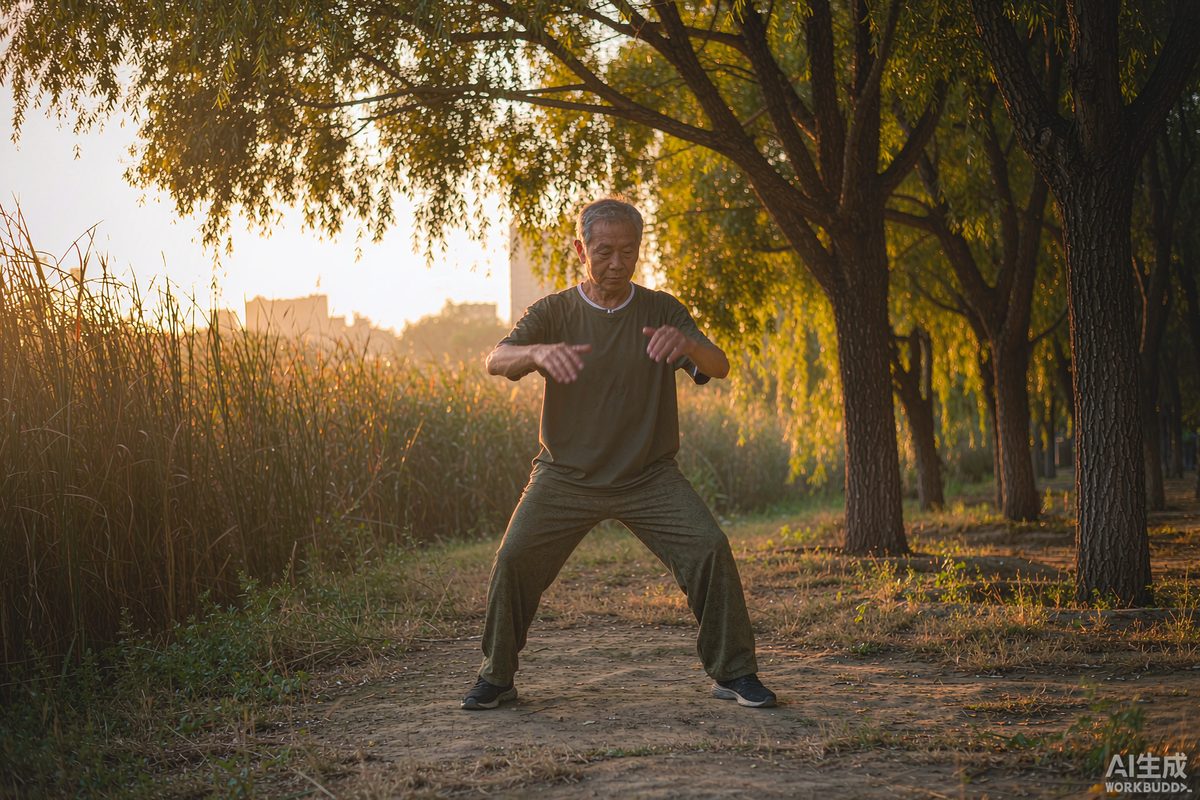
Two pictures of a finished workout. In the first, a man drops his shirt on the gym floor and it lands with a slap — soaked through, wringable, the floor around him dark with drips. In the second, a woman in a city park finishes a slow set of qigong forms, and the only evidence of effort is a damp collar and a faint sheen at the hairline.
The gym would score the first man higher. Sweat as proof of work; no puddle, no payoff. Chinese medicine scores it the other way, and has for two thousand years. In the classical texts, sweat is not a byproduct worth counting up. It is an asset worth counting down — fluid drawn from a reserve the body needs for things more important than cooling a treadmill.
The old framing goes further than that. Sweat, in the Huangdi Neijing, is assigned to a specific organ. Not the skin, oddly enough. The heart. 'The heart's fluid is sweat,' the Suwen says flatly, in its list of which zang organ governs which body secretion. Losing a lot of it, then, is never a neutral event.
It is a withdrawal from a particular account — one that traditional physiology links to the pulse, the mind, and the sleep you get that night.
This article is about that claim. Where it came from, what it meant to the physicians who wrote it, and — the part we check carefully — how it holds up next to the modern literature on sweat rates, dehydration thresholds, and fluid replacement. The two systems were built without knowledge of each other. On the size of a safe workout sweat loss, they land closer than you would expect.
- Sweat volume is a budget question, not a scoreboard: the useful number is how much you lost, not how wet you got.
- A rough home method exists — weigh yourself before and after a session — and Section 5 explains the threshold modern research draws with it.
What Sweat Is, in Two Systems
Start with the classical description, because it is more physical than the mysticism reputation suggests. ' Yang here means warmth, movement, the driving force; yin means the body's fluids and moistening reserves. Push heat into fluid and drive it to the surface, and it comes out as sweat. No spirits, no metaphors required.
It is a pressure-and-boiler model of the body, and as models go, it is not far from a thermodynamics diagram.
The texts also insist that this fluid is not unlimited and not generic. Jin-ye — the fluids — circulate to moisten skin, muscles, joints, and orifices, and sweat is jin-ye leaving through the surface. What leaves the body as sweat is the same substance that, kept inside, moistens and nourishes.
That is why the Lingshu chapter warns physicians off harvesting both at once: drain sweat from someone who has already lost blood, or bleed someone who has sweated heavily, and you take from a single pot twice.
The modern description swaps vocabulary but keeps the arithmetic. Adults carry somewhere between two and four million sweat glands, mostly the eccrine type, and they secrete a hypotonic fluid — water first, with sodium, chloride, and small amounts of everything else — onto the skin. 58 kcal of heat.
That is the whole cooling trick: the body trades internal fluid for external temperature control, and the exchange rate is fixed.
So both systems describe the same transaction. A fluid the body maintains deliberately is spent through the skin to buy heat control. Where they diverge is on the question modern gym culture rarely asks: what happens to the account when the spending goes on too long.
- Sweat is hypotonic — it loses water faster than sodium — which is why heavy sweating without sodium replacement gradually dilutes the blood rather than just drying it.
- The classical and modern models agree sweat is a real cost from a real reserve, not an inert byproduct.
"When yang acts upon yin, the result is sweat."
Why the Heart Owns the Sweat
The organ assignment sounds arbitrary until you read the reasoning. The heart governs the blood — xue — and the Neijing treats sweat and blood as two outputs of one shared source: the body's deep fluids. Sweat is the light form that escapes through the pores; blood is the dense form that stays in the vessels. Clinically, the logic runs: what depletes one strains the other.
A patient who has bled heavily was not to be given sweating treatments. A patient drenched in sweat was treated as if partly bled — pale, weak pulse, cold. The overlap in symptoms is the whole argument.
From there it is one short step to the claim in this article's title. If sweat shares a source with blood, and blood is the heart's domain, then sweat is the heart's fluid by extension — han wei xin zhi ye, a phrase later textbooks fixed into a maxim. And the heart, in the same physiology, houses the shen: the mind's clarity, the steadiness of sleep, the calm of the pulse.
Oversweating was classically described as draining toward that whole cluster.
What does overdraft look like, in the old case language? Palpitations that start after a heavy sweat. A floating, restless pulse. Insomnia in a body that is exhausted but too jittery to rest — the picture of heart qi shaken loose by fluid loss.
Any Chinese pharmacy still stocks formulas for exactly this pattern; the flagship one, Sheng Mai San, pairs ginseng with ophiopogon root and schisandra, and its printed indication is barely a sentence: after great sweating, qi and yin both damaged, thirst, a weak racing pulse. The formula has been in continuous use since the Tang dynasty for the morning after a too-hard effort in the heat.
We flag the evidence boundary here, because it matters. The chain 'big sweat depletes heart fluid, therefore palpitations' is a traditional etiology, not a demonstrated biochemical pathway, and no PubMed-indexed trial shows schisandra repairing a depleted heart account.
What the old texts offer is a precise clinical observation — that certain symptoms cluster after heavy fluid loss — plus a centuries-long habit of treating the fluid loss itself as the thing to fix first.
- Palpitations, a restless pulse, or wired-but-exhausted insomnia after heavy sweating is the classic 'heart fluid damaged' cluster in TCM terms.
- The Tang-era formula Sheng Mai San — ginseng, ophiopogon, schisandra — was designed for exactly the after-sweat state; it remains a useful lens even if you never take it.
"Of the five zang, each transforms its own fluid: the heart's fluid is sweat, the lungs' fluid is snivel, the liver's is tears."
Damp Collar, Not Puddles
So how much sweat did the classics consider acceptable? The most operational answer is not in the Neijing at all. It is in Zhang Zhongjing's Shanghan Lun, the third-century cold-damage manual, tucked into the aftercare instructions for taking cinnamon decoction: sip hot porridge, cover with a blanket, and wait for the whole body to break a fine, continuous, slightly clammy sweat.
That is the therapeutic ideal — bian shen zhi zhi, a fine mist over every limb. And then the caution, which every Chinese medical student memorizes: do not let it pour like water streaming down, ru shui liu li. If the sweat flows like that, the disease will not resolve; the fluid will be spent for nothing.
Read it as an exercise prescription and it maps onto the park at six in the morning. The traditional standard for health exercise — tai chi, the Brocades, walking forms — is a damp collar and a light film of sweat across the back. The phrase old teachers used is han chu er bu chuan: sweat, but do not pant. You are meant to finish refreshed, appetite intact, sleep sound that night.
A practice that leaves you wrung out and ravenous has, in this framework, overspent.
The reasoning behind the ceiling is classical physiology again: sweat is not only fluid but the vehicle of yang qi, which pushes it out.
' That is the textbook description of the wrecked, hollow, two-days-to-recover feeling after an overheated overperformance, and it is why cold water, cold wind, and cold showers immediately after heavy sweating are discouraged: the surface is open, and tradition holds that cold slips straight in.
None of this forbids hard training. Chinese history has plenty of brutal conditioning — soldiers, dockworkers, iron palm drills. The distinction the tradition draws is between exertion with a plan and expenditure as performance. The puddle on the gym floor is fine if you budgeted for it. The problem, then as now, is treating the puddle itself as the goal.
- The Shanghan Lun standard for a 'good' sweat is fine and continuous across the whole body — never a river; use it as a RPE of sorts for traditional practice.
- Old teacher's rule for health exercise: sweat but don't pant (han chu er bu chuan). If you're gasping, the form has become a workout, which is allowed — just budget differently.
- Classical aftercare treats the post-sweat window as vulnerable: warm fluids, no cold drafts, no ice baths straight off the floor.
"Let the sweat spread fine and clammy over the whole body — this is best. Do not let it pour like water streaming down; if it does, the illness will surely not resolve."
The Two-Percent Line, and Where the Lab Draws It
Now the modern side of the ledger, because the numbers are worth knowing precisely.
The most-cited review on the question, Cheuvront, Carter and Sawka's 2003 synthesis in Current Sports Medicine Reports, puts the performance threshold plainly: when dehydration exceeds about 2% of body weight, endurance performance degrades — cardiovascular strain rises, core temperature climbs, perceived effort inflates — and heat stress makes every one of those worse. 4 kg.
Roughly a liter and a half, given that sweat is water with a little salt riding in it.
How fast can a person cross that line? Faster than gym lore assumes. Sweat rates are wildly individual — they scale with body size, fitness, heat acclimation, humidity, and sheer genetics, and published ranges run from about half a liter per hour in cool conditions to well over two in hard work in the heat.
Murray's 2007 review of hydration and physical performance walks through the same spread and adds the awkward detail that thirst lags: by the time you feel genuinely thirsty, the deficit is already a percent or two deep, which is why drinking purely to thirst undershoots in long or hot sessions.
Hold the classical ceiling next to the lab's number and the correspondence is hard to ignore. 'Do not let it pour like water streaming down' — for an average adult, an hour of dripping sweat is one to two liters, which is precisely the zone where the modern threshold sits. The Shanghan Lun physicians never measured body mass to the gram.
They watched patients for centuries and drew a line in the same place the calorimetry eventually landed.
To be clear about what this is and is not: it is a convergence, not a proof. The old texts were not doing physiology the way Cheuvront's lab does, and the overlap does not validate everything in the Neijing. But on this one operational question — how much sweat is too much before function pays for it — the two systems shake hands.
- 2% of body weight is the modern red line: about 1.4 kg for a 70 kg adult, roughly 1.5 L of sweat.
- Sweat rates range from ~0.5 to over 2 L per hour depending on heat, humidity, intensity, and the individual — a friend's tolerance tells you little about yours.
- Thirst lags the deficit; in sessions over an hour or in heat, planned drinking beats waiting for the signal.
When Sweat Reads Like a Warning
Chinese medicine did not just cap sweat; it read it. Diagnostic tradition sorts abnormal sweating into a small set of patterns, and the sorting is worth knowing because each pattern points somewhere different.
Zi han, spontaneous sweating — perspiring at a desk in an air-conditioned room, after no exertion at all — classically flags qi that is too weak to hold the surface closed. The pores are a door and the qi is its latch; a sweating-at-rest body is a door rattling in the wind.
Dao han, night sweats — falling asleep dry and waking in damp sheets — points the opposite direction, toward yin deficiency with internal heat: the fluid seeps out in the night when the body's cooling, anchoring side is offline. Leng han, cold sweat, skin clammy and pale, is the emergency-tier sign in the old books, the sweat of a system shutting down rather than cooling down.
Exercise adds a modern category the classics never saw, and it deserves its own caution. Red flags that should send you to a doctor rather than a formula: night sweats that persist for weeks without any training change, drenching sweats accompanied by unexplained weight loss or fever, palpitations or chest tightness that reliably follow heavy sweating, sweat on one side of the body only.
These overlap with real medical conditions — thyroid dysfunction, infection, cardiac issues — that no traditional framework should be asked to rule out.
Within the honest limits: the pattern-reading above is a traditional diagnostic lens, refined over centuries of case-watching, not a substitute for a workup. Its practical value for a healthy trainee is as a feedback loop. Sweating pattern is one of the few training signals you generate every single day, for free.
A summer of workouts that leave you soaked and a bedroom that stays dry is a different data point than the reverse, and the old physicians would ask about both before they asked about anything else.
- Sweat at rest (zi han) and sweat during sleep (dao han) are distinct classical patterns pointing to different imbalances — note which one you have before self-treating either.
- See a doctor for: weeks of unexplained night sweats, sweating with weight loss or fever, palpitations after sweating, or one-sided sweating.
- Treat your sweating pattern as a daily feedback signal — changes in it often precede changes in how training feels.
"One who has lost blood must not be made to sweat further; one who has lost sweat must not be drained of blood."
Putting It Back: The Refill Rules
Spending less is half the discipline. The other half is what the tradition does about the account afterward, and here the old pharmacy and the modern lab have their second conversation.
' Sour flavors, the doctrine holds, gather and retain what is leaking; sweet ones moisten and build. Hence the shelf of fluid-generating standards: wu mei (dark plum), wu wei zi (schisandra, the 'five-flavor seed' named for tasting like all five), mai dong (ophiopogon tuber, sweet and slightly cold, aimed straight at heart yin).
Stir a sliced plum into hot water after a summer session and you are doing sixteenth-century sports nutrition. '
The modern lab's version of the same afternoon: repair volume with sodium in it. Research on rehydration is blunt that plain water is the wrong tool after heavy sweat loss — it dilutes plasma sodium, which both blunts thirst before the deficit is closed and drives the kidneys to dump the very water you just drank.
Sodium-containing fluids or a salty meal alongside the drink keep what you drink, and the standard guidance is to take in roughly 150% of what you lost over the following hours: lose a liter, take in about a liter and a half, spaced out.
Kenefick's 2018 review of drinking strategies splits the difference between planning and thirst sensibly — below ninety easy minutes in mild weather, drink when thirsty; beyond that, or in heat, plan it.
And one inherited habit costs nothing. The classics time the refill to the meal, not the bottle: congee with salted plum, miso-adjacent soups, broths after summer labor. Fluid taken with food and a little salt absorbs like a deposit. Fluid chugged alone leaves like a rumor.
- Post-sweat refill rule of thumb: ~150% of losses over the following hours, with sodium — about 1.5 L for every liter sweated.
- The old fluid-generators — sour plum, schisandra, ophiopogon — encode the same idea as the lab's: retain and rebuild, don't just flush.
- Eat your fluids when you can; a salty broth after a heavy session rehydrates better than the same volume of plain water.
"Schisandra: the flavor is sour. It nourishes the five zang, clears heat, and strengthens yin."
A Working Framework for the Week
Rules condense to this. Match the sweat budget to the session's purpose. For qigong, tai chi, walking forms, and recovery days, the classical target is also the sensible one: warm, loose, lightly damp at the collar, breathing steady. That is the dose those practices were designed around, and chasing more turns a restoration session into an expenditure session.
For ordinary strength work under an hour in a temperate gym, expect and accept roughly half a liter to a liter — well under the red line for most adults — and let thirst plus a bottle at hand handle it. For the heavy tier — summer runs, hot yoga, sauna rounds, anything over ninety minutes in warmth — the old ceiling and the lab both say the same thing: this is planned-drinking territory.
Know your rough rate (the weigh-before, weigh-after habit takes a week to establish and pays off for years), front-load some fluid, carry sodium for sessions past an hour, and finish with the 150% protocol rather than a single triumphant bottle.
Season counts, in this framework. Summer invites sweat; the texts accept it and just demand the refill. Winter is the opposite — han he zai li, the classical motto for the cold months is 'sweating hidden, yang stored' — and a winter of daily drenching workouts is treated as leaving the storeroom open all season.
You need not share the cosmology to notice the symmetry with modern overtraining wisdom: winter blocks are for building, not for monthly heroics that take a week to absorb.
One question to close on, and it is not rhetorical. After your next hard session, before you log the distance or the weight, pick the shirt up off the floor. If you can wring it, the workout drew on an account that also pays for your sleep, your pulse, and tomorrow's focus. The gym will tell you what you spent it on. Nothing in the gym will tell you what it cost — that part is still your job.
- Easy sessions: damp collar is the target, not drenched. Heavy or hot sessions: plan fluid and sodium in advance; don't chase the puddle.
- Winter tradition — 'sweat hidden, yang stored' — lands close to modern periodization: build in the cold months, save the drenching efforts for when the season supports the refill.