Cold Starts Are the Expensive Part
The weekend warrior's risk is not the total workload. The cohort data, covered honestly in the companion article on this site, shows compressed weekend exercise carrying most of the survival and cardiovascular benefit that spread-out exercise does. The risk is the transition — the first fifteen minutes, when a five-day-sedentary body meets near-maximal effort with no ramp between the two.
First-sprint calf strains, first-change-of-direction hamstring pulls, the groin complaint that arrives before anyone has broken a sweat: these cluster at the opening of the session, before fatigue could take any of the blame.
What a warm-up buys is a graded transition. Temperature rises, nerve conduction speeds up, the ankle and hip wake in progressively larger amplitudes, and the tendons get a preview of the loads they are about to transmit. None of this is mystical, and most of it is free — jogging, ramping efforts, practicing the sport's own movements at increasing intensity.
The gear in this review exists only to make that sequence more reliable: easier to do correctly, harder to skip, and better targeted at the tissues that fail.
The gear question deserves its own honesty, because this category is drowning in products pitched as injury insurance. Massage guns, compression sleeves, vibrating spheres — the recovery reviews elsewhere on this site cover several, and the evidence there is genuinely mixed. This review deliberately stays on the cheaper, earlier side of the Saturday problem: the ten minutes before the game.
The prevention research credits the warm-up sequence far more consistently than it credits any post-game gadget, which makes this corner of the catalog unusual — the cheap options and the defensible options are, for once, the same options.
A word on what does not count. The old ritual — a hamstring stretch held for a minute, then another, then straight into the game — survives in parks everywhere, and the research has largely dismantled it. Long static holds before effort show no injury-prevention benefit and measurably dull force output in the short term.
The tools below were each chosen because they push the warm-up toward movement and progression, not away from it. Every pick ends with who should skip it, because the honest answer for some readers is: a brisk walk and your own legs are enough.
- Time-box the warm-up to ten or twelve minutes. Longer routines die of logistics; short ones survive contact with a Saturday schedule.
- The ramp matters more than the tools: easy movement first, then half-effort, then game speed. Gear only packages this sequence.
"The first fifteen minutes are where cold weekends collect their debts. A warm-up is simply a payment plan."
What the Warm-Up Research Supports — and What It Doesn't
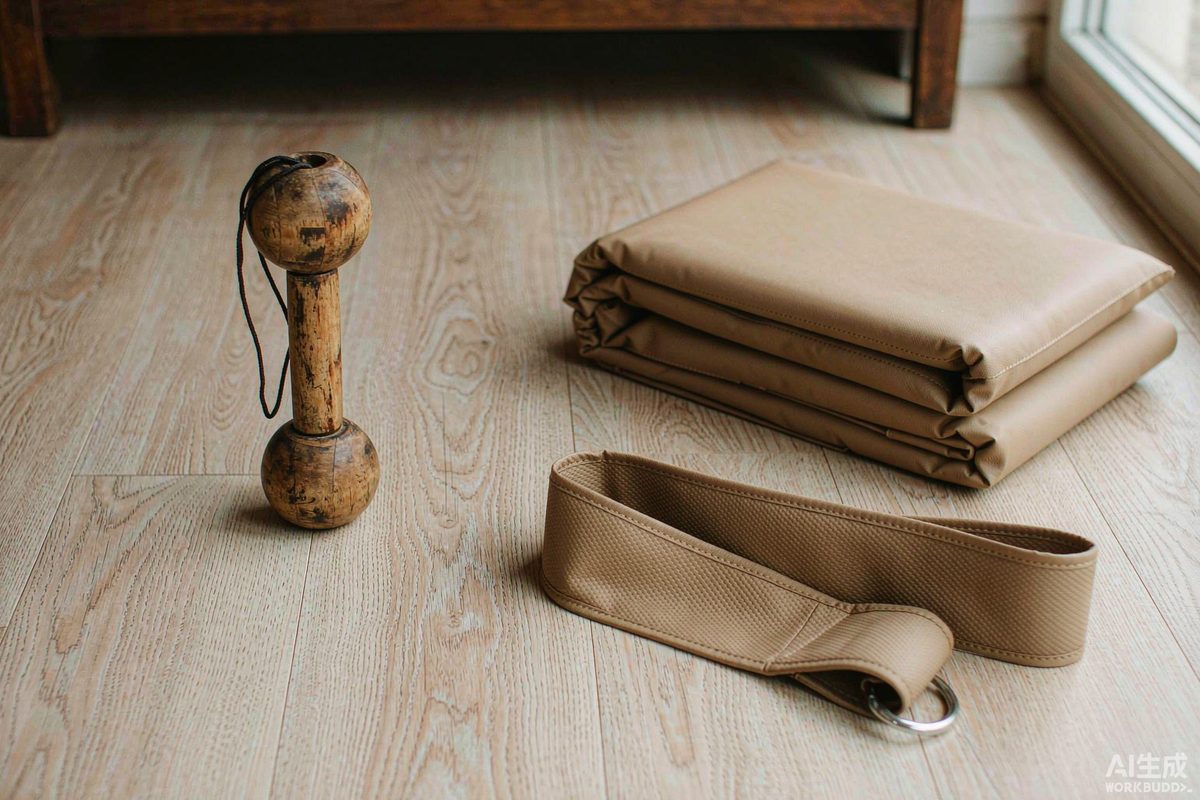
Two bodies of research anchor this review, and they say different things.
The broader one, a 2026 systematic review in the journal Sports covering forty studies from warm-up through recovery, found that structured neuromuscular warm-up programs — think FIFA 11+ style sequences of dynamic movement, balance, and progressive effort — were repeatedly linked with fewer lower-limb injuries and better sprint, jump, and balance performance. Dynamic warm-ups acutely improved power measures.
That is the strongest floor the field has: complete, progressive, movement-based warm-ups help.
The narrower body is the stretching file, and the 2016 systematic review by Behm and colleagues remains its clearest summary. Static stretching held longer than a minute per muscle produced small performance deficits afterward; shorter holds did less harm; and across the board, stretching showed no clear effect on all-cause or overuse injuries.
The authors' own conclusion is the one this review is built on: stretch briefly if you like, inside a warm-up that includes dynamic activity afterward, and expect the injury protection to come from the whole sequence rather than the stretching part.
Range of motion gains from any method fade within about half an hour — another reason mobility work belongs immediately before the game, not on a different day as a separate ritual.
So the three tools below are ranked by how reliably they contribute to the movement-based sequence the evidence actually credits. None of them is magic, one of them is borderline optional, and the strap in particular earns its place by limiting — not enabling — the static stretching. Prices in these categories are commodity-low; the differentiators are construction details, noted in each entry.
- Look for 'dynamic' and 'progressive' in any warm-up you copy from the internet. Parked stretching routines are the genre's dead weight.
- Do mobility immediately before sport. The flexibility gains fade in half an hour, so a morning stretch routine does not protect an afternoon game.
"The research credits the sequence, not the props. Tools earn their keep by making the sequence harder to skip."
The Strap: Assisted Positions Without the Bounce
A multi-loop stretching strap is twelve dollars of woven nylon that solves the two chronic failure modes of pre-sport stretching: overshooting the range, and bouncing. With a belt or bare hands, every position is estimated; with loops, each rung is a fixed rung of the ladder, and the hold is isometric rather than springy.
For a cold-start body, that difference is the difference between a controlled position and a small ballastic event on an unprepared hamstring.
Where the strap earns a niche beyond sport: the desk week itself. Five days of chair posture settles the body into shortened positions — hip flexors closed, hamstrings dormant, calves asleep in shoes — and then Saturday asks for full range at speed. The brief pre-game positions function as a bridge between the week's shape and the weekend's requests.
The classical sinew-channel texts describe the sinews as belonging to the Liver and flourishing on movement done in measure, and the phrase wears well here: measured is the operative word. Thirty seconds a position, then movement — a strap used for five minutes with intent beats twenty minutes of aimless floor time before any kickoff.
The evidence, stated plainly, is what Behm's review allows: brief holds (under a minute per muscle) inside a movement-based warm-up are performance-neutral, they acutely widen range of motion, and that wider range is useful in the movements that follow.
This is why the strap ranks first among the three picks despite being the least dramatic: it is the tool that lets the old stretching habit survive in its harmless, short-hold form instead of its harmful, long-hold one. Calves against a wall strap-assisted, hamstrings supine with the leg rung-locked, a figure-four hip position — thirty seconds each side, then the strap goes back in the bag and the movement begins.
Buying notes from a strap that has been stood on, hitched to fences, and washed: eight feet covers most bodies, ten if you are tall or stiff; stitching at the loops is the failure point, so double-stitched rungs or nothing; and flat webbing beats rope-style straps for grip.
Skip it if you already own a yoga strap — the loops are convenience, not physics — or if you have genuinely retired from floor stretching; the warm-up works without this tool, just slightly less precisely.
- Under sixty seconds per position before sport. The long, delicious holds belong to the evening, not the kickoff.
- Hook the strap's middle loop around the foot, not the arch end — pressure through the ball of the foot keeps the position honest.
"The loops are a speed limiter. The strap does not make stretching powerful; it makes it brief, measured, and over on time."
The Rope: Three Minutes of Ramp
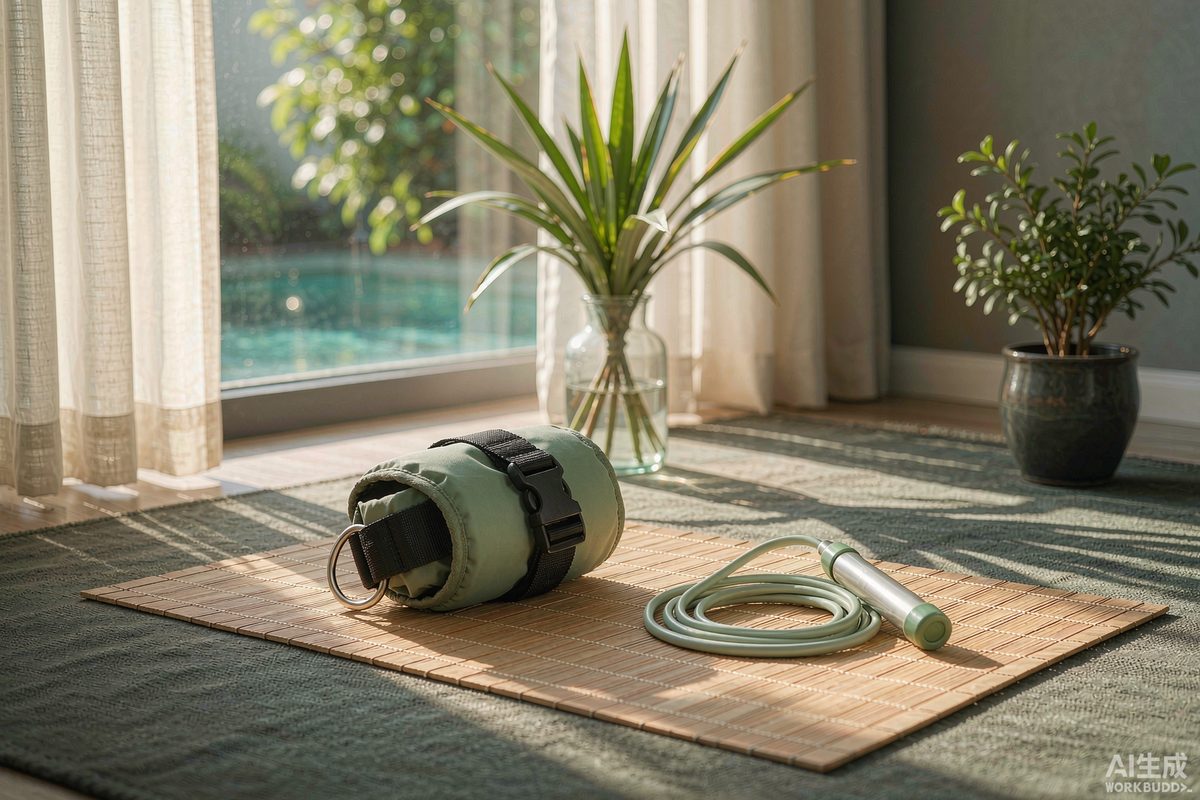
No tool converts standing still into warm faster than a speed rope. Three to five minutes of easy skipping raises core temperature, lifts the breath into the zone where speech gets shorter, and — more valuable than either — loads the calves and Achilles in hundreds of small springy contacts, which is precisely the tissue pair that fails in the first sprint of an unprepared Saturday.
The contacts are low and frequent rather than high and rare, which is why they read as preparation instead of assault.
Rhythm matters as much as duration. Turns that alternate stumble and restart teach less than slower, continuous bouncing, so beginners should shorten the rope's effective length — choke up on the handles, or wind an adjustable cord a notch short — until a full turn clears the head comfortably. Cadence first, height never, tricks at the end of the season if at all.
That ordering is what keeps the tool in the warm-up column rather than the highlight reel, and it is the difference most product tutorials skip.
The rope also carries a bone footnote worth reporting without overselling. A two-year quasi-experimental study of 176 Hong Kong schoolgirls, published in PLoS One in 2017, found that weekly rope skipping was associated with higher heel (calcaneal) bone density — with no difference at the forearm and no fitness advantage measured.
The population is adolescent girls, not forty-something basketball players, and the study measured an association across school years, not a warm-up protocol. What it usefully illustrates is the mechanism class: small, repeated, springy impacts are a signal bone and tendon both respond to. The warm-up doses described here are gentler than the study's, and we claim gentler things.
Buying notes: adjustable length is non-negotiable — stand on the rope's middle; the handles should reach armpit height. Bearing-mounted handles outlast sleeve-mounted ones by years of weekly use. Thin PVC cords whip faster and teach rhythm better than beaded ropes, but beaded ropes survive pavement and travel better; our travel bag holds the beaded one.
Skip the rope if you carry an Achilles history or plantar fasciopathy without clinical clearance — a brisk uphill walk is the same engine with the bounce removed.
- Low bounces, barely leaving the floor, for the first minute. Height comes later; ankles come first.
- Miss a turn? Keep bouncing on the spot and restart. The goal is cadence, not tricks — double-unders on cold calves are how warm-ups become injuries.
"Three minutes of rope is a thermostat and a rehearsal in one: the calves get four hundred rehearsals of the exact load the game will ask for."
The Ladder: Coordination Before Chaos
The agility ladder is the pick most likely to look like a toy and least likely to be missed once owned. Flat rungs on a strap webbing, unrolled in fifteen feet of driveway: two minutes of foot patterns — one foot per rung walking, then jogging, then lateral shuffles, then the in-in-out step — and the nervous system has rehearsed acceleration, deceleration, and direction change at submaximal speed.
That rehearsal is the point. Saturday sports fail bodies in the transverse plane and in the first hard cut; the ladder is where those patterns get a non-contact dress rehearsal.
Honesty requires a smaller claim than the category's marketing makes. The 2026 systematic review credits neuromuscular warm-up programs as a whole — agility and balance components included — with lower injury rates and performance gains, but no trial isolates the ladder as the active ingredient.
Consider it one delivery vehicle for the coordination element the successful programs share, chosen here because it is cheap, tenable on any grass edge, and self-evidently progressive: walking patterns graduate to jogging patterns graduate to game-speed cuts, on the same fifteen feet.
One durability note from two seasons of lending this one out: ladders die at the seams between rungs, not at the rungs themselves. Check the stitching when one arrives and again each spring, and retire a ladder whose rungs twist in their webbing — a twisted rung is a small, repeating ankle hazard dressed as a training tool.
Store it rolled loosely rather than folded; creases in the webbing become permanent and leave the rungs sitting uneven, which matters more on race day than any brand name printed on the carry bag.
Buying notes are short because the product is simple: flat rungs only — raised hard rails roll ankles when caught, and catches happen — bright color for visibility on grass, and enough rungs (ten to twelve) to fit a full stride cycle. A carry bag comes with most; the pegs at the ends matter more, since a ladder that migrates across the field mid-drill is a ladder that lives in the trunk.
Skip it if your weekend is cycling, hiking, or any linear unhurried sport; nothing in your failure modes needs it. For court and field athletes, it is the third tool and the first to be lent out, which is a fair trade.
- Five patterns are plenty: walk-through, jog, lateral shuffle, in-in-out, one hard cut at the end. Two minutes total.
- Errors are data, not failure. A stumble on rung four at warm-up speed is the stumble the game would have charged you for at full speed.
"The ladder rehearses the exact sentence the game will shout later — go, stop, turn — at a volume the body can survive."
The Ten-Minute Template, Assembled
Tools in hand, the sequence that assembles them runs like this. Minutes one to three: rope, low bounces, building cadence until breathing shortens. Minutes four to six: strap positions — calves, hamstrings, hips — thirty seconds a side, brief holds, no lingering.
Minutes seven to nine: ladder patterns at rising speed, finishing with two or three short bursts in your sport's own movement: a cut, a sprint start, a lunge to the net. Minute ten: game begins, but from a body already two gears in. Total equipment weight under two pounds; total cost under sixty dollars new, under thirty secondhand; total excuse budget, zero.
The sequence deliberately front-loads temperature and rear-loads specificity, because that is the order the physiological rationale runs in: warm tissue first, mobilized positions second, rehearsed speeds last, full effort only after something at half effort has already happened. It is also deliberately short.
Every additional minute of ritual is a minute that a busy Saturday will eventually refuse to fund, and an abandoned warm-up protects nobody.
A note on the pieces we tested and left out. Massage guns and compression sleeves are recovery tools, not warm-up tools, and the recovery evidence is heterogeneous enough that the 2026 review above declines to give it a strong endorsement — worth reading before spending there. Long-hold stretching routines failed the pre-sport evidence test, as covered.
And powered vibrating foam rollers, whatever the demonstration videos imply, did nothing in the ramp role that three minutes of rope did not do better for a tenth of the price.
Scaling notes by weekend type: before a long, low-intensity session — a hike, a long ride — the rope and ladder shrink to a couple of minutes each and the walk itself becomes the ramp. Before a high-intensity court or field session, nothing shrinks; if anything, add one more set of practice bursts. And in cold weather, everything doubles in duration because temperature is the whole first act.
The template bends; the order does not.
- Lay the kit out before changing clothes. The biggest variable in whether a warm-up happens is whether the rope is already on the ground.
- End every warm-up with one effort at ninety percent game speed. It is the last rehearsal and the best single predictor that the first real sprint will be uneventful.
"Three tools, ten minutes, one order: warm, mobilize, rehearse. The game starts afterward — and it starts differently."
Who Should Skip What
A closing audit, in the direction this site prefers: who needs none of this. If your weekend is walking, easy cycling, or anything that begins at conversational pace and stays there, the first ten minutes of the activity are your warm-up, and the bag can stay in the trunk.
If you already train midweek — two short sessions between Tuesday and Thursday, as the companion article suggests — your cold-start risk is lower, and the full sequence can compress to rope plus bursts. The gear accelerates a ramp that consistency eventually builds for free.
One seasonal note, since weekend sport is a calendar animal: the first warm weekends of spring are this template's most important deployments. Early-season demand spikes — leagues restart, courses reopen, the first long ride of the year arrives — while tissue capacity sits at its annual minimum after a sedentary winter.
Run the full template with extra rope minutes for the first three weeks of any season, and treat the first two weekends as rehearsal at deliberately reduced volume. The injuries that end seasons almost always collect their debts in weeks one through four.
Who should not skip parts of it: anyone returning to pivoting sport after a winter indoors, anyone over forty whose Saturdays are their only hard effort, and — with the standard clinical caveat — anyone with a prior Achilles rupture, hamstring tear, or a tendinopathy that is currently quiet.
That last group should treat the strap section as homework rather than optional and should get the all-clear from a clinician or physiotherapist before resuming full-speed cutting, because a quiet tendon is not the same as a resilient one.
And the boundary under everything: none of these tools is medical equipment, and warm-ups reduce risk; they do not abolish it. A body that pops anyway needs a professional, not a better rope.
What the ten minutes honestly buys is a lower probability of the ordinary failures — and, observed across one long Saturday season, something less measurable but real: the players who ramp are still playing in October, and the players who sprint from the chair are the ones telling injury stories. The literature, for once, is on the side of the boring.
- Pain that localizes to one point on a tendon during a warm-up ends the session. That rule is free and outranks every tool in this review.
- Secondhand is fine for all three items — straps and ladders barely wear, and used ropes cost pocket change. The ramp matters; the receipt does not.
"Buy less than the catalog suggests, use it more than the catalogs assume: ten boring minutes, every Saturday, before the fun starts."