The Fastest Thing on the Table
Most meals are eaten at a speed nobody chose. Lunch happens at the desk, in eleven stolen minutes between meetings. Dinner competes with a screen. The food was picked with some care — the grain bowl, the steamed vegetables, the home-cooked soup — and then swallowed in pieces so large and so fast that the tongue barely files a report.
There is an odd asymmetry in how we treat food now: hours deciding what to eat, seconds actually eating it.
Chinese medicine noticed the speed long before the trial data existed. The classical texts treat hurried meals as their own category of insult to the body, separate from eating the wrong things, and they hand the damage to a specific address: the Spleen, the functional system charged with transforming food into usable Qi.
Modern physiology has since mapped a version of the same problem — satiety signals that run on a delay, appetite hormones that respond to how long food spends in the mouth, meal-size experiments where the only variable changed was the number of chews.
This article works through both accounts. What chewing actually does, mechanically and hormonally, before the stomach joins the process. What the observational and randomized studies show — and where they stop short of proof. And what the Suwen's granary officials have to do with any of it.
- Speed is the one meal variable that costs nothing to change. No groceries, no recipes, no macros — just the pace of what you were going to eat anyway.
- The desk lunch deserves suspicion even when the food is good. Eating while working reliably raises the pace, because attention goes to the task and the swallow becomes automatic.
"The meal was chosen slowly and eaten fast, and the body only counts the second half."
What Chewing Buys Before the Stomach Starts

Chewing looks like a formality. It is not. The mouth is the first processing station of digestion, and everything downstream inherits its output. Mechanically, teeth shear food into particles whose total surface area climbs with every cycle — which is the only part of the digestive tract that actually multiplies surface area by effort.
Saliva arrives on schedule, carrying amylase that starts breaking starch apart before any stomach acid is involved, plus lipase for the first act of fat digestion.
Then there is the part most people have never heard of: the cephalic phase. The act of chewing and tasting — duration, not just presence — triggers reflexes that prime the stomach and pancreas for what is coming, and releases gut hormones along the way. Research on oro-sensory exposure has shown that satiation, the process that ends a meal, is driven partly by how long the mouth stays involved.
Shorten that window and the signals that say 'enough' arrive late, after the extra food is already down.
The classical texts say a version of this with different vocabulary. Food that arrives at the Stomach already broken down by the mouth asks less of the transformation machinery below it. Food that arrives in slabs asks the Spleen to do the mouth's job too — work the texts consider borrowed, and borrowed work gets repaid as bloating, heaviness, and fog an hour later.
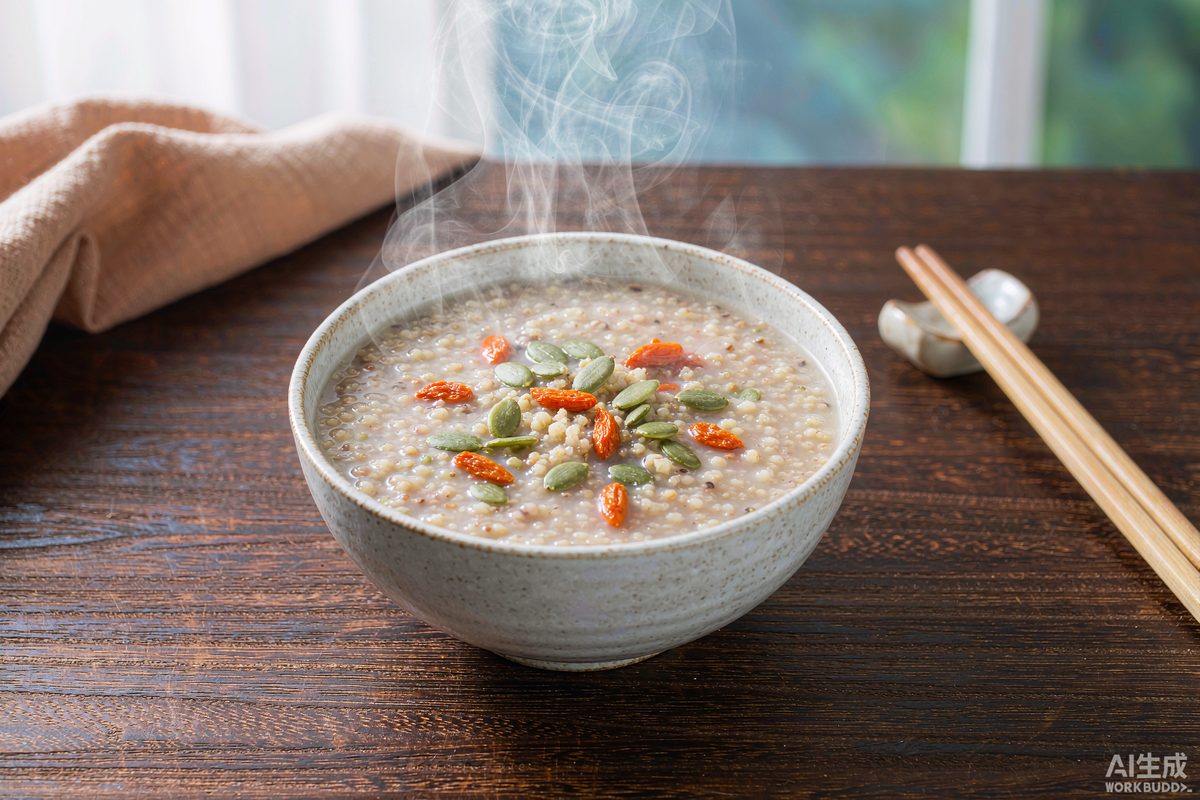
- Soft foods cheat the system. Congee, soups, and stewed dishes — staples of the Chinese dietary tradition — need less chewing and sit lighter on the stomach, which is one quiet reason they appear in every convalescent menu in the tradition.
- If your meals are mostly raw salads and dry protein, pace matters even more: those foods ask the most from the teeth, and rushing skips the step they need.
"The mouth does a third of the digestion. Rush it, and someone downstream has to do the missing third without the equipment."
The Numbers Behind the Habit
Now the data, with their seams showing.
A 2015 meta-analysis in the International Journal of Obesity pooled the observational studies on eating speed and body weight. The pattern held across cohorts: people who reported eating fast carried roughly double the odds of obesity compared with slow eaters.
The effect was consistent across Japanese, Chinese, and European populations, which matters because eating cultures differ and the association survived the differences. Observational data cannot prove the direction — fast eating might cause weight gain, or heavier bodies might eat faster for mechanical reasons — but the association itself is one of the more replicated findings in eating behavior.
The experimental work is smaller and more interesting. A 2014 randomized-style feeding study in the Journal of the Academy of Nutrition and Dietetics manipulated the one variable directly: adults — normal-weight, overweight, and obese — ate test meals with a prescribed number of chews per mouthful. Raising the chew count cut total meal size by roughly ten percent, without instructions to restrict anything.
A companion study in Physiology & Behavior the same year held the meal amount fixed and varied chewing in older men: more chews suppressed postprandial appetite ratings and flattened the glucose response. Same food, different pace, different metabolic aftermath.
Read honestly: the mechanism has decent support, the causal chain from chewing to weight change over years is plausible but not nailed down, and no trial has shown slow eating alone to produce major weight loss. The honest claim is smaller and still worth having — slower meals reliably end sooner, and the appetite signals line up better with what was actually eaten.
- Beware the internet's chewing-count prescriptions. The studies manipulated chew counts in supervised lab meals; no trial proves counting to thirty per bite transfers to daily life. Direction, not arithmetic, is the evidence-backed part.
- If you want one number to watch, use the clock, not the count: a main meal finishing in under ten minutes is fast by any study's definition, whatever the food.
"The effect size is modest. So is the cost, which is the entire trade."
The Spleen's Complaint
Set the trials aside and open the Suwen. Chapter 8 names the digestive pair 'the officials of the granary' — 仓廪之官 — the civil servants who receive the harvest, store it, and issue rations in proper measure. The image is deliberately administrative. Granaries do not accept deliveries by dumping the whole cart in at once; they process in graded loads, and a rush delivery is a logistics failure, not a feast.
Chapter 21 supplies the mechanism the tradition had in mind. ' Transformation is a transport chain with a capacity, and the Spleen sits at its busiest node. What arrives half-processed — swallowed whole, washed down, barely tasted — consumes the chain's capacity on work the mouth was supposed to have finished.
The residue the texts describe as Dampness maps, in modern experience, onto the familiar post-meal slump: the heavy tongue, the thick head, the distended belly that shows up after the twenty-minute meals were eaten in eight.
This is why the dietary tradition's favorite meals are slow by design. Congee that must be sipped. Small bowls of grain, refilled by decision rather than momentum. Chopsticks, which transfer food at a pace no fork can match. None of this was austerity. It was engineering — the granary officials were given work they could finish on schedule.
- The classical meal template — a warm soft breakfast, an unhurried lunch, a light early dinner — is a pacing prescription as much as a menu. Every meal in it is one a person can finish chewing properly.
- A traditional after-meal ritual: a warm palm on the upper belly, slow circles over the point Zhongwan for two minutes. The Zhen Jiu Da Cheng names that point as the Stomach's own settle-down switch. It costs nothing and it forces you to stay at the table a little longer, which is most of the benefit.
"The Stomach and Spleen are the officials of the granary; from them the five flavors emerge."
Twenty Minutes of Slack
Here is the physiological detail that makes pace matter more than willpower. The signals that end a meal run on a lag. Stretch receptors in the stomach wall fire early, but the hormonal side — CCK and GLP-1 released as nutrients hit the small intestine — takes something like fifteen to twenty minutes to build into a genuine 'stop' message that reaches the brain.
A meal that finishes inside the lag ends before the brakes arrive. The eater was never full at the last bite; fullness showed up late, at the table's edge, and got misread as a bad food reaction.
That lag is why the overfull slump and the nine-minute lunch travel together so reliably. It is not that the food was wrong. It is that the meal outran its own feedback system, and the surplus was decided by whoever served the plate, not by appetite.
Every slowing tactic that survives scrutiny works by exploiting this lag rather than fighting it. Put the fork down between bites and each mouthful takes ten more seconds — the hormones get their window. Eat with someone and conversation imposes its own throttle. Serve food in courses instead of piles, and the first course's signals arrive before the second is served.
None of these tricks touches what is on the plate. They only buy the feedback system the twenty minutes it needs — which, given how cheap the purchase is, is about the best-returns trade in eating behavior.
- The single most effective version, in our experience: eat one meal a day with the phone in another room. Attention is the variable most people skip, and distraction reliably speeds the swallow.
- Watch the last third of the plate. Meals usually start slow and end fast; deciding in advance to keep the opening pace through the finish is where the actual change lives.
"Fullness is not a fact at the table. It is a rumor from the gut that takes twenty minutes to arrive."
Slowing Down Without Counting to Thirty
The practical version of all this should fit into a week, not a retreat.
Start with the meal you eat alone most often, because nobody performs at that one. Give it a fixed start and one rule: utensil touches the table between mouthfuls. The first days feel theatrical, then the pace resets itself. Chewing per mouthful will rise on its own — the fork-down habit is doing the counting so you don't have to.
Change the vessel next, because the vessel sets the pace as much as the person does. Chopsticks slow food transfer without any effort at all. Small bowls refill by decision; the big plate disappears by momentum. The Chinese dietary tradition's small-bowl, many-dishes structure is a pacing system wearing the costume of a cuisine.
Even the soup-first sequence common across East Asian meals buys the satiety lag several minutes before the dense course arrives.
And keep one warning from the tradition, because it cuts against the modern version of this advice. Slowing the meal does not mean stretching it across an evening of grazing. The Suwen's 'food and drink with measure and rhythm' covers the whole arc — an unhurried meal, then the table closes.
A pace problem fixed by a grazing problem is no fix at all; the classical physician would read that as trading one overload for a slow drip of them.
- Pick the utensil before the rule. Chopsticks, a teaspoon for lunch, the smallest bowl in the cabinet — any of them moves the pace without asking the mind to stay vigilant for thirty minutes.
- If evenings are your fast meal, the fix is upstream: a more substantial midday meal slows dinner by shrinking the hunger driving it. Starving people do not eat slowly, whatever technique they know.
"Eat slowly, then stop completely. The two halves of the sentence carry equal weight."
Where the Evidence Ends
An honest accounting, because this is health writing and the topic attracts exaggerated claims.
The observational association between fast eating and obesity is real and replicated, but observational. Self-reported eating speed is coarse — nobody knows if 'fast' means the same thing across respondents — and reverse causation has not been excluded.
The chewing experiments are genuine randomized-style feeding trials, but they are single meals in lab settings with modest effects, mostly small samples, and durations far too short to measure any weight outcome. The trial that varied chewing for months in free-living adults and measured real weight change has not, to our knowledge, been done. Anyone selling 'lose weight by chewing more' is forecasting past the data.
There are also bodies this advice does not fit. People with swallowing disorders, some post-surgical situations, certain GI conditions — those belong with a clinician, not a stopwatch. And slow eating is not a treatment for anything. It is a modifier of how a diet behaves, the way timing is; it rides on top of what is eaten and rarely rescues a bad menu.
What survives all the hedging is still useful: fast eating is a marker — and plausibly a driver — of eating past need, the mechanism has a plausible hormonal basis with some direct support, and the cost of slowing down is a few minutes per meal. Evidence-bounded, unglamorous, cheap. That is the honest ceiling of this intervention, and it is higher than most.
- If you take one claim from the literature, take the meal-size one: controlled trials did show that more chews per mouthful ended meals sooner. The weight-loss extrapolation is a guess; the smaller-meal finding is data.
- Anyone with a swallowing difficulty, recent GI surgery, or a diagnosed digestive condition should treat pacing advice as something to raise with their clinician first.
"The claim is not that slow eating heals. The claim is that fast eating costs, and the bill arrives about twenty minutes late."
An Experiment You Can Eat
The Neijing's granary officials ask for a workload they can process. The physiologists ask for twenty minutes of lag the hormones can fill. Two literatures, one instruction, neither expensive.
So run the smallest version this week. One meal, phone away, utensils down between bites, and the clock running. Notice two things only: how long the meal took, and how the body felt an hour after — the slump or the absence of it. Twenty minutes against a habit most people have never once audited.
Neither tradition promises transformation from this. What they promise is subtler: that the body keeps accounts the mind doesn't watch, and the pace of a meal is one of the entries. The person who eats well and still feels heavy after every meal is usually missing a variable — and the variable is rarely on the plate. It is on the clock.
Leave the last question open: if nine minutes felt like nothing, what else is the meal telling you that you have never been slow enough to hear?
- Log the one-audit experiment twice — once before changing anything, once after. The hour-after comparison is the data that persuades; the meal itself rarely does.
- Keep the change where it fits. One slowed meal kept for a month beats three slowed meals kept for a week, in both traditions and in every adherence study.
"The body keeps accounts the mind does not watch. Pace is one of the entries."