The Strategy Is Real. The Friction Is the Problem.
Volume eating — swapping in foods with fewer calories per gram so the stomach gets its expected load for less energy — has a respectable research file behind it. A one-year Penn State trial found that women counseled to eat more water-rich foods alongside less fat lost more weight than a fat-cutting-only group, ate a greater weight of food doing it, and reported less hunger.
First-course salads and pre-meal soups measurably shrink what people eat afterward, provided the dense part of the meal shrinks in response.
So why doesn't everyone eat this way? Because the strategy has a weakness built into its anatomy: water-rich food takes work. Vegetables need washing, drying, peeling, cutting. Soup needs cooking and blending. Every step between the intention and the plate is a chance for the dense default — the takeout menu, the freezer box, the bread basket — to win on convenience alone.
That is the only premise of this article. These are not miracle tools and none of them burns anything. Each one attacks a specific friction point in the sequence between 'I should eat more low-density food' and a bowl of it being on the table. We own or have long cooked with all three, and the review is organized around a harder question than product specs: which tool still gets used six months later, and why.
Spoiler — the answer correlates with whether the tool was bolted onto an existing meal habit or asked to carry a brand-new one.
A word on how to read the picks, because none of them carries a brand endorsement and none should. Each product entry links to a search rather than a specific listing — models rotate seasonally, prices swing, and the specification that matters (motor wattage, bowl capacity, suction design) survives the churn better than any model number does.
The price ranges reflect what we observed across major retailers at writing time, and the lower end is usually fine; the premium tier buys durability and quieter motors, not better weight-loss arithmetic. None of these items requires the premium tier to do its job. Every tool below earns its place by removing a specific step, in a specific meal, that would otherwise send the eater back to the dense default.
Where a tool cannot make that case, we say so in the entry itself.
- Before buying anything, name the specific weeknight meal each tool would serve. No existing meal means no standing job means drawer.
- The strategy only pays when water-rich food displaces denser food. Tools can't do the subtraction for you.
The Spiralizer: Pasta Night, Rebuilt From the Inside
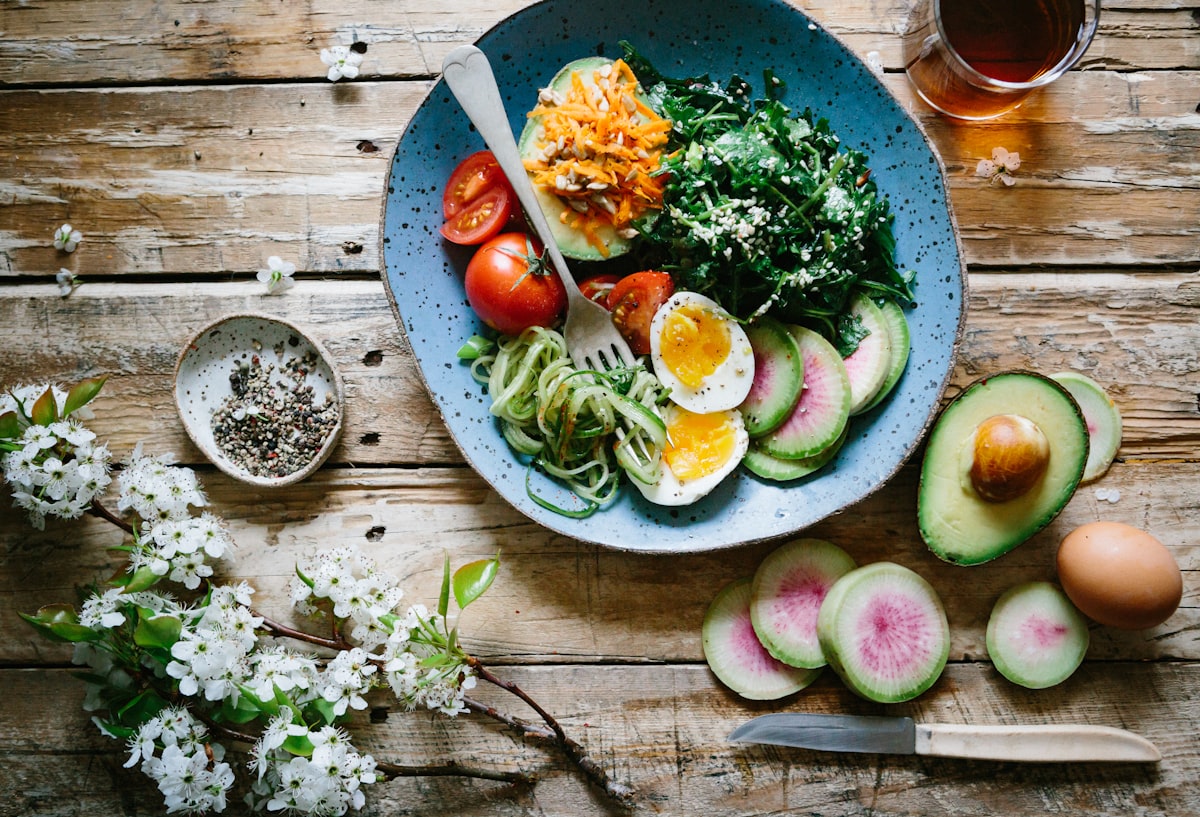
Of the three tools, the spiralizer has the most specific job and the narrowest. It converts firm vegetables — zucchini, sweet potato, butternut, beet — into continuous ribbons that eat like noodles.
If your household has a pasta-with-sauce night, and most do, that is the opening: ribbons can replace half the pasta in the pot, which drops the dish's calories per gram meaningfully while the bowl, the fork, and the sauce stay identical.
The countertop crank model beats the handheld version decisively. The handheld 'spiralizer pens' work acceptably on zucchini and exhaustingly on anything firmer, and tool abandonment tracks wrist effort with remarkable fidelity. A crank with a suction base turns out two servings in minutes and handles dense roots the pens can't.
Check the suction foot before anything else — a crank that walks across the counter is a crank you will stop cranking.
What nobody tells you is the water problem. Vegetable noodles are roughly 90-plus percent water, and salt draws that water out; sauced immediately, a zoodle dish runs thin. Light-salt-and-drain for ten minutes, or roast the ribbons briefly for firmer texture. None of this is hard, but it's the difference between a dish you make twice and a dish you make weekly.
Who shouldn't buy one: households that don't cook saucy noodle dishes, people who dislike Zucchini Attempts, anyone who already owns a julienne peeler and uses it. The spiralizer is a one-idea tool. It's a good idea, applied with force, to exactly one dinner.
Care notes, since they decide whether the tool stays. The blades are the whole product; hand-wash them, keep them out of the dishwasher's rack chaos, and they hold an edge for years. Dull blades produce soggy shreds and quiet resentment. The suction base wants a clean, dry, smooth counter — a crumb or a wet spot defeats it, which looks like a defect and is actually housekeeping.
Expect two usable ribbons per zucchini with the core and skin left over; the tool is less wasteful than it looks if the cores go into stock bags in the freezer. And a request from experience: skip the five-blade sets. The extra blades cut shapes almost nobody asks for twice, they add ten dollars, and they migrate to the drawer first.
A three-blade crank, washed immediately after use, is the configuration with a documented survival record in real kitchens.
- Half-pasta swap is the durable play — a full swap tends to leave diners hungry by 9 p.m. and resenting the zucchini.
- Suction base quality predicts long-term use better than blade count. Three blades are plenty; a walking tool is zero.
The Salad Spinner: A Tool Whose Best Feature Is the Fridge
A salad spinner does one thing — spins water off washed greens — and the thing you'd assume it does (dry lettuce for tonight) is the least valuable half of its service. The valuable half is Tuesday-through-Friday. Wet greens rot in days; spun-dry greens keep for a week or more in a bag with a paper towel. , the entire decision.
Why does a first-course salad matter enough to buy equipment for it? Because when researchers served a large low-energy-density salad before a pasta main, total lunch intake dropped by about 12 percent — the volume filled stretch receptors and the main course took the hint. The same salad made dense with cheese and full-fat dressing did the opposite, raising intake by up to 17 percent.
The tool is only as strategic as the dressing bottle next to it.
Buy for capacity over cleverness: a large bowl so greens aren't crammed (crowded greens half-dry), a lid mechanism you can operate one-handed, and a basket that pulls out and serves as the colander. Pull-cord and pump mechanisms both work; skip the crank-handle budget models, which spin lazily. The honest downside is cabinet real estate — spinners are the widest one-trick items in the kitchen. Measure your shelf.
And if you already buy pre-washed boxed greens weekly, the spinner's economics change: whole heads with a spinner cost a fraction of the boxes, and the greens are better.
Technique matters more than the box suggests. Fill the bowl with cold water, swish the greens, lift the basket out — dirt stays behind in the water, which is the colander-inside-a-bowl design quietly doing its second job — drain, refill, and repeat once before spinning. Spin in two short bursts rather than one long pull; the greens bruise less.
For herbs, the same routine roughly doubles their fridge life, and for anything from the brassica family, spin dry after washing and the prep for Wednesday's stir-fry is already done. The one genuine failure mode is overpacking: a full load spins at half speed and dries at quarter quality.
Two rounds of a half-full basket beat one round of a stuffed one, every time, and the difference shows up in the bag a week later.
- Spin, then store with a folded paper towel in the bag or bowl — the towel catches residue moisture and stretches the week further.
- The spinner serves fruit too: washed berries dry and keep markedly better after a gentle spin.
The Immersion Blender: Where the Evidence Is Strongest
If the three tools were ranked by the strength of the research behind the meal they enable, the immersion blender wins without a contest.
Soup preload is among the most replicated findings in the satiety literature: in a Penn State study, adults who ate a low-energy-density vegetable soup before lunch reduced total meal energy intake by about 20 percent compared with eating no soup, and the result held across all four textures tested — broth with vegetables, chunky, chunky-pureed, fully pureed.
A related classic showed the mechanism precisely: casserole with water blended in reduced intake; identical casserole with a glass of water alongside did not. Water must be inside the food's structure to count.
Making blended vegetable soup the friction-light way is exactly what a stick blender exists for. Vegetables simmer in broth for twenty minutes, the wand goes into the pot, sixty seconds later there is a silky soup, and the cleanup is rinsing the shaft under the tap. No countertop blender's pitcher to wash, no hot-liquid transfers, no cooling step.
In soup-on-a-weeknight terms, the immersion blender is the difference between the plan surviving Wednesday and dying on it.
Buy on motor (600 watts or more for root vegetables), variable speed, and a detachable shaft. A whisk attachment is occasionally useful and never decisive. The honest limits: a preload is a modest bowl before an ordinary meal, not a meal substitute, and certainly not a license to add a 600-calorie blended smoothie on top of dinner.
The arithmetic only works when the soup is nearly free and the main course does the shrinking.
For the build itself, a working template: one onion, two carrots, two celery ribs, garlic, then whatever dense vegetable is cheap that week — cauliflower, butternut, a fist of red lentils — covered with broth, simmered until a knife slides through, blended in-pot. Season after blending; pureed soup tastes flat before it is smooth, and home cooks who salt early often overshoot.
A parmesan rind in the pot does more for body than cream does, at a fraction of the density cost. Leftovers hold four days and freeze flat in bags. What the wand cannot do is make a thin broth taste of anything; that is the cook's department, and it is why the first pot should be small.
Once the template is reflexive, the preload step costs about five active minutes, which is the number the whole strategy rises or falls on.
- Sunday pot: onion, carrot, celery, one dense vegetable, broth, simmer, blend in-pot, portion for three weeknight first courses.
- Keep the preload under roughly 150 calories. The studies that worked used low-density soups, not meal-replacement bombs.
What the Evidence Actually Supports — and What It Doesn't
A quick ledger, so nobody buys three gadgets on the strength of one overreached summary.
Well supported: reducing dietary energy density lowers energy intake in controlled feeding studies, sometimes dramatically; soup and low-density first courses reliably reduce intake at the meal that follows; the year-long trial showed real weight advantage when water-rich food addition was paired with fat reduction, alongside less hunger.
A 2009 review by the Penn State group synthesizes decades of this — across lab meals and longer trials, intake tracks density with impressive consistency.
Not supported, or at least not yet: adding fruit and vegetables on their own, with no instruction to displace anything, does not produce weight loss. The 2014 meta-analysis pooled randomized trials of increased produce intake and found no discernible weight effect. The tools in this review can only help the displacement half happen faster; they cannot perform the subtraction.
Also worth naming: most satiety studies run over single meals or a few weeks, with food provided and intake weighed by technicians. ' Anyone managing obesity clinically should treat these as supports for a dietary pattern worked out with professionals, not as an intervention.
And a standing caveat we keep on every review: body weight is one health signal among many, and eating more plants has documented benefits — fiber, micronutrients, cardiovascular markers — that arrive regardless of what the scale does.
"The five grains nourish, the five fruits assist, the five livestock benefit, the five vegetables fill."
What the Old Kitchen Assumed
The Inner Canon's dietary chapter distributes jobs across the plate, and the clause that matters here is the last one: 五菜为充, the five vegetables fill. Fill is a structural word. Vegetables were assigned the task of completing the meal's bulk — occupying the stomach's capacity — while grains did the nourishing and meat did the strengthening.
Read against modern energy-density research, the old text split the plate exactly the way the split turns out to matter: dense food for the job it does, watery food for the space it takes.
The Lingshu goes further and describes digestion as a rhythm: the stomach full while the bowel empties, the bowel full while the stomach empties, 'emptying and filling in turn, so qi moves up and down.' Capacity and turnover, in that picture, are the machinery of appetite — which is why a plate engineered mostly of nearly-free volume works with the machinery rather than negotiating with it.
Even the Han-era pharmacy nods to it. The Shennong Bencao Jing lists white gourd seed among its superior items 'benefiting qi and preventing hunger' — a watery vegetable praised, essentially, for delivering fullness at low energetic cost. Winter melon soup, that mild giant simmered in Chinese kitchens for two thousand years, is a preload study in a bowl. None of which means the ancients ran trials.
It means that when feeding people well was a survival calculation, kitchens independently arrived at the same engineering: the cheapest way to satisfy a stomach is to give it the water and fiber it expects, and let the dense stuff do a dense thing's smaller job.
How to Choose, and How Not to Buy Three Drawers
If only one tool is in the budget, the immersion blender earns the slot — it enables the meal form with the strongest evidence, at the lowest ongoing friction, and it doubles for sauces, dressings lightened with yogurt, and baby food. Second place goes to the salad spinner, whose value compounds daily in the fridge rather than at any single meal.
The spiralizer is third and situational: essential for pasta-forward households, decorative for everyone else.
More useful than any ranking, though, is the adoption rule this whole review keeps circling. A tool survives when it is attached to a meal that already happens. Pasta Thursday makes a spiralizer permanent. A weekly soup habit makes a stick blender permanent. A household that eats salads when greens are convenient makes a spinner permanent.
The reverse — buying equipment in hopes of manufacturing the meal habit around it — is how kitchen drawers fill up with well-made, barely-used machinery.
So run the honest audit before checkout: name the weeknight, the existing dish, and the swap the tool would serve. If the answer is a shrug, spend the money on three weeks of good produce instead and see which low-density meal your kitchen naturally gravitates toward. Buy the tool for that one. The plate comes first; the gadget is just the person who keeps showing up for it.
Maintenance and exit criteria, stated plainly. All three tools are mechanically simple, and their failure modes are predictable: blades dull, cords fray at the handle, lid gaskets stiffen. None is repairable in any serious sense, so the buying rule is mid-range quality with a return window rather than either extreme. And the exit criteria deserve the same honesty as the entry pitch.
If the soup pot has not come out in a month, if the spinner's greens have gone slimy twice, the tools are not failing — the meal plan is, and no further equipment will fix it. Return them, keep the produce habit, and reconsider when a specific recurring meal reopens the case. The kitchen-drawer graveyard is full of tools bought on hopeful arithmetic. The counter is for tools attached to dinners that already exist.
- Budget order: immersion blender first, spinner second, spiralizer only if pasta night is real.
- Return-window test: if a tool hasn't earned its counter spot in three weeks of real weeknights, back it goes.