Why Stretching the Side of Your Body Feels Nothing Like Stretching Your Hamstring
Here's the question that changed how I think about stretching. Why does reaching overhead and leaning to one side — armpit to hip — feel like your entire body just took a breath? And why does a basic hamstring stretch, by contrast, stay local? It's a question about chains.
The side-body line runs from your ribs to your hip, and when you pull it open, you're not just lengthening one muscle — you're releasing a route that holds your posture's entire history.
The 12 primary meridians of Chinese medicine are these lines: continuous channels of fascia and connective tissue, each with a specific path, a specific organ connection, and a specific stretch that opens it. The Lung line runs from the chest down the inside of the arm to the thumb.
The Bladder line — the body's longest — starts at the inner eye, goes up over the skull, and plunges down the entire back and both legs to the little toe. The Liver line climbs the inner thigh. When you stretch each one with awareness, three things happen at once: fascia lengthens, acupoints along the route get stimulated, and the organ the channel governs gets a nudge.
That's the gap between stretching and meridian stretching. One works on muscle. The other works on channels — and the difference shows up fast. A 2017 study in the Journal of Bodywork and Movement Therapies compared the fascial anatomy of the lower limb to classical meridian pathways and turned up striking overlap. The maps match.
They've been matching for two thousand years — we just gave the territories different names.
- The 12 meridians pair into six Yin-Yang couples — Lung/Large Intestine, Heart/Small Intestine, Pericardium/Triple Burner, Spleen/Stomach, Kidney/Bladder, Liver/Gallbladder. You'll feel the pairing logic in the routine.
- Meridian stretching is Dao Yin — the ancient Chinese practice of guiding (Dao) and stretching (Yin) the body to move Qi. Sun Simiao prescribed it in the Tang Dynasty for everything from back pain to longevity.
"The twelve regular meridians are the pathways through which Qi and Blood travel, connecting the interior organs with the exterior limbs, linking the upper and lower body into one whole."
Breath, Time, Order, and What Not to Do
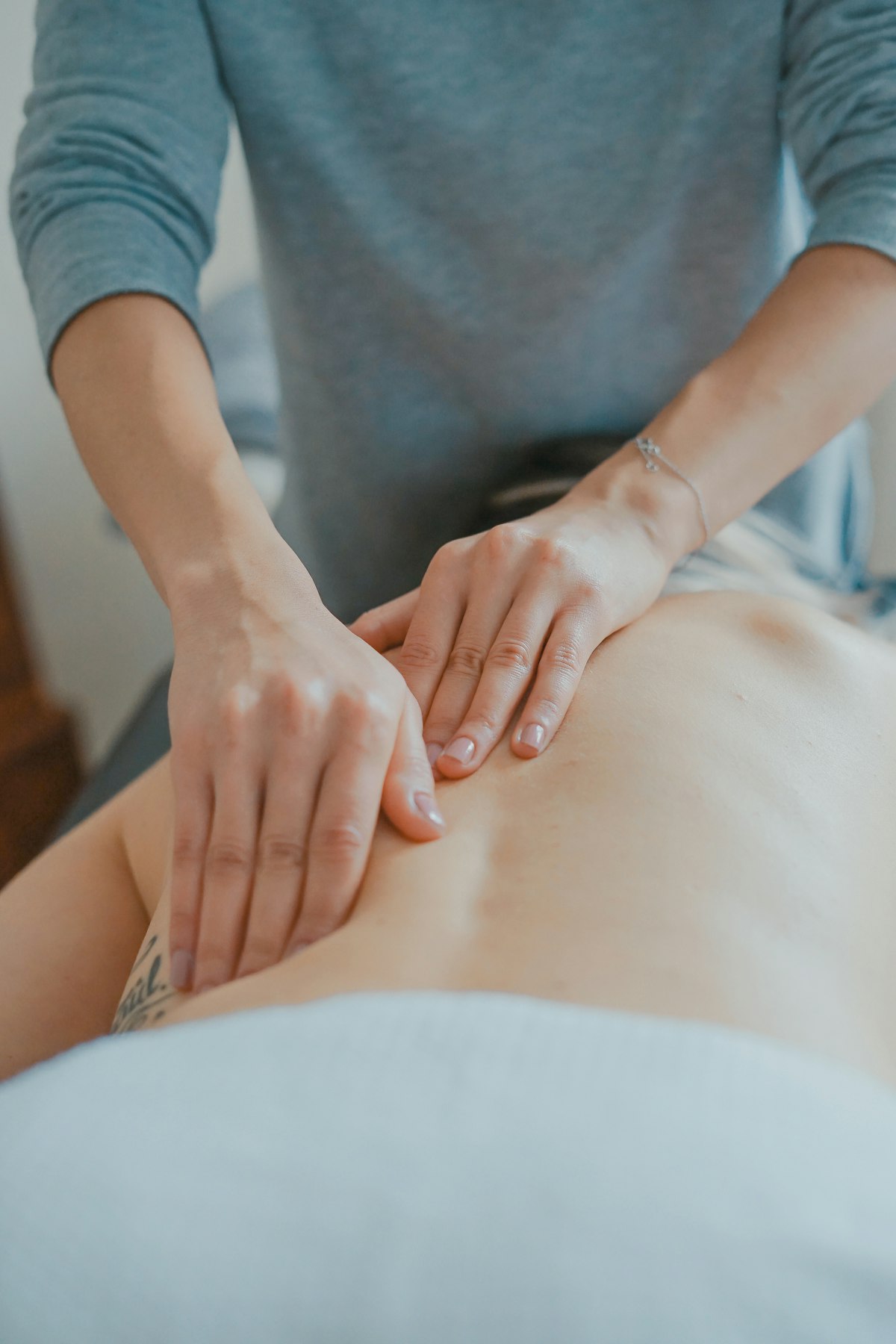
The routine is dead simple: twelve stretches, one minute each. But the difference between twelve wasted minutes and twelve minutes that actually open your channels? That's all in the details.
First: breathing. Every stretch follows one pattern — inhale as you settle into position, exhale as you deepen, then slow, even breaths through the hold. Don't hold your breath. A held breath is a blocked channel. Your exhale is your depth gauge: let the stretch creep open, a centimeter at a time, on each release.
Second: duration. One minute per meridian is the prescription. If you're tight or new to this, start at thirty seconds per side and build. The first twenty seconds of any stretch are the 'fight' phase — your nervous system bracing, resisting. The last forty seconds are where the release actually lives. Give each stretch its full minute.
Third: order. Upper body first, then lower. The arm and shoulder meridians are shorter and they warm up your spine; the leg meridians are long, demand more heat, and anchor you at the finish. Don't skip around. The sequence stacks — each stretch preps the tissue for the next.
Fourth: don't be a hero. No bouncing. No forcing past a 6 or 7 out of 10. Sharp pain, joint pinching, nerve tingling — that's not 'opening,' that's damage. If you have herniated discs, severe osteoporosis, or recent joint surgery, work with a physical therapist before going deep on the forward folds. And warm up. Always.
Five minutes of walking or the Five Animal Frolics warm-up set will buy you more stretch quality than any amount of grit.
- Stretch in loose clothing with bare feet if possible — the Kidney meridian starts at Yongquan (Bubbling Spring) on the sole of the foot, and contact with the floor stimulates it.
- The routine is meant to feel like a moving meditation: slow transitions, soft gaze, steady breath. If you finish breathless, you're doing it wrong.
"When the body is guided and stretched, the Qi flows freely. When the Qi flows freely, the hundred ailments do not arise."
The Upper Six: Lung, Large Intestine, Heart, Small Intestine, Pericardium, Triple Burner
The first six meridians run through the arms, shoulders, and chest — which is exactly where modern bodies lock up first. Desk work. Phone scrolling. The low-grade stress that rides between the shoulder blades. Here's each one.
Stretch One — Lung (LU, Yin, chest to thumb). Stand tall, reach both arms behind you, interlace your fingers, and lift your hands away from your body. Pull your shoulder blades together without forcing them. The stretch should travel across the front of the chest and down the inner arm to the thumb. Hold for a full minute.
The Lung governs Qi and defensive Wei Qi — so opening this line deepens breathing and supports immunity. If you sit at a desk all day, this is the stretch that saves your shoulders.
Stretch Two — Large Intestine (LI, Yang, index finger to the nose). Extend your right arm straight out in front of you, palm down. Reach your left hand behind your back and grab your right fingers — pull them gently toward your body, flexing the wrist. You should feel it along the top of the forearm and the outer shoulder. Thirty seconds per side.
The Large Intestine handles elimination; this stretch unloads the arm tension that builds up from typing, and it stimulates the channel that connects to the colon.
Stretch Three — Heart (HT, Yin, armpit to little finger). Clasp your hands behind your back and lift — chest open, ribs lifted. The stretch runs from the armpit down the inner arm to the little finger. The Heart houses the Shen, your spirit, and governs blood circulation. Opening this line quiets the mind. It releases the 'heavy heart' feeling anxiety leaves in the chest.
If your hands don't reach, hold a towel between them — the line of pull matters more than the clasp.
Stretch Four — Small Intestine (SI, Yang, little finger to the shoulder blade). Bring your right arm across your chest. Hook your left elbow with your left hand and pull the arm toward your body, turning your head slightly to look over the right shoulder. The stretch should hit the back of the upper arm and into the shoulder blade. Thirty seconds per side.
The Small Intestine 'separates the pure from the turbid' — it governs discrimination and mental clarity. This one's subtle, and most people skip it. Don't. It unlocks the deep rotator-cuff tension that limits your shoulder overhead range.
Stretch Five — Pericardium (PC, Yin, chest to middle finger). Extend your right arm straight out, palm up. With your left hand, pull the fingers of your right hand down toward the floor, flexing the wrist. The stretch runs along the center of the inner forearm. Thirty seconds per side. The Pericardium protects the Heart and governs emotional response to connection and intimacy.
Desk workers and phone-scrollers hold this line flexed all day — this undoes 'phone arm' and settles the nervous system.
Stretch Six — Triple Burner (TE, Yang, ring finger to the temple). Tilt your head gently to the right, ear toward shoulder. Rest your right hand lightly on your left temple — no pulling, just weight. Feel the stretch along the left side of the neck and down the left arm. Thirty seconds per side. The Triple Burner governs fluid metabolism and body temperature.
This releases the neck tension that blocks flow between the upper, middle, and lower burners, and it helps with headaches, ear ringing, and that stubborn 'stuck' feeling in the shoulders.
- For the Lung stretch, imagine you're squeezing a ball between your shoulder blades — the stretch should feel like it's traveling down the inner arm to your thumb, not just across the chest.
- The Small Intestine stretch is the one most people skip because it feels subtle. It's also the one that unlocks shoulder overhead mobility — give it its full minute.
- If your hands don't reach each other behind your back for the Heart stretch, hold a towel or strap between them — the line of pull matters more than the clasp.
"The Lungs are the canopy of the hundred vessels. They govern Qi, and the skin and body hair are their external manifestation. When Lung Qi is full, the defensive Qi is strong."
The Lower Six: Stomach, Spleen, Bladder, Kidney, Gallbladder, Liver

The lower-body meridians run through the legs, hips, and trunk — the territory of sitting, standing, and aging. These lines tighten from too many hours in a chair and too few on the floor.
Stretch Seven — Stomach (ST, Yang, face to second toe). Kneel on something padded, knees hip-width apart. Tuck your toes under and lean back gently, hands on the floor behind you for support. You should feel it along the entire front of the thighs. If kneeling hurts your knees, do a standing quad stretch instead.
The Stomach is the 'sea of grain and water' — opening the front of the body stimulates digestion and releases the tight quads that pull your pelvis into the desk-worker slump.
Stretch Eight — Spleen (SP, Yin, big toe to the chest). From kneeling, shift your weight to one hip. Plant your hand on the floor beside you and rotate your upper body, letting the stretch travel up the inner thigh. Switch at thirty seconds. The Spleen transforms food into Qi and blood. This stretch supports energy production and tackles the 'heavy legs' feeling that comes with sluggish digestion.
Stretch Nine — Bladder (BL, Yang, inner eye to little toe). Stand, hinge at the hips, fold forward. Knees soft. Let your arms hang. If your hamstrings are tight, hold your elbows or rest your hands on a chair seat. Hold for sixty seconds, breathing into the lower back. Depth doesn't matter here — sustained breath is the medicine.
A fold to chair height with a straight back opens the line far better than a rounded collapse to your toes. The Bladder meridian runs parallel to the spine, all the way up to the head. This is the master stretch for your back.
Stretch Ten — Kidney (KI, Yin, sole of the foot to the chest). From your forward fold, bend your knees deeply into a low squat. Plant your hands on the floor, then lift your hips back up toward the ceiling — fold, squat, lift, repeat, slowly, for a full minute. You should feel it through the arches of your feet and up the inner calf and thigh. The Kidney stores Jing — your constitutional reserves.
This cycle stimulates Yongquan (KD-1), the Bubbling Spring on the sole. It's as close to a longevity exercise as TCM gets. If your knees complain, skip the deep squat and just stand on one foot, rolling the ankle to wake up the arch line.
Stretch Eleven — Gallbladder (GB, Yang, outer eye to fourth toe). Reach your right arm overhead and lean your whole body to the left, both feet planted. Imagine you're reaching over a wall. You should feel one continuous line from the right armpit down the right flank, hip, and outer thigh — all the way to the ankle. Switch at thirty seconds. The Gallbladder governs decisions and the free flow of Qi. '
Stretch Twelve — Liver (LR, Yin, big toe to the chest). Sit on the floor, soles together, knees out wide. Gently press your knees toward the floor with your elbows, back tall. You should feel it along the inner thighs. If you're tight, sit on a folded blanket to tilt your pelvis forward. The Liver stores blood and governs the smooth flow of Qi — stress, anger, flexibility, all of it.
This stretch is the antidote to the tight adductors of the sitting life.
- For the Bladder fold, the depth is irrelevant — the sustained breath is the medicine. A fold to chair height with a straight back stretches the line far better than a rounded fold to your toes.
- The Kidney stretch's fold-squat-lift rhythm is the most advanced movement in the routine. If your knees object, skip the deep squat and simply stand on one foot, rolling the ankle, to stimulate the arch line.
- The Gallbladder side-bend should feel like a single continuous line from fingertip to outer ankle — if you only feel it in the waist, reach further through the arm and root down through the opposite foot.
"The Liver is the general of the army. It governs strategy, stores the Blood, and rules the sinews. When Liver Qi flows freely, the body is supple and the mind is decisive."
The Pairing Logic Your Stretches Already Follow
If you've been paying attention, you noticed a structure: every Yin stretch is followed by its Yang partner. Lung then Large Intestine. Heart then Small Intestine. Pericardium then Triple Burner. The same pattern continues through the lower body.
This isn't decoration. Each Yin-Yang pair shares a root — they arise from the same organ network, and their channels travel opposing but complementary lines. The Yin member runs the inner surface of the limb, the flexor side, the side of storage. The Yang member runs the outer surface, the extensor side, the side of activity. Lung: inner arm. Large Intestine: outer arm. Kidney: inner leg. Bladder: outer leg.
Stretch both sides of the same functional system and the joint they share gets freed on both ends.
There's a modern equivalent to this logic. Every joint in your body is a tension balance between flexors and extensors — the inner and outer lines. Stretch only the front of the hip and the back line stays tight, and the joint stays off-kilter. Stretch the pair and you get the equilibrium the joint actually needs.
The routine alternates by design: a Yang stretch re-engages the muscles the Yin stretch just lengthened, keeping your nervous system awake and your joints stable. You never stretch the same tissue family twice in a row, and you never leave a partner line untouched.
Once this pairing logic sinks in, you can build your own short sequences: a desk-break pair (Lung + Large Intestine), a pre-sleep pair (Heart + Small Intestine), a back-pain pair (Bladder + Kidney).
- Notice that the Yin stretch of each pair always comes first in this routine, followed by its Yang partner. Yin first, Yang second — storage before activity — mirrors the order of the organ clock.
- The six pairs map to the six 'levels' of the classical Six Stage theory, but you don't need the theory to benefit: just remember that inner-line stretches and outer-line stretches of the same limb belong together.
"Yin and Yang are the root of the body. When Yin is calm and Yang is secret, the spirit is at rest. When they are in harmony, the hundred diseases cannot arise."
Morning, Evening, or Between Sets: When to Do This

Timing matters. The meridian stretch routine has a clock of its own, and the clock changes what you get out of each session.
Morning (5-9 AM, the Large Intestine and Stomach hours) is when Yang is naturally rising — Qi is moving outward. A full twelve-minute run first thing is the ideal wake-up. It fires the digestive meridians as the body preps for food, and it opens the Lung channel to fresh air. Drink a glass of warm water, then do the routine before breakfast. You'll feel the difference by mid-morning.
Evening (5-9 PM, Kidney and Pericardium hours) is when the body's energy turns back inward. This is the time for the Yin-nourishing stretches — Kidney, Liver, Heart, and Pericardium — which settle the nervous system before bed. A shortened version (lower-body six plus Heart and Pericardium) makes a solid pre-sleep ritual, especially if your mind likes to race the moment the lights go off.
Before a workout? Different answer. Static stretching before explosive or heavy work can temporarily drop power output — the research has been clear on this since the 2015 systematic review in the Journal of Strength and Conditioning Research. Before training, do the routine at 50% intensity, thirty seconds per meridian, and follow it with dynamic warm-up movements. The goal pre-workout is activation, not depth.
After a workout, though? Stretch for real. The muscles are warm, the tissue's pliable, and the meridian lines are flushed with freshly circulated blood. This is when the full twelve minutes pays its biggest dividend: metabolic waste clears, joint position resets, and your nervous system shifts from fight mode to rest mode — which is exactly when adaptation happens.
One rule with no exceptions: never stretch a cold body. Five minutes of walking first. Always. Cold-tissue stretching is how you pull a hamstring at forty-three and blame the stretch.
- Desk workers: do one pair (two minutes) every two hours — Lung/Large Intestine mid-morning, Bladder/Kidney mid-afternoon. This beats one heroic evening session for reversing postural damage.
- Travel or illness days: do the routine at 50% intensity or skip it entirely. Sun Simiao's advice for the sick is rest, not exercise — a depleted body cannot spare Qi for stretching.
"In the morning, move the Yang. In the evening, nourish the Yin. To stretch against the clock is to row against the current."
The Full Sequence, Minute by Minute
Here it is. Set a one-minute interval timer and move through without pausing — the transitions are practice, not gaps.
Minute 1 — Lung: arms behind the back, fingers interlaced, lift and open the chest. Breathe into the front of the shoulders.
Minute 2 — Large Intestine: right arm extended, left hand pulling the fingers toward you. Switch at thirty.
Minute 3 — Heart: hands clasped behind the back, lift, let the stretch travel to your little fingers.
Minute 4 — Small Intestine: right arm across the chest, hook the elbow, look over the shoulder. Switch at thirty.
Minute 5 — Pericardium: right arm forward, palm up, flex the wrist down. Switch at thirty.
Minute 6 — Triple Burner: right ear to right shoulder, light hand on the temple, no pulling. Switch at thirty.
Minute 7 — Stomach: kneel, tuck toes, lean back. Or standing quad stretch if kneeling hurts.
Minute 8 — Spleen: shift to one hip from kneeling, hand to floor, rotate. Switch at thirty.
Minute 9 — Bladder: hinge at the hips, fold forward, soft knees, breathe into the back for a full sixty seconds.
Minute 10 — Kidney: fold, squat, plant hands, lift hips. Repeat the cycle slowly. Feel it through the soles and inner legs.
Minute 11 — Gallbladder: right arm overhead, lean the whole body left. Switch at thirty. One line from armpit to ankle.
Minute 12 — Liver: sit, soles together, knees wide, press gently with elbows. Breathe into the inner thighs.
When the timer stops, stand up. Place your hands on your lower abdomen, two inches below the navel — the lower Dantian. Five slow breaths. This closing step isn't optional. It gathers the Qi you've opened and stores it. The whole thing: twelve minutes, every channel, nothing needed but a floor. Do it daily for a month.
You'll notice the difference not as flexibility — you'll get that too — but as a sense of the body being threaded through with space. That's what an open meridian feels like.
- Print this list and keep it next to your mat for the first two weeks. By week three you won't need it — the sequence becomes muscle memory.
- If twelve minutes feels like too much on a busy day, do the upper-body six (minutes 1-6) in the morning and the lower-body six (minutes 7-12) in the evening. Same total, split by the clock.
- Track one measurable marker — toe-touch depth, shoulder reach, or how easily you can put on socks — and check it weekly. Progress on one meridian line is progress on all twelve.
"The body is like a bow: it must be drawn and released, drawn and released. The one who knows how to loosen the string keeps the bow for a lifetime."