The Day Doesn't End at Bedtime — It Needs to End Before
TCM divides the daily cycle into Yang and Yin. Yang is the rising half: activity, warmth, outward movement, brightness. Yin is the descending half: rest, coolness, inward turning, dark. Morning belongs to Yang. Night belongs to Yin. The classical rule, straight out of the Yellow Emperor's Inner Canon, says the wise person rises with the Yang and rests when it withdraws.
But there's a detail in the Chinese view that modern life bulldozes right over: the transition matters as much as the destination. You can't stop a train at full speed and expect a soft landing. Your body can't jump from sympathetic overdrive into sleep either. It needs a ramp. The Yang has to descend gradually, or it 'floats upward' into the head.
That's how you end up lying in bed with an exhausted body and a busy mind — the pattern TCM calls 'Yang floating,' one of the most common insomnia patterns in modern practice.
Western physiology describes the same event in different language. The autonomic nervous system runs two branches: sympathetic (fight-or-flight) and parasympathetic (rest-and-digest). Sleep onset requires parasympathetic dominance. Heart slows. Blood pressure eases. Cortisol drops. Melatonin climbs. But this shift doesn't happen on a switch.
It takes 20 to 40 minutes of quiet for the parasympathetic branch to establish control. An evening wind-down is just a deliberate way to build that ramp.
The TCM framework adds one more layer: each movement in the sequence I teach isn't chosen just because it relaxes muscles. It's chosen to work specific meridians that carry the day's residue — the Liver (stores frustration), the Kidney (anchors the body's energy), and the Heart (houses the Shen, or spirit, which has to settle for sleep to arrive).
- Start your wind-down 60–90 minutes before you plan to sleep. The nervous system doesn't downshift on command — it needs that runway.
- Treat the wind-down like brushing your teeth: non-negotiable, not optional. A transition ritual, not 'stretching if I have time.'
"When Yang is abundant, one is active; when Yin is abundant, one rests. Therefore the sage... follows the order of Yin and Yang rather than defying it."
Movement 1: Liver Meridian Release (3 Minutes)

The Liver meridian, in TCM, is where the day's emotional debris gets stored. Frustration you swallowed during a meeting. The tight jaw from deadlines and difficult conversations. Its pathway runs along the inner thigh, through the groin, and across the ribcage. That's why a stressful day shows up physically as tight hips and a rigid ribcage. The Liver's emotion is anger.
Its physical signature is tension held in the inner thighs and flanks.
Movement 1 opens both those zones. Start standing, feet wide — about hip distance and a half. Inhale, both arms overhead. Exhale, fold into a slow side bend to the right — right hand sliding down the outer leg, left arm arcing overhead. Hold for three slow breaths. Feel the stretch along the left flank, through the lat, into the ribcage. Inhale back to center. Repeat to the left. Three side bends per side.
Now move to the floor. Sit with the soles of your feet together, knees falling outward — classical butterfly position. This opens the inner thighs, where the Liver meridian runs its most exposed path. Don't bounce the knees. Hold quietly for 60 seconds. Let the hips sink under their own weight. Breathe into the groin.
If you want more, walk your hands forward for a seated forward fold, spine long, and rest there 30 seconds.
Finish with a figure-four stretch: lie on your back, cross one ankle over the opposite knee, pull the bottom leg toward your chest. This hits the glute and lateral hip — the areas that hold the day's 'clenching.' The rule across the entire sequence: no forcing, no bouncing, no pain. The Liver responds to patience. Not aggression. Which is, itself, the lesson.
- Breathe into the stretch on the exhale — that's when muscle tissue relaxes and the parasympathetic branch engages.
- If your mind replays the day during side bends, let it. The movement is doing work in the body whether the mind is quiet or not.
- The butterfly fold is a two-minute fix for 'desk hip' — tight adductors from hours of sitting that pull on the pelvis and lower back.
"The Liver stores the ethereal soul and governs the flow of Qi... When the Liver is free-flowing, the body is at ease; when it is constrained, tension arises."
Movement 2: Kidney Anchoring (3 Minutes)
If the Liver release lets go of the day's tension, the Kidney work brings you back down to the ground. In TCM, the Kidney is the deepest organ system — it stores Jing, the body's essence, and anchors the body's Qi the way roots anchor a tree. Its first point, Yongquan (KD-1, 'Bubbling Spring'), sits in the sole of the foot, about a third of the way from the toes toward the heel.
TCM theory says that when the day has pulled your Qi upward — into the head, into worry, into mental chatter — the Kidney is the force that draws it back.
Start standing. Feet hip-width, knees soft. Take three slow breaths. With each exhale, imagine your weight sinking through the soles, deep into the floor — roots growing downward. Now do 20 gentle heel drops. Rise slowly onto your toes, pause at the top, then drop — not a stomp, a soft rhythmic tap. The movement is small. The sensation you're looking for is a subtle wave traveling up through the legs.
In qigong terms, this 'dredges' the Kidney meridian and its partner, the Bladder meridian, which runs the length of the back.
Next, find Yongquan. Seated or standing, press your thumb firmly into the sole of one foot — roughly a third of the way from the base of the toes to the heel, in the natural hollow between the two large foot pads. Press for 30 seconds per foot with steady pressure, breathing long exhales. This point is the classic treatment for anxiety, insomnia, and 'heat rising.' Pressing it is like grounding a live wire.
Finish standing, palms together at the chest, weight settled in the feet, for 30 seconds of quiet stillness. Notice your feet. They should feel heavier, warmer, more present than when you started. That's Kidney Qi descending.
- KD-1 pressure is an instant anxiety reset. If you wake at 2 AM with a racing mind, press both soles and breathe slowly for two minutes.
- Do the heel drops on carpet or a mat, barefoot, to feel the impact wave travel clearly through the legs.
- Cold feet at night? A few minutes of heel drops before bed warms them up — cold feet are a common and underappreciated sleep-onset blocker.
"The Kidney governs water and stores the essence... Its power is rooted in the feet, from where the Qi of the whole body is drawn downward."
Movement 3: Shen-Calming Breath with Arm Circles (4 Minutes)
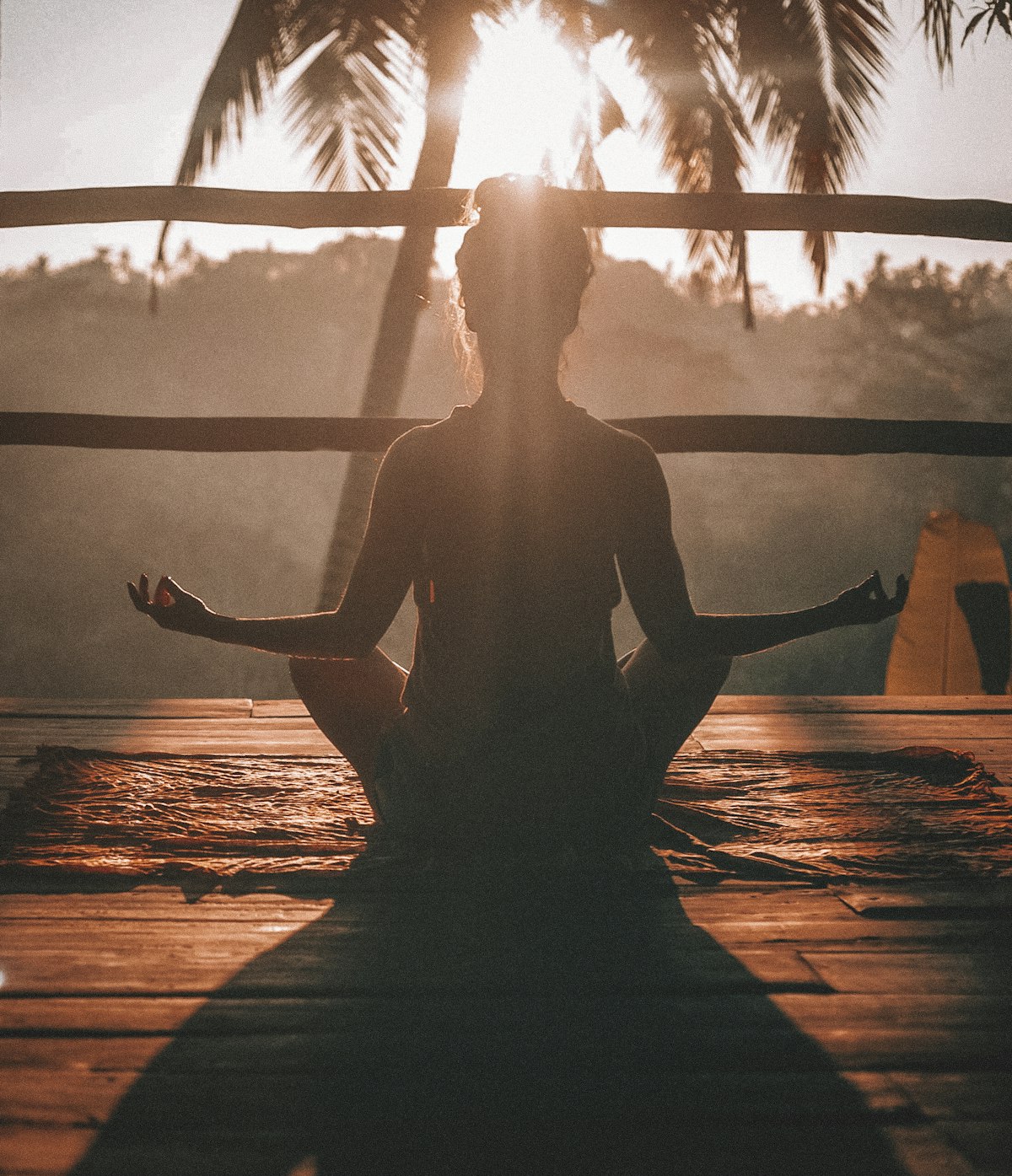
The final movement is the quietest and, in a sense, the one that matters most. In TCM, the Heart houses the Shen — the spirit, the seat of awareness. When the Shen is scattered, sleep becomes impossible. The mind spins. The heart races. The classical remedy is to gather the Shen — to call the attention back from the thousand tiny distractions of the day into the body's center.
Movement 3 does this with breath and a barely-there arm movement. Stand or sit, spine tall. Begin slow arm circles: inhale, both arms float up from the sides to shoulder height, palms up, like lifting a bowl of light. Exhale, arms lower slowly, palms turning down, like pressing something gently downward. Keep the circles continuous and unhurried — one full circle should take roughly ten seconds.
Let the exhale be longer than the inhale. Daoist instruction: the exhale is the breath of the Heart, the breath that allows the Shen to settle. Do six circles. Then bring the hands to the lower abdomen, palms stacked over the navel, and breathe here for two minutes. Feel the hands rise and fall.
With each exhale, imagine the breath gathering in the lower abdomen — drawing the scattered Shen downward into the body's center, the Dan Tian. Thoughts will visit. Don't fight them. Return to the hands on the belly. That's the practice.
Final 30 seconds: one palm over the heart, one over the abdomen. Breathe. Let your awareness rest in the space between your hands. This is the classic 'calm the Heart, settle the Shen' practice — the closest thing TCM has to an on-ramp for sleep. By the end of four minutes, most people feel a palpable shift: shoulders dropped, jaw loosened, the mind's endless rehearsal of tomorrow gone quiet.
That's the Shen coming home.
- Make the exhale audibly soft — a gentle sigh quality accelerates parasympathetic activation measurably.
- Rushing the arm circles? Slow them until they feel like movement underwater. That's the right pace.
- Don't skip the final hands-on-body minute. Physical contact anchors awareness. It's the actual 'settling' step. Without it, the sequence is unfinished.
"The Heart is the sovereign ruler... and the Shen resides in it. When the Shen is calm, sleep comes of its own accord."
Three Things That Undo the Wind-Down Before It Starts
The evening wind-down only covers half the equation. The other half is knowing what to avoid, because certain evening habits actively sabotage the parasympathetic transition. Each one has a TCM explanation that lines up with the modern evidence.
Intense cardio after 7 PM. High-intensity exercise spikes cortisol, adrenaline, and core temperature — all sympathetic signals. A 2019 systematic review of evening exercise and sleep found that vigorous exercise within two hours of bed can delay sleep onset. In TCM terms, intense evening cardio fans the Yang when it should be sinking — a textbook cause of 'Yang floating upward' insomnia.
Heavy strength training at night. Beyond the cortisol hit, heavy lifting lights up the nervous system's arousal circuits. That's the exact opposite of what the Liver and Shen need. If evening is your only training window, finish at least three hours before bed, keep the session below your max, and follow it with a full wind-down sequence.
Cold showers or aggressive cold exposure. Cold is Yang-stimulating and sympathetic-activating. It's a morning tool, built to wake the system up. In the evening, warm is the medicine. A warm shower 60 to 90 minutes before bed supports the core-temperature drop that sleep onset requires.
Beyond these three, the smaller saboteurs add up: bright screen light (suppresses melatonin and overstimulates the Shen), late caffeine, alcohol (fragments sleep architecture even if it knocks you out faster), and the biggest one — checking work email in bed. The bed has to become a no-sympathetic zone. What you do in the last hour teaches your nervous system what to expect from the bed.
If the bed is where stress lives, the bed becomes the trigger for stress.
- If evening exercise is unavoidable, keep it gentle and slow — the wind-down sequence itself, a walk, or light qigong. Save intensity for daylight.
- Swap the cold shower for a warm one. If you must have a temperature shift, let the water run slightly cool at the very end — only after you're already calm.
- Screens out of the bedroom entirely, or at minimum out of the bed. The wind-down happens away from the phone. Or it doesn't happen.
"If one exerts Yang in the evening, the Yang cannot return to its root, and sleep will be disturbed... In the evening, be as gentle as the fading light."
The Full 10-Minute Script, Minute by Minute
Here's the complete wind-down exactly as I prescribe it, timed out. Prep the space first: dim the lights to warm amber. Phone in another room, or at least face-down and silenced. Mat or quiet patch of floor ready.
Minute 1 — Settle in. Stand, feet hip-width, hands at your sides, eyes soft or closed. Three slow breaths. Consciously drop the shoulders. Intention: the day is done. Nothing needs solving in the next ten minutes.
Minutes 2–4 — Liver release. Three slow side bends per side (about 90 seconds). Butterfly seated fold (60 seconds). Figure-four lying stretch, 30 seconds each side. Keep the breath long. Let each exhale carry something out.
Minutes 5–7 — Kidney anchoring. Stand. Three rooting breaths (30 seconds). Twenty gentle heel drops (about 60 seconds). Seated or standing, press KD-1 on each sole, 30 seconds per foot (60 seconds). Close with palms together at chest, weight sunk into feet (30 seconds).
Minutes 8–9 — Shen-calming breath. Six slow arm circles, about 10 seconds each (60 seconds). Two minutes of hands-on-belly breathing, exhale longer than inhale.
Minute 10 — Settle and complete. One palm on the heart, one on the belly. Breathe quietly for the final minute. Then, ideally, move to bed. The ideal order: warm shower → wind-down → bed. Dark, cool, quiet.
What you'll notice, starting in the first week, isn't dramatic. It's the quiet difference between hitting the pillow still 'on' and hitting it already 'off.' That's the point of a transition ritual. By the time you lie down, the descent has already happened.
- Print or screenshot this script and keep it beside your mat for the first two weeks. You won't need it after that.
- Same time every evening. The nervous system learns patterns — regularity is half the mechanism.
- Only have five minutes? Abbreviated version: heel drops (2 min) + hands-on-belly breathing (3 min).
"The transition between day and night is the hinge of the day... One who honors this hinge sleeps like a child and wakes like the dawn."
Foot Soak + Sleep Tea: the Ritual That Wraps Around the Wind-Down
The wind-down stands on its own, but it was designed as the centerpiece of a larger evening ritual. Two companions amplify its effects: a warm foot soak and the right sleep tea.
The foot soak is the oldest sleep aid in the Chinese pharmacopeia and one of the most physiologically sound. Warm water — 40 to 42°C, about 104 to 108°F — for 15 to 20 minutes draws blood to the feet through peripheral vasodilation. When you step out, the body rapidly sheds that heat, producing the core-temperature drop that sleep onset requires.
In TCM terms, the soak pulls Yang downward into the feet — the same anchoring principle as the Kidney work in Movement 2. That's why they pair so naturally. Order: soak (15 min) → wind-down (10 min) → bed. Not negotiable, just the sequence that works.
Sleep tea fills the gap that movement can't reach. TCM's classic sleep herbs — Suan Zao Ren (sour jujube seed), Fu Ling (poria mushroom), a touch of honey — work on the same axis as the practice: calming the Shen and anchoring the Qi. A cup of warm, caffeine-free sleep tea, 30 to 45 minutes before the wind-down, adds a chemical layer to the mechanical and energetic ones.
So the full evening looks like this: 8:15 PM — tea, screens off. 8:30 PM — foot soak. 8:50 PM — the ten-minute wind-down. 9:05 PM — bed, dark, cool, quiet.
This isn't a prescription to obey rigidly. It's a template to adapt. The principle is the thing: light going down, warmth going down, movement slowing, breath lengthening, mind gathering. Do that night after night, and the body relearns its oldest skill — the art of descending into rest.
- Add 1–2 drops of lavender or 3–5 slices of fresh ginger to the foot soak. Both are mild sedatives in the TCM materia medica.
- Keep the soak under 20 minutes. Longer soaks can over-dilate blood vessels and trigger a middle-of-the-night adrenaline rebound in sensitive people.
- Match the tea to your pattern: Suan Zao Ren for racing minds, chamomile-licorice blends for digestive heaviness, or just warm water if you're highly sensitive.
"When the feet are warm and the head is cool, the Qi has descended; when the Qi has descended, sleep follows like water finding its level."