The Soldier's Exercise — Still Working 800 Years Later
The story goes that Ba Duan Jin was built by General Yue Fei, a Song Dynasty commander fighting a war he couldn't win with numbers. The Jurchen army had more men, more horses, more everything. Yue Fei's edge had to come from somewhere else.
So he designed a conditioning system for his soldiers that solved a very specific problem: how do you keep thousands of men battle-ready every day without exhausting them before the fight even starts? No equipment. No drills that leave muscles wrecked. Something that heals the injuries they've already accumulated instead of adding new ones.
He settled on eight movements. Not twenty. Not a hundred and eight like some of the longer qigong forms. Eight. Enough to touch every major organ, every major joint, every meridian that matters. Few enough that anyone with two working arms and legs could learn them in a week.
The name 'Eight Brocades' isn't just decoration. Brocade was the finest silk in ancient China — the stuff emperors wore. The implication: these eight movements weave health into the body the way a master weaver works silk into a robe. That's the ambition.
Eight centuries later, the practice is still here. Walk through any Chinese park at 6:30 AM and you'll find groups of retirees — some pushing ninety — flowing through these postures with the kind of unhurried precision that only comes from doing the same thing every morning for forty years. Nobody's sweating. Nobody's grimacing. They're just... moving.
And by pretty much every health metric you'd care to name, they're doing better than most thirty-year-olds with gym memberships.
The reason a practice this simple produces results this significant is that Ba Duan Jin doesn't train muscles in isolation. It trains systems. Fascia, meridians, organs, breath, attention — all at once. You don't need to be flexible. You don't need experience. You need fifteen minutes and the willingness to try something your body has been missing without ever knowing how to ask for it.
- Ba Duan Jin was designed for soldiers who trained daily without depleting combat readiness — the practice should leave you energized, not drained.
- All eight Brocades at a flowing pace take 12–15 minutes. Add 3 minutes of standing meditation at the end and you've got the perfect morning practice.
"The running water never stagnates, and the door hinge never rusts. This is because they are in constant motion. The same principle applies to the human body."
All Eight Brocades, in the Order You Do Them
Here's every Brocade — the Chinese name, the English translation, the TCM logic that makes it work, and the execution details most online guides skip. The order isn't random. It moves upper body to lower body, external to internal, Yang to Yin. Do them in sequence.
Brocade 1: Two Hands Hold Up the Heavens (双手托天理三焦)
Feet shoulder-width, knees soft, hands interlaced low in front of you, palms facing upward. Inhale — raise your hands along the center line, past the chest, past the face. At the top, turn the palms to the sky and press upward, letting your heels lift slightly off the floor. Hold for three breaths. The stretch should run from fingertips down to tailbone.
Exhale. The hands float back down, palms turning earthward, all the way to your lower abdomen. Then do it again. Six rounds total.
This one move opens the set's master lock. The target is the San Jiao — the Triple Burner — which isn't a discrete organ so much as a functional system governing fluid metabolism, temperature regulation, and Qi distribution through the whole body. When the Triple Burner is open, energy moves freely between upper, middle, and lower body cavities. When it's blocked, you feel heavy, stuck, sluggish.
Not a metaphor — that heavy, stuck, sluggish thing people describe to their doctors and get handed a shrug.
The mechanics are straightforward: the upward press decompresses the thoracic spine, opens the intercostal spaces, and mobilizes the fascia connecting diaphragm to pelvic floor. That's the literal anatomical pathway of the Triple Burner.
One movement, done properly, can loosen shoulder tension that's been parked there for years, settle a stomach that's been churning since lunch, and create a sense of space in the chest that a surprising number of adults haven't felt since childhood.
- The palm turn at the top is the key. Don't just shrug — internally rotate the arms, palms face sky, then lengthen through the armpits.
- Keep your neck neutral. Don't crane back to stare at your hands. Let your gaze follow the middle fingers, chin slightly tucked.
- The lowering isn't a drop. Control the descent. The sensation should be energy pulling down through you into the earth.
"The Triple Burner is the official in charge of irrigation. It controls the waterways and ensures that Qi and fluids move freely through all three body cavities."
Brocade 2: Drawing the Bow to Shoot the Hawk (左右开弓似射雕)
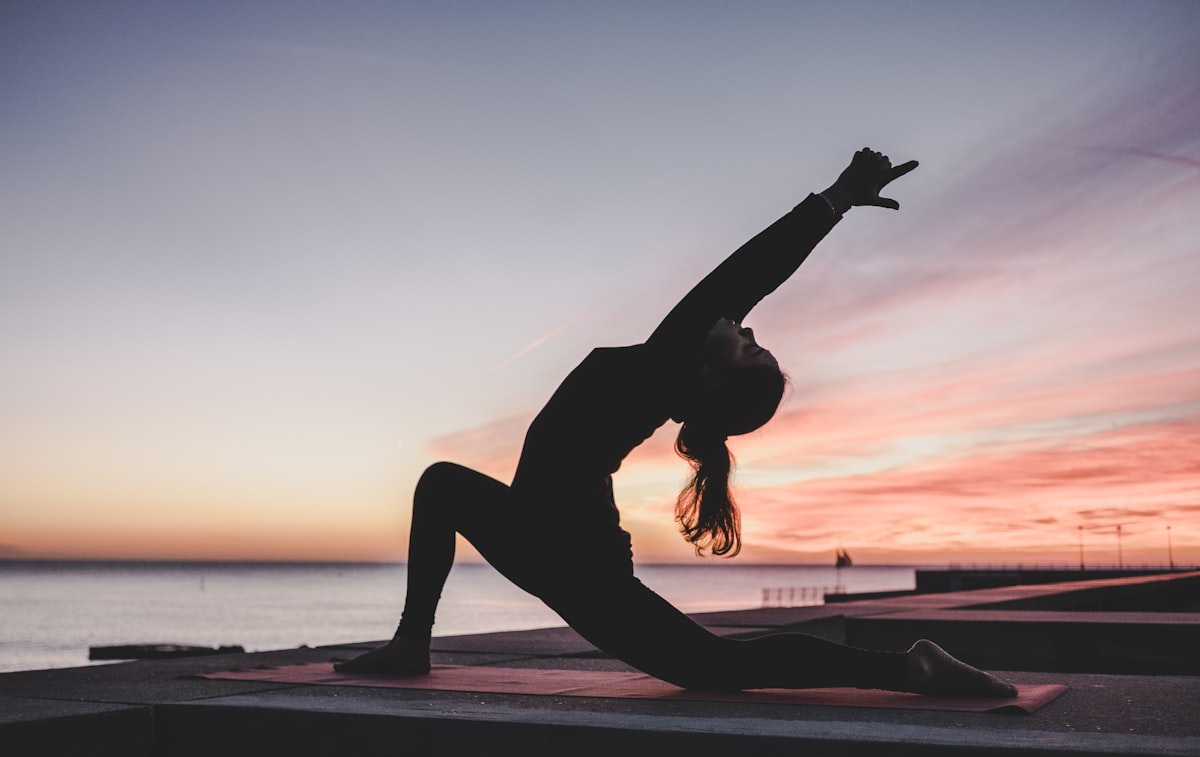
Drop into horse stance. Doesn't have to be deep — bend your knees as far as comfortable. Extend your left arm to the side, index finger pointing up, thumb out — exactly like drawing a bowstring. Right arm bends at the elbow, fist at your right shoulder, as if pulling the bowstring back. Turn your head to look at the extended index finger.
Hold for two breaths. Switch sides. Three rounds per side.
This one hits the Lung meridian — which runs the inner arm to the thumb — and the whole chest-and-shoulder girdle that's been curling inward since you got your first desk job. Lateral eye movement, the thing you're doing when you look at that extended finger, connects to the Liver meridian in TCM. So you're working lungs, shoulders, and liver all at once.
For the slouched-over-a-screen crowd — pecs shortened, upper back rounded, shoulders rolled forward — this single Brocade might buy you more relief than six months of generic shoulder rehab exercises you won't actually do. The archery metaphor isn't just poetic. You're literally pulling tension out of your chest the way you'd draw an arrow from a bow.
- Horse stance depth: bend knees only as far as comfortable. Knee pain means you've gone too low. Depth comes with time, not willpower.
- The extended index finger is acupressure point LI-1 (Shangyang), first point on the Large Intestine meridian. Keeping it extended stimulates the channel.
- The gaze should be sharp — like a hunter sighting prey. This trains the Shen (spirit) through the eyes. Not tense, just focused.
"The Lungs govern the Qi of the entire body. When Lung Qi is strong, the defensive Wei Qi is abundant and external pathogens cannot invade."
Brocade 3: Separate Heaven and Earth (调理脾胃须单举)
Feet shoulder-width. Left hand presses up, palm toward the sky. Right hand presses down, palm toward the ground. You're stretching the space between heaven and earth with your body in the middle. Hold for three breaths, feeling the stretch along the left flank and the engagement in the right lat. Return to center. Switch sides. Six rounds, alternating.
This Brocade targets Spleen and Stomach — Earth element, digestion, transformation. The alternating press creates a gentle traction on the abdominal organs. It's mechanically stimulating peristalsis, massaging the stomach and intestines, encouraging the upward-rising function of the Spleen and downward-descending function of the Stomach.
There's a logic to its placement as Brocade 3: the San Jiao is open (Brocade 1), the Lungs are engaged (Brocade 2), and now you're directing freshly mobilized Qi straight into the digestive system.
I've seen this one movement resolve chronic bloating in patients who'd been chasing food sensitivity diagnoses for years. One woman in her forties — bloated after every meal, eight different elimination diets, no answers — started doing Brocade 3 for five minutes before eating. Thirty days later, the bloating was gone. Her gastroenterologist said it was coincidence. She didn't care.
- The pressing hand extends like a plant reaching for sunlight, not like you're shoving something away. The lowering hand settles — leaf floating down, not pressing down.
- Breathe into the stretch on the raised-arm side. You should feel expansion in the lower ribs and flank, where the Spleen and Stomach meridians travel.
- Best timing: 30 minutes before meals to stoke digestive fire, or 60 minutes after to help transformation and transportation.
"The Spleen and Stomach are the granary officials. The five flavors issue from them. When they are in harmony, the hundred diseases cannot arise."
Brocade 4: The Wise Owl Gazes Backward (五劳七伤往后瞧)
This one looks too simple to matter. Stand with feet shoulder-width, arms hanging naturally, palms facing backward. Slowly turn your head to look over the left shoulder. Your torso stays facing forward. Hold for two breaths. Return to center. Repeat right. Six rounds, alternating.
The neck is a traffic hub. Yang meridians of the arms and legs converge here with the Du Mai (Governing Vessel) and Ren Mai (Conception Vessel). The gentle rotation stimulates all of them simultaneously. The name references the 'five fatigues and seven impairments' — classical TCM's taxonomy of how the body breaks down under stress.
Five fatigues: overuse of the five zang organs (Heart, Liver, Spleen, Lungs, Kidneys) from too much thinking, too much physical labor, too much sitting, bad diet, and sexual depletion. Seven impairments: specific organ-damage patterns from emotional and environmental causes.
The backward gaze stretches sternocleidomastoid, scalenes, upper trapezius — exactly the muscles that seize when you're stressed — while stimulating cervical vertebrae and the Bladder meridian that runs parallel to the spine. It's a reset button for the neck and, through the neck, for the whole nervous system. So simple it's almost embarrassing.
So effective I've had office workers tell me this single move solved tension headaches they'd been medicating for years.
- Go slow. The benefit is in the sustained passive stretch and meridian stimulation, not in range-of-motion bragging rights.
- Keep a slight chin tuck throughout. Protects the cervical spine and engages the deep neck flexors.
- Dizziness during the hold? Close your eyes. The sensation often points to Liver Yang rising or Blood deficiency — this movement helps rebalance both.
"Prolonged looking injures the Blood. Prolonged sitting injures the flesh. Prolonged standing injures the bones. These are the five fatigues that deplete the five zang organs."
Brocade 5: Sway the Head and Swing the Tail (摇头摆尾去心火)
The signature Brocade. Wide horse stance, hands on thighs. From here you describe a full circle with your torso: lean forward and right, swing the head and upper body down and across to the left, circle back up through center. Like a pendulum tracing the inside of a bowl. The head leads; hips stay low. Whole torso sways as one unit. Repeat the other direction.
This targets Heart Fire — excess heat in the upper body that shows up as anxiety, insomnia, racing thoughts, mouth sores, that wired-but-exhausted state where you're too tired to function but too amped to sleep. The downward-forward motion pulls excess Yang from head and chest into the lower body.
The hip engagement stimulates Kidney-1 (Yongquan, 'Bubbling Spring') — the point on the sole of the foot that has a cooling, grounding effect in TCM theory. The sway mobilizes the entire spine through flexion, lateral flexion, and rotation — all three planes of movement desk workers never access. Plus the rhythmic compression-release massages abdominal organs.
This is the hardest Brocade to get right and the most rewarding when you do. Three to six rounds each direction. Don't rush it. Don't perform it. Let it happen.
- Knees stay bent, hips stay low through the entire circle. The moment your legs straighten, you lose the grounding effect that draws Heart Fire downward.
- The 'tail' is your coccyx. Imagine it drawing circles in sand. This engages the pelvic floor and stimulates Conception and Governing vessels.
- Balance shaky? Narrow the stance. Knees complaining? Raise them a bit. This is a progression, not a performance.
"Excessive joy injures the Heart. When the Heart is overstimulated, the Shen becomes scattered and sleep is disturbed. Calm the Heart and the hundred spirits find their proper place."
Brocade 6: Two Hands Hold the Feet (两手攀足固肾腰)
Feet together, arms relaxed. Inhale — sweep both arms overhead, palms forward, stretch tall. Exhale — fold forward from the hips, not the waist. Arms float down, hands reach toward the feet. No bouncing. No forcing. If you reach your shins, fine. Ankles, fine. Toes, fine. The depth literally doesn't matter. The sustained forward bend does.
Hold for three breaths. Then roll up — vertebra by vertebra, head coming up last. Six rounds.
The target is Kidneys and lower back, the seat of Jing, your constitutional essence. The forward bend opens the Bladder meridian — it runs from the inner eye all the way down the back, through the hamstrings, to the little toe. Longest meridian in the body, most directly responsible for ferrying Qi to the Kidneys.
When you fold forward and breathe into your lower back, you're pressing Qi into the Kidney region, mechanically.
Elderly practitioners regularly name Brocade Six as the one that saved their backs. The slow roll-up is at least as important as the fold — it massages each vertebra and feeds the spinal discs with synovial fluid. Skip the snap-back. Take five seconds minimum on the way up. Feel each segment stack back into place.
- Keep knees slightly bent. Locked knees strain the lower back and block Bladder meridian flow through the popliteal fossa behind the knee.
- At the bottom, place palms on your lower back (the Kidney region) and breathe into them for one extra breath before rolling up. This warms Ming Men — the Gate of Life.
- Roll up slowly — at least five seconds. Feel each vertebra stack, one by one, like building a column of pebbles.
"The Kidneys store the essence of life. They govern birth, growth, reproduction, and aging. When Kidney essence is abundant, the bones are solid and the lower back is pain-free."
Brocade 7: Punch with Angry Eyes (攒拳怒目增气力)
Horse stance. Loose fists at your waist, palms face up. Extend the right fist forward slowly — four or five seconds from start to finish — rotating the forearm as you go so the palm faces down by the time the arm is fully extended. As you punch, your eyes widen with intensity. Not anger. More like the look on someone's face when they've spotted a mountain on the horizon and they're trying to make out the details.
Hold for one breath. Draw the fist back to your waist, slow, rotating the palm up again. Alternate sides. Six punches per arm.
This is the power Brocade. It builds Liver Qi — the raw material of explosive strength and decisiveness in TCM — by combining isometric arm-and-shoulder tension with the eye focus that directly stimulates the Liver meridian. Modern exercise science has a word for this: irradiation. Focused mental attention amplifies muscular activation.
TCM has been exploiting this for centuries and called it directing intention (Yi) and spirit (Shen) through the gaze.
The slow punch builds tendon strength, not muscle bulk. It trains connective tissue — the stuff that deteriorates with age and disuse — at a pace the body can actually adapt to. In a culture that either ignores strength work entirely or smashes it with deadlifts until something pops, Brocade Seven sits in the middle: enough resistance to stimulate adaptation, not enough to deplete.
- This isn't a jab. It's a slow, deliberate extension that takes 4–5 seconds start to finish. The resistance is internal.
- The 'angry' gaze is focused, not tense. Eyes widen as if seeing a distant mountain, brow lifts slightly, attention sharpens — but your jaw stays loose.
- Drawing the fist back: imagine pulling against resistance, like retracting a heavy elastic band. The eccentric contraction builds tendon strength more than the punch itself.
"The Liver rules the sinews and manifests in the nails. Its emotion is anger, and its sound is shouting. When Liver Qi is abundant, the sinews are supple and the grip is powerful."
Brocade 8: Bouncing on the Toes (背后七颠百病消)
Feet together, hands at your sides. Rise onto your toes — as high as you can — and hold for one breath. You'll feel it through your calves, ankles, the soles of your feet. Then drop the heels. Not a violent stomp. A controlled descent that lands with a soft thud and sends a wave of vibration up through your skeleton. Let your body absorb it naturally. Knees slightly bent. Seven repetitions.
This is the closing Brocade, and the design is elegant. The heel drop creates a vibration that travels calcaneus → spine → skull, gently shaking the entire skeletal system. In TCM, this vibration 'awakens' the bone marrow where Jing is stored and stimulates the Governing Vessel along the spine.
' The eccentric loading on each drop also stimulates bone density in spine and hips — precisely what aging bodies need to fight osteoporosis.
There's another layer. The heel houses Kidney-1 (Yongquan, 'Bubbling Spring') and is where the Bladder meridian passes. Rhythmic compression and release of the heel stimulates these points and tonifies Kidney Qi with every bounce. The word 'settle' is important here. After seven Brocades of mobilizing energy, Brocade Eight settles everything into the body's deepest reserves.
- The drop lands through the heels, but the impact should be absorbed by the whole body. Knees, hips, spine — all act as shock absorbers.
- Don't clench your jaw. The vibration needs to travel freely through your skull. A clenched jaw blocks the Governing Vessel path.
- After the seventh bounce, stand still with eyes softly closed for 30 seconds. This is integration. Your body is 'uploading' the practice.
"Disease enters through the feet. When the Kidney meridian is stimulated at Yongquan, the root is strengthened and the hundred vessels are harmonized."
What Each Brocade Does to Your Organs — the Short Version
Someone always asks: 'Which Brocade should I focus on for X?' Fair question. Here's the cheat sheet.
Brocade 1 (Hold Up the Heavens) → San Jiao / Triple Burner: fluid metabolism, energy distribution, whole-body integration.
Brocade 2 (Draw the Bow) → Lungs and Large Intestine: breathing, chest tension, shoulder mobility, immune defense.
Brocade 3 (Separate Heaven and Earth) → Spleen and Stomach: digestion, bloating, food sensitivity, post-meal energy crashes.
Brocade 4 (Gaze Backward) → All five zang organs via neck meridians: stress, cervical tension, the 'five fatigues and seven impairments.'
Brocade 5 (Sway Head, Swing Tail) → Heart and Kidneys: anxiety, insomnia, Heart Fire, wired-but-tired.
Brocade 6 (Hold the Feet) → Kidneys and Bladder: lower back pain, Kidney deficiency, age-related spinal stuff.
Brocade 7 (Punch with Angry Eyes) → Liver: low energy, weak grip, tendon issues, indecision, Liver Qi stagnation.
Brocade 8 (Bouncing on Toes) → Kidney meridian and Governing Vessel: bone density, grounding, integration.
You can cherry-pick. I get it — time is tight. But the full sequence is designed to cascade. Each Brocade sets up the next. Give the complete set at least a month before you start customizing. You might find that the Brocade you thought you didn't need was the one your body was silently asking for.
- Only have time for three? Brocades 1, 3, and 8 cover Triple Burner, digestion, and grounding — daily maintenance essentials.
- Stress really your thing? Brocades 4, 5, and 8 form a nervous-system reset that's more effective than most meditation apps I've seen.
- Track symptoms before and after 30 days. Improvements are often so gradual you won't notice them without a baseline to compare against.
"The twelve regular meridians connect the interior to the exterior, the upper to the lower. When Qi flows smoothly through all meridians, there is harmony. When it is obstructed, there is disease."
Breath: The Part Most People Skip
Without the breath, Ba Duan Jin is slow calisthenics. With it, you're moving Qi. The rule is simple — and takes a few weeks to feel natural: inhale during opening, expanding, rising movements. Exhale during closing, contracting, descending ones.
Brocade 1: inhale as hands rise, exhale as they lower. Brocade 2: inhale drawing the bow, exhale releasing. Brocade 6: inhale reaching up, exhale folding forward. This isn't someone's aesthetic preference. It follows the diaphragm's mechanics. Arms rise, chest opens, diaphragm descends, lungs expand — you inhale. Fold forward, contract, diaphragm ascends, lungs compress — you exhale.
Fight this and you're creating internal resistance.
The advanced technique is reverse abdominal breathing — abdomen draws slightly inward on the inhale, expands on the exhale. That's martial qigong breathing. It increases intra-abdominal pressure, stabilizes the spine, concentrates Qi. But don't touch reverse breathing until you've had at least three months with the natural pattern. Seriously. Skip the foundation and all you get is tension masquerading as power.
The most common mistake? Holding your breath. People focus so hard on getting the arm angle right that they forget breathing is even happening. Some Brocades include a natural brief pause (the hold at the top of Brocade 1), but the breath should be held with intention, not abandoned. Mental timer: if five seconds go by without an inhale or exhale, you've probably stopped breathing.
- Beginner rule: nose breathing only. Mouth breathing activates the sympathetic nervous system — the thing you're trying to quiet.
- Your breath should be audible to you but no one else. A soft oceanic sound at the back of the throat — ujjayi if you've done yoga — is ideal.
- Overwhelmed by coordinating breath and movement? Spend two weeks just doing the movements naturally. The breath can wait. The movements can't.
"The true man breathes from his heels. The ordinary man breathes from his throat. The man who has lost the Way breathes from his mouth, panting and gasping."
What the Studies Actually Show
A 2017 RCT out of Evidence-Based Complementary and Alternative Medicine put 96 older adults (mean age 67) through Ba Duan Jin three times a week for 12 weeks. The people doing the Brocades showed significant gains in balance (single-leg stance, Berg Balance Scale), lower body strength (chair stand test), and quality of life scores compared to a control group doing generic stretching.
A 2019 study on breast cancer survivors — 12 weeks of Baduanjin — found significant improvements in physical function, reduced fatigue, and, notably, better sleep quality versus usual care. The sleep result is interesting through a TCM lens: Brocade Five specifically targets Heart Fire, which is the classical pattern behind insomnia.
A 2018 systematic review of qigong for chronic fatigue found moderate-to-large improvements in fatigue severity and physical function across multiple studies, Ba Duan Jin included. The proposed mechanisms: improved vagal tone (the parasympathetic brake), reduced inflammatory markers (IL-6, TNF-alpha), enhanced heart rate variability.
Here's the stat that jumps out at me every time I read these papers: adverse events were essentially zero. Compare that with running (up to 80% annual injury rate, depending on the study you pick), CrossFit (20–30%), even yoga (around 10%). Ba Duan Jin might be the safest effective exercise system anyone's bothered to study.
Your body wants to do this. Question is whether you'll let it.
- Minimum effective dose from the research: three sessions per week, 15–20 minutes each. More frequent = better results.
- The clinical trials used trained instructors for initial form teaching. If you're learning from video, practice in front of a mirror for the first two weeks.
- Combine Ba Duan Jin with a 20-minute walk and you've got a joint-friendly daily regimen covering cardio, mobility, and meridian stimulation.
"Treating disease after it has arisen is like forging weapons after war has begun, or digging a well after you are already thirsty."
Making It Stick: A Morning Routine That Survives Tuesday
Morning is ideal. 5 to 7 AM, Large Intestine hour, Yang energy naturally rising. But the actual best time is whenever you'll do it consistently. 3 PM is infinitely better than 6 AM never.
Start with five minutes. Not fifteen. Not all eight Brocades. Just Brocades 1 through 3, three reps each. Do that every day for a week. Add Brocades 4 and 5 in week two. By week three, you're doing the whole thing. The trap everyone falls into is trying to learn all eight on day one, getting tangled, and quitting. Your nervous system needs time to encode movement patterns. Give it that.
Practice outside if you can. The Lung meridian draws strength from fresh air and morning light, and there's something about sky overhead that changes the quality of the practice. A park, a backyard, a balcony — anywhere beats a living room. Wear loose clothes. Drink a glass of warm water before you begin (cold water shocks the Spleen and dampens digestive fire in TCM thinking).
After the practice, stand still for a minute with hands resting over the lower Dantian, two inches below the navel. This is the closing. Your body is storing the Qi you've mobilized. Skip it and half the benefit evaporates.
What people notice after about a month: waking up rested instead of groggy. Fewer afternoon energy crashes. Better digestion, especially after meals. And a physical ease that's hard to describe — your body just works better. That's not placebo. That's eight targeted organ prescriptions doing exactly what they were built to do.
- Anchor it to an existing habit: Ba Duan Jin right after brushing your teeth. The thing you already do becomes the trigger for the thing you're building.
- Can't do mornings? 5–7 PM (Kidney hour) is the second-best window. Energy naturally turns inward then, and the Kidney-tonifying Brocades (6 and 8) are especially potent.
- Warm water with a slice of ginger wakes up the Stomach meridian and preps the digestive system for the Qi you're about to mobilize.
"At cockcrow, rise, wash, rinse the mouth, comb the hair, put on loose clothing, and practice the guiding and stretching exercises. This is the way to nourish life."
The Mistakes I See Every Time I Teach
Hundreds of students, same handful of errors. Here they are, plus the fix.
Locked knees. Ba Duan Jin's standing postures want soft, slightly bent knees. Never locked. Locked knees block Qi flow through the leg meridians, strain the lower back, and kill the grounding effect that pulls energy downward. Think springs, not stilts.
Rushing. Pace should be about six seconds per movement phase: rise, hold, lower. Count in your head. If you're through all eight Brocades in five minutes, you're flying.
Breath-first anxiety. People concentrate so hard on getting the inhale-exhale timing right that they become rigid. The body knows how to breathe. Let it follow the movement naturally for the first month.
Arm-waving. Ba Duan Jin is rooted in the legs and hips. Power comes from the ground up, not the shoulders out. If your legs aren't mildly fatigued after the set, you're probably just flapping your arms around.
Skipping transitions. The moments between Brocades — returning to center, settling weight, finding breath — matter as much as the Brocades themselves. That's where integration happens.
Pushing through pain. TCM separates 'good pain' (stretch sensation, mild effort that feels productive) from 'bad pain' (sharp, stabbing, joint-specific). If you feel the second one, back off. Ba Duan Jin should feel good. Challenging, maybe. Never painful.
- Film yourself once a week. Compare to an instructional video. The gap between what you think you're doing and what the camera shows is usually humbling — and instructive.
- Find a practice buddy. Ba Duan Jin was designed for group practice (Yue Fei's soldiers did it together), and the accountability factor is real.
- After three months, try one session with eyes closed. You'll discover imbalances and gaps in your alignment that visual feedback was hiding.
"Practice does not make perfect. Only perfect practice makes perfect. The body records every repetition — make sure you're recording what you want to keep."