The Most Expensive Half Second in Your Workout
Watch most people lower a weight and you will see gravity doing the work. The dumbbell drops. The squat sinks in a blink. The pull-up bar catches the full weight of a body released mid-air. One half of every repetition — the lowering half — gets treated like dead time between the parts that count.
That habit costs more than it appears to. Each repetition has two phases. In the lifting phase, called a concentric contraction, the muscle shortens under load. In the lowering phase, an eccentric contraction, the same muscle lengthens while still holding tension, paying out rope like a winch lowering cargo. Same iron. Very different job.
The physics are lopsided, and the lopsidedness favors the lowering. A muscle can control roughly 20 to 60 percent more weight during a lengthening contraction than it can lift. Fewer motor units are recruited, so each engaged fiber carries more force. And the whole affair runs on a fraction of the oxygen — which is why walking downhill feels easy to the heart while it wrecks the thighs.
So the half second you have been skipping is, mechanically, the strongest thing you do all day. Nobody rushes past it because it does not look like effort. No grimace, no grinding, no bar speed to chase. It just looks like putting something down.
Chinese physical culture never split movement this way. Classical texts judged an exercise by where the work landed — in the sinews, the bones, the qi — not by which half of the rep it happened in. But the old framework lands, by coincidence or not, on the same conclusion: the controlled yield under load is where a particular kind of strength gets forged.
Modern exercise science eventually gave that yield a name, a force signature, and a bibliography. This article walks through both languages, because each one notices things the other does not.
You Can Lower What You Could Never Lift
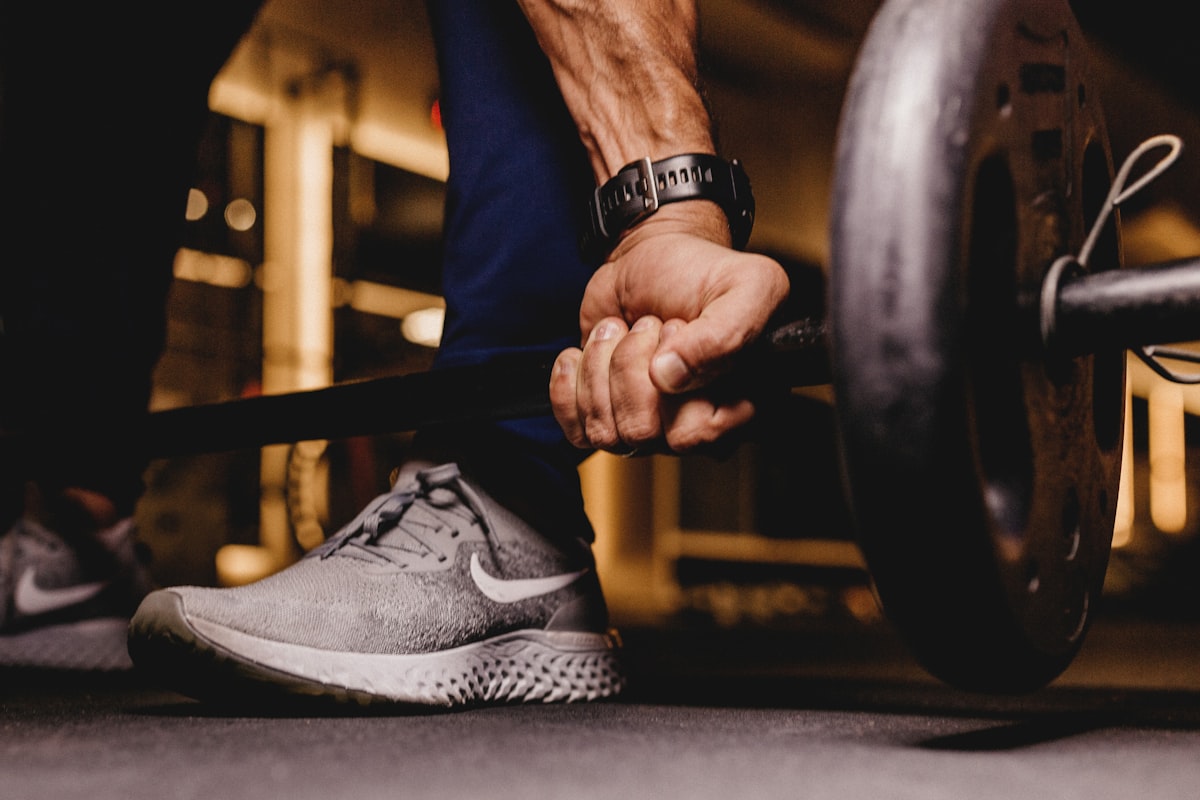
Try a test. Find a pull-up bar. Even if you cannot do a single full pull-up, jump to the top position — chin over bar — and lower yourself as slowly as you can manage. Most beginners get five honest seconds before gravity wins. That one descent did more for your pulling strength than a distracted set of lat pulldowns, and it used a strength you already owned: eccentric strength.
The asymmetry runs deeper than the jump test. During lengthening contractions, cross-bridges in the muscle are mechanically strained rather than recycled, so each fiber produces high force while metabolic cost stays low. The muscle is acting as a brake, and brakes are strong.
This is why rehabilitation clinics can load a post-surgical knee eccentrically weeks before the patient could squat the same weight conventionally.
There is a second effect hiding under the soreness. Eccentric loading at long muscle lengths is one of the few reliable triggers for adding sarcomeres in series — new contractile units threaded end to end along the fiber — which shifts where in the range of motion a muscle can produce force.
Tendons adapt too: the collagen matrix reorganizes and stiffens in response to repeated slow lengthening, which is exactly why slow heavy lowering shows up in protocols for Achilles and patellar tendons.
None of this arrives free. The mechanical strain that drives adaptation is the same strain that produces micro-damage, and the day-after ache is the receipt. The tissue rebuilds. The only question is whether you planned for the receipt or pretended the mail does not come.
- The jump-and-lower test works on chairs too: sit down on a five count instead of dropping. Same strength, smaller stage.
- If a two-arm pull-up negative is too heavy, loop a resistance band under one foot or put toes on a bench — or start with a doorway row, lowering over three seconds.
What the Studies Show — and Where They Stop
The systematic review by Douglas and colleagues pooled chronic training studies and found eccentric-focused work produced strength gains that matched or exceeded conventional training, with the largest advantages showing up when testers measured isometric and eccentric strength, and similar muscle growth across both styles.
LaStayo's earlier work made a related point from a different population: because lengthening contractions cost so little oxygen, elderly adults and cardiac patients could tolerate remarkably high muscle loads on eccentric-biased equipment without paying the cardiovascular bill.
The same logic shows up in tendon clinics, where slow heavy calf lowering became a standard-of-care exercise for mid-portion Achilles tendinopathy after Alfredson's 1998 protocol spread from a Swedish trial into physiotherapy rooms everywhere.
Now the honest part. Most of these trials were short. Many used lab equipment and close supervision that a home trainee will not have. Muscle growth comparisons between the two styles land near a tie in the better-controlled studies — the eccentric advantage is mostly about strength per unit of effort and tendon response, not bigger biceps by Christmas.
Soreness, as a later section covers, is a real adherence problem: people who hurt for three days after session one tend not to show up for session two.
So the claim worth carrying forward is narrower than the internet's version. Eccentric emphasis is a legitimate, sometimes superior way to build strength and tendon resilience — especially for tendons themselves, for older adults, and for anyone whose sport is mostly braking: running downhill, descending stairs, stopping on a court.
It is not a shortcut around progressive loading, and it is not gentle just because it feels quiet.
The Liver Governs the Sinews: An Old Map for the Same Tissue

The Huangdi Neijing assigns the sinews — jin (筋) — to the liver. Suwen, Chapter 9 puts it plainly: the liver is the root of withstanding fatigue, and its fullness is manifested in the sinews. Jin covers what anatomy would split across tendons, ligaments, and the fascial sheets lacing muscle to bone.
The classical claim is less about organ reverence than about a clinical observation that has kept its shape for two thousand years: people who are run down — blood-depleted, in the old vocabulary, from illness, overwork, or diets too thin to rebuild tissue — show it first in stiff, tight, easily strained sinews.
Read that map against eccentric loading and the overlap gets interesting. A slow lowering is a sinew-dominant event. The muscle belly does its share, but the tendon and the junctional tissue take the brunt of the lengthening strain, and that is precisely the territory the classics file under jin.
The Neijing also warns in the other direction: sinews overworked without recovery slacken and tear, and the fatigue the liver is supposed to withstand runs out. Traditional practice built its answer around pacing — dao yin sequences that alternate loading with stretching, rest treated as part of the prescription rather than the absence of one.
The Zhen Jiu Da Cheng, Yang Jizhou's 1601 compendium, adds an acupuncture footnote: Yang Ling Quan (GB-34), the gathering point of the sinews, was a default entry in point combinations for sinew stiffness and strained movement.
Whether or not needles are your territory, the choice of point records where clinicians of that era located the problem — in the tissue between muscle and bone, the same place a five-count squat lowering leaves its mark.
- In the classical frame, heavy soreness after an eccentric session reads as the liver's stores running low — the traditional advice was warm food, early sleep, and a lighter next session, which happens to rhyme with what modern recovery science suggests.
"The liver is the root of withstanding fatigue; its fullness is manifested in the sinews."
Stairs Are the Test Nobody Assigns
Here is an uncomfortable pattern hiding in plain sight: older adults fall on stair descents far more often than on ascents. Going up is a concentric job — pushing, which gym culture spent decades training. Going down is eccentric — catching, lowering, braking — and almost nobody trains it until the day it wobbles.
Watch the mechanics on a staircase descent and you see a small controlled collapse: the lead leg absorbs body weight at length, knee and hip paying out tension while the foot plants on a narrower surface than any gym floor. Do it twenty times a day, every day, and the tissue adapts or complains depending on its training history.
The quadriceps soreness after a long downhill hike is the same signal, concentrated: mountains collect their fee on the way down.
The good news is that this particular decline responds quickly. Slow chair lowerings, step-downs from a single stair with a handrail nearby, heel lowerings off a curb — the doses are small, and the repeated-bout effect (the way a second session of the same eccentric work produces far less damage than the first) arrives within days to weeks.
For readers past fifty, this may be the highest-value strength work available at the price: no equipment, two minutes, a hallway.
And it generalizes past falls. Lowering a cast-iron pan onto a high shelf, easing a toddler into a car seat, sliding a suitcase off a luggage rack — daily life is eccentric exercise with poor form coaching. The gym version exists to make the kitchen and the staircase boring.
There is a quiet asymmetry in how ability disappears, too. Grip studies get the headlines, but watch someone in their seventies negotiate a bus step and the giveaway is the descent — the hesitation before committing weight to a lower surface. Eccentric capacity is a last line of defense for independent living, and it responds to two-minute doses.
Physiotherapists have known this for years; general fitness culture is only now catching up to the idea that the way down deserves its own session, not the tail end of someone else's.
- Step-downs: one stair, hand hovering over the rail, three seconds down, drive back up. Two sets of five per leg is a real start.
- If joint pain (not muscle ache) shows up during descents, shrink the range first; persisting knee pain deserves a clinician's eyes, not more loading.
Programming the Negative Without the Wreck
Tempo is the tool. Pick a lowering count of three to five seconds — long enough that you must control the weight, short enough to keep the set honest — and lift at a normal speed. Two sets to start. Give the same muscle group seventy-two hours before you load it eccentrically again; the soreness curve punishes back-to-back days with enthusiasm.
The classic methods, ranked from least to most exotic. First, simply slow the descent on whatever you already do: squats, push-ups, rows. Second, two-up-one-down: lift with two limbs, lower with one — the pull-up negative is the famous version, but single-leg chair lowerings belong to the same family.
Third, loaded extremes like weighted dip negatives or heavy slow hamstring lowers, which deserve a training age and ideally a spotter.
For tendons the prescriptions change shape. The Achilles protocol that physiotherapy carried out of Alfredson's clinic — three sets of fifteen single-leg heel lowerings off a step, daily, for twelve weeks — is eccentric work at a specific dosage and tempo, and people who improvise their way to double the volume on day one meet the soreness of a lifetime.
Follow a published protocol or a clinician's version of one rather than inventing your own under the influence of ambition.
One warning deserves its own sentence: eccentric work rewards patience more than almost any other training style, because the damage-to-adaptation exchange rate is steep at both ends. Five controlled seconds buys remodeling. Thirty uncontrolled seconds buys a week on the couch. The dose makes the medicine, as the old toxicologists said — and nowhere in fitness is that sentence more literal.
- Start with a five-count chair squat: two sets of eight, every other day. Add depth before you add reps.
- Log the lowering count like a weight. If five seconds becomes two by the eighth rep, the set ended earlier than you think.
Soreness Is Data, Not a Trophy
Delayed onset muscle soreness — the 24-to-72-hour ache that follows unfamiliar loading — is dominated by eccentric exercise. Cheung, Hume, and Maxwell's review lays out the chain: mechanical strain disrupts sarcomeres and connective tissue, inflammation follows, and the soreness peaks while repair machinery is already at work. The pain is not the adaptation.
It is the cost estimate attached to the work order, and the two can be uncoupled — some anti-inflammatory strategies shave the ache while quietly blunting part of the adaptive response.
The useful pattern is the repeated-bout effect. After one properly dosed eccentric session, the same work a week later produces a fraction of the damage. The muscle remembers in a way that has nothing to do with conscious effort — protective mechanisms shift at the fiber and nervous-system level. Practical translation: the first week of slow lowerings is a titration period, not a proof-of-character period.
Half doses. Let the biology buy its insurance.
And then the boundary. Rarely, extreme or novel eccentric exertion — the classic report involves hundreds of eccentric-biased reps attempted in one unaccustomed session — triggers rhabdomyolysis, a breakdown of muscle tissue that floods the blood with myoglobin and can injure the kidneys. Warning signs: severe swelling, weakness far beyond soreness, and urine the color of tea or cola.
That combination is an emergency department visit, not a rest day. The condition is uncommon and mostly preventable with exactly the progressive dosing this article keeps repeating, but health writing that praises micro-damage owes you the other half of the sentence.
Muscle ache that spreads across the belly of the muscle, peaks around day two, and fades by day four: a normal course. Sharp, one-sided, joint-anchored pain that arrived mid-rep: a different conversation, best had with a professional.
A quick field guide to dosing by soreness, then. If the day-after ache is mild and symmetrical — both quads, both calves, the same on each side — you are inside the productive zone. If one side hurts far more than the other, you likely carried an asymmetry worth correcting before adding load.
If the ache migrates into joints, ligaments, or the lower back, the pattern was wrong rather than the dose: drop the tempo, cut the range, or get a coach's eye on the hinge. Soreness maps are not precise instruments. They are free, though, and they beat guessing.
Start With the Chair, Then Walk Downstairs Differently
The minimum effective version of everything above fits in a hallway. A chair squat taken on a five-second count, two sets of eight, every other day, for six weeks. Add push-up negatives once the chair squats stop producing soreness, then a band-assisted pull-up negative if pulling strength is on your list.
That is the whole program for a beginner — and for an older reader it is not a beginner's program at all; it is the training that keeps staircases and bathtubs classified as furniture rather than hazards.
Expect the timeline the research actually supports. Strength moves within two to three weeks, mostly through nervous-system tuning. Soreness shrinks by week two, courtesy of the repeated-bout effect. Tendon remodeling is the slow transaction — months, not weeks — and the imaging evidence for structural change in human tendons under training is mixed even where symptoms improve.
Anyone selling a six-week tendon transformation is selling something other than tendons.
One honest limitation belongs in a closing paragraph rather than a footnote: most of this evidence comes from healthy adults in controlled settings. If you have a tendon that has already torn, a joint replacement, kidney disease, or a medication story that includes statins plus hard training, your dosing questions have answers we cannot responsibly guess at from here.
A physiotherapist or sports physician can individualize in one visit what this article can only sketch.
The practice, though, starts now and costs nothing. Tomorrow, take the stairs down on a slow count and notice which part of the leg is doing the holding. That muscle, working in that direction, is what the classics called sinew and the labs call eccentric — and it has been waiting for you to count to five.