The Muscle That Bites Down Like It Means It
Right now — reading this, mid-scroll — your teeth should not be touching. Dentists leave a two to four millimeter gap between the upper and lower teeth whenever the jaw is at rest. They call it freeway space, which is either the best or the worst name in dental anatomy depending on your commute. If you just noticed your molars sitting together: welcome to the club.
Most people carry their teeth together for hours a day and have no idea.
The habit has a name and better numbers now than it did a decade ago. A 2024 meta-analysis covering studies from 2003 to 2023 put global prevalence at roughly 21 percent for sleep bruxism and 23 percent for the awake kind — one adult in five, give or take, before children even enter the count.
When researchers swap questionnaires for sleep labs, the sleep figure jumps to 43 percent, because a lot of clenching never makes a sound anyone hears.
The muscles involved are not fragile instruments. The masseter — the short, thick strap you can feel bunch up under your cheekbone if you clench once — is among the strongest muscles in the body for its size. Ordinary chewing loads the molars with perhaps 70 to 150 pounds of force. During sleep-bruxism episodes, measured bite forces have run two to three times that, held for seconds at a stretch, many times a night.
Teeth evolved for occasional steak duty, not an eight-hour isometric hold.
Loads like that leave receipts: flattened facets on enamel, masseters that ache on waking, temples that complain before the first coffee, a click on the first yawn. The painful versions get grouped under temporomandibular disorder, TMD, and the long-running OPPERA cohort — 3,258 adults followed across four US sites — found about 4 percent of previously pain-free people developing clinically verified TMD each year.
Among the strongest predictors were simple self-reports of jaw habits like clenching and grinding. People who noticed their own jaws were usually right.
Chinese medicine had opinions about this hinge long before electrodes. Some of them age better than you'd expect.
- Run a check right now — say it in your head: lips together, teeth apart, tongue resting on the palate. That's the resting position. Set three phone alarms across the workday to re-check it.
- Place two fingertips on your cheekbones and clench once. If the muscles jump hard under a light bite, they're carrying more baseline tension than they should.
Awake Bruxism: the Habit Hiding in Your Workday

Grinding gets the attention because it's audible. Clenching is the quiet sibling and, by prevalence, the bigger one. In 2013 an international group of bruxism researchers settled on a working definition covering both: repetitive jaw-muscle activity — clenching or grinding of the teeth, bracing or thrusting of the mandible — divided by the clock into sleep bruxism and awake bruxism.
They also proposed grading it as possible, probable, or definite, which is a polite way of saying that self-report, chairside findings, and sleep-lab measurements each tell a slightly different story.
Awake bruxism is the one people miss. It shows up during focused work, highway driving, heavy lifting, tough conversations — any moment the body quietly decides the jaw is load-bearing. The OPPERA data found that a person's own report of jaw parafunction predicted developing painful TMD more strongly than an examiner's findings did. Your own suspicion, in other words, outranks someone else's quick look.
The tell-tale signs are unglamorous: cheek ridges you can catch with your tongue, a jaw that feels tired after deep work, the phantom urge to chew something, morning fatigue in the masseters. And stress is part of it — though not the whole story, and not a moral failing either.
TCM reads the same picture through the Liver, which 'governs the sinews': sustained tension under constraint is Liver qi stagnation, the classic pattern of people who sigh a lot, feel chest tightness under deadlines, and carry their stress in their bite. The language is pre-modern. The observation isn't.
None of this is a character flaw. It's a load-bearing habit, and habits have addresses.
- Run a three-day tally: every time you catch your teeth touching during the day, add one mark. Deadline days tend to be louder on paper than in memory.
- Try the straw trick at your desk — hold a straw lightly between your lips, not your teeth, during focused work. If it drops, the jaw has drifted back into clenching.
A Highway Runs Through the Jaw: the Yangming Channel
Open a meridian atlas and follow the Stomach channel — the foot yangming — from its start below the eye. It curves down along the nose, crosses the upper gum, circles the mouth, and then does something a cartographer would call a grand tour of the jaw: out along the jawline at Daying, through Jiache, up in front of the ear past Xiaguan, across the temple.
The channel doesn't pass through the jaw on its way somewhere else. The jaw is the itinerary.
Two of the channel's busiest points sit right there. Jiache, ST-6 — literally 'jaw bone' — lives in the belly of the masseter, one finger-width forward and up from the angle of the jaw. Xiaguan, ST-7, 'below the joint', is the hollow under the cheekbone directly in front of the ear: the TMJ itself, addressed by name and address.
Add the Large Intestine channel — the hand yangming — crossing the region near the mouth, and old texts end up treating jaw complaints as a Yangming matter almost by default.
The Suwen gives the logic in a single line: the Yangming is the sea of the five zang and six fu, the one that moistens the sinews, binds the bones, and frees the hinges. In that frame a dry, catching hinge isn't a local mystery. It's a channel problem — under-resourced or jammed — and the treatment logic follows: warm it, move it, feed it.
Is 'channel' anatomy? No. It's a pre-modern map, and honest writing has to say so. But the map's landmarks land on real estate every dentist knows: masseter belly, temporalis insertion, joint capsule. Two vocabularies, same ground.
"The Yangming is the sea of the five zang and six fu. It moistens the sinews, binds the bones, and frees the hinges of the body."
Stomach Heat and the Old Diagnosis for Grinding
Classical texts had a specific word for night grinding: xie chi, 齘齿 — literally 'teeth that grind against each other'. The attribution of choice was stomach heat. Heat agitates; an agitated stomach pushes its channel's jaw to chew on nothing, all night, while the rest of you sleeps.
Pediatric sources added worms and food stagnation as suspects, which tells you how long parents have been asking why the kid sounds like a millstone.
Strip out the ancient framing and you get a usable checklist. The stomach-heat picture: grinding that clusters after late, heavy, rich, or spicy meals and alcohol, with thirst, gum tenderness, a thick yellow tongue coat. m. brain. The blood-not-nourishing picture: a thin, pale person whose jaw and neck stiffen as the month wanes and who feels better with warmth.
These are pattern hypotheses — three different levers to pull first.
The heat picture is the most testable at home, and it has a plausible modern cousin. Alcohol, late calories, and heavy dinners fragment sleep, and sleep fragmentation shows up in the bruxism literature as a real modifier of arousal-related grinding. You don't need to accept 'stomach heat' as a mechanism to run the experiment: simpler dinners, three hours before bed, count the noisy nights.
What the old frame refuses to do is promise. No pattern, ancient or modern, has been shown to switch off sleep bruxism at will — and any article claiming otherwise is selling something. Patterns, old or new, are hypotheses you can run on yourself cheaply and reversibly. That's the honest version of what they're for.
- If grinding nights cluster after late or boozy dinners, run two weeks with the last full meal three hours before bed and no alcohol. Count noisy nights before and after. One variable at a time.
- Keep a bed-side log for four weeks: date, dinner time, stress zero to ten, grinding heard yes or no. Four rows a week beats any guess and gives your dentist something real to read.
What the Evidence Will and Won't Promise
Start with the blunt version: nobody can reliably switch off bruxism. The 2013 international consensus deliberately redefined it as a jaw-muscle activity to be graded and monitored — a behavior with consequences — rather than a disease with a cure. Treatment, in the modern literature, means two things: protect the structures and lower the load.
Protection is the guard's job. There's broad clinical acceptance that a well-fitted splint shields enamel from the wear it would otherwise absorb. What the evidence does not support is the stronger claim — that splints meaningfully reduce the underlying muscle activity. Reviews have repeatedly found the effect on actual grinding episodes to be small or unproven. A guard is a seatbelt.
It is not a brake, and anyone selling it as a brake is overselling.
Lowering the load is where the more interesting findings sit. OPPERA — the same cohort that tracked 3,258 adults — found that deteriorating sleep quality predicted new-onset painful TMD. Relaxation training and cognitive-behavioral approaches show reductions in perceived symptoms in trials. None of it is dramatic.
All of it points the same direction: the jaw keeps score of your week, so the week is part of the treatment.
The heavier interventions have thinner tails. Botulinum toxin can shrink an overworked masseter and helps some severe grinders; the evidence is mixed and the use is off-label. Acupuncture for TMD pain shows short-term improvement over sham in some reviews, with study quality that never quite settles the debate.
Both are options, neither is a miracle, and both cost more than a hot towel — which, annoyingly, does half the work for free.
- Before buying any guard, ask your dentist one question: 'Do my findings point to muscle, joint, or both?' The answer changes which kind of splint even makes sense.
- If you snore loudly or wake unrefreshed, ask about sleep apnea screening first. Grinding events often ride on airway arousals — protecting teeth without checking the airway is fixing the bumper on a car with brake trouble.
Two Points, No Needles: Jiache and Xiaguan
Find Jiache (ST-6) by clenching once. The masseter bulges; the point sits in the middle of that bulge, roughly one finger-width forward and up from the jaw's angle. You'll know you're on it because pressing it reproduces the exact ache you get after a bad night — a tired, deep soreness rather than a sharp one.
Xiaguan (ST-7) is the hollow directly below the cheekbone, in the notch in front of the ear canal. Open and close your mouth slowly and you'll feel the joint move beneath it, which is why the name translates to 'below the joint'. This is the TMJ's front door, and gentle is the rule here — the structures under it are thinner than they feel.
The technique hasn't changed much since the classics listed these points for lockjaw and painful chewing. Warm hands, kneading circles, thirty to sixty seconds per point, twice a day, breathing slowly enough that the jaw has permission to drop. Expect tenderness in the three-out-of-ten range; anything sharp means lighter pressure or stop.
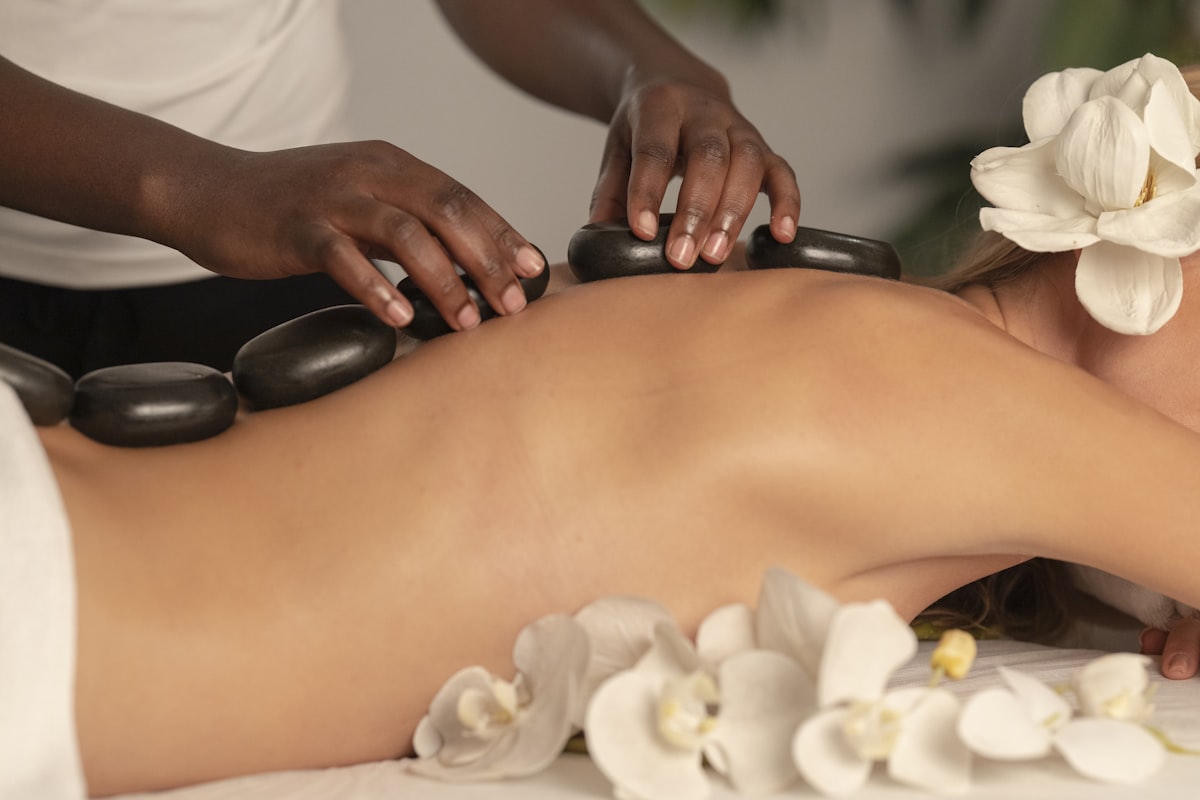
Warmth first — a shower, a warm towel — makes everything after it work better, which TCM would attribute to moving qi and blood and a physiotherapist would attribute to vasodilation. Same towel either way.
What to honestly expect: softer masseters, a bit more jaw opening, some relief from the tension-type morning ache. The classics claimed grander things for these points; a locked joint or a damaged disc is not something fingers fix. What fingers fix is the muscle half of the problem — and for most people with a tight jaw, the muscle half is most of it.
- Anchor the routine to the shower: heat first, then one minute of slow circles on each point. Habits survive when they piggyback.
- Time it to the problem. Evening sessions land better for noisy nights; a midday minute works better for daytime clenching.
"For a jaw that will not open and teeth clenched tight, for pain at the jaw bone and an inability to chew — open the meeting point at the jaw."
A Six-Week Reset You Can Actually Run
Here's the whole program on one page. It has four layers — protect, unload, retrain, sleep — and it borrows its shape from cardiac rehab more than from wellness marketing: measure, do the boring things, measure again.
Weeks one and two are baseline plus protection. Get the guard question settled with your dentist, start ten minutes of moist heat on the jaw every evening, add the two-point acupressure after it, and write down three numbers each morning: jaw tightness zero to ten, headache minutes before coffee, and how many stacked knuckles fit between your front teeth. Two knuckles is workable, three is typical for an adult.
Write the numbers down. Memory lies about pain, cheerfully and constantly.
Weeks three and four add retraining. Three phone alarms across the workday — lips together, teeth apart, tongue resting on the palate. The straw trick during focused work. Caffeine cut off eight hours before bed. On mornings after a grinding night, make the day a soft-diet day; the masseter deserves the same courtesy you'd give a sore calf.
Weeks five and six add the sleep layer, the one OPPERA's data quietly points to. Same sleep and wake window, within half an hour, seven days a week. A wind-down that doesn't involve a screen held eighteen inches from a face that's been clenching since noon. Then re-measure everything.
Expect trends, not miracles: the good mornings should outnumber the bad ones by the end. If the clicking turns painful, or the jaw ever locks open or shut, the experiment ends and the professional assessment begins — which is the next section.
- Track exactly one number daily — morning jaw tightness, zero to ten. One honest number beats five fuzzy ones, and five is how spreadsheets die.
- Put the guard, the heat wrap, and the logbook in one place by the bed. Friction is the enemy; a routine you have to assemble nightly is a routine that dies in week two.
When a Tight Jaw Stops Being a Stress Story
Self-care has a scope, and these are the fence posts. If your mouth opens less than two knuckles wide — roughly thirty millimeters between the front teeth, where forty to fifty-five is typical — that's not a stretching project. If the jaw locks open or shut, even briefly, even once. If a click that used to be painless starts to hurt, or if opening has gotten noticeably worse over months.
Trauma to the face or chin, swelling around the joint, fever, a toothache that shifts around when you press the jaw muscles — each of these changes the appointment you need.
There's a sleep-shaped flag too. Loud snoring, pauses a partner witnesses, waking unrefreshed despite a full night: bruxism events in many people ride on airway arousals, the brain jolting the body half-awake with the jaw clamped. Screening for sleep apnea before investing in dental hardware isn't perfectionism. It's sequencing.
Then there's the spending-shaped flag. Be slow with anything irreversible sold as a bruxism cure — wholesale bite adjustment, full-mouth reconstruction, permanent enamel reshaping.
Modern consensus treats irreversible dental work as a last resort for bruxism, not a first move, and the stories of people who paid five figures for a 'bite realignment' that didn't stop the grinding are common enough to have their own genre.
A dentist who focuses on TMD or an orofacial pain clinic is the right first stop for any of the above. Imaging happens when it's indicated, not as a formality. And if the first consult leads with a five-figure treatment plan and no measurements? That's not a consult. That's a sales floor.
- If the jaw locks, don't force it — ever. Warm it, rest it, book the appointment. Forcing a locked joint is how small problems become surgical ones.
- Photograph your teeth from the front and both sides once a year. Wear patterns you can compare across photos beat ones you vaguely remember at a cleaning.
The Hinge That Holds What You Don't Say
English says grit your teeth. Chinese says 咬紧牙关 — bite the joints tight. Two languages, thousands of miles apart, both reached for the jaw when they needed a picture of endurance. The jaw is where determination turns physical: the set mouth of someone absorbing bad news, the clenched stillness of a person white-knuckling a deadline. Nobody teaches this. Everyone does it.
The old physicians noticed. In their reading, overthinking knots the qi — 思则气结, from a famous line in the Suwen that lists how emotions move, or stall, the body's workings. A knotted qi doesn't flow; a knotted jaw doesn't open. Whatever you make of the metaphysics, the overlap with a modern stress-gauge view of the masseter is hard to miss.
So is the prescription hidden in the old language: movement, warmth, breath, expression — things that un-knot.
So end with the smallest possible experiment, not a summary. Tonight, after the heat and the two points, lie down and let the teeth float apart until you can feel the freeway space — that absurdly small, absurdly valuable two-millimeter gap. Notice what the jaw does when it's finally off duty.
If it keeps reaching for contact, that's information, not failure; it tells you which layer of the six-week reset needs another pass.
The hinge will be back at work tomorrow. It keeps score, faithfully, of deadlines and dinners and sleep. All this — the towel, the two points, the alarms — is just the reply it's been waiting for: noted, and handled.
"The hundred diseases arise from qi: anger drives it upward, fear drives it downward, and overthinking knots it where it stands."